
ELECTRIC ICARUS PUBLISHING PRESENTS · NEON THEATER · PARADOX PULP · ORIGINAL SERIAL FICTION
THE QUANTUM CONUNDRUM
The doctor is in. Unfortunately, so are several other versions of him.
Episode 005: The Parcel from Platform Zero
Mystery · Sci-Fi · Dark Satire · Paranormal Absurdism
Previously: Two versions of Dr. Elias Locke and Agent Karen confronted a false death invoice and the Corridor of Borrowed Names. The attempted claim was withdrawn, but the bloodstained doctor’s memory of a railway platform and an unknown photographer remained unresolved. Then a delivery boy arrived with a ticking parcel for the one who isn’t expecting it. Read Episode 004 — The Name on the Door.
The parcel was ticking.
That was the first thing Dr. Elias Locke disliked about it.
The second was its address.
TO THE ONE WHO ISN’T EXPECTING IT.
The third was the delivery boy’s cheerful insistence that it needed a signature.
"Whose signature?" Locke asked.
"Yours, sir."
"Which of us?"
The boy looked from one doctor to the other.
"I don’t know, sir. I’ve never had a parcel addressed to a grammatical problem before."
Agent Karen stepped between the two Lockes and the box.
"Before anybody signs, tell me who sent it."
The delivery boy turned it over. The return address had been carefully covered with a rectangle of black paper.
"That’s what they said you’d ask."
"Who did?"
"The fellow at the depot. He wore a hat with a clock on it."
"What depot?" asked the bloodstained Locke.
The boy consulted his clipboard.
"Platform Zero."
Karen glanced at the other two men. Weller’s missing-person file concerned a railway station demolished thirty years earlier, and now someone had arranged delivery of a ticking parcel from a platform that should not exist.
"Did you go there yourself?" she asked.
"No, ma’am. A woman handed it to me at the sorting office. She was wearing white gloves."
"Did she have a name?"
"Probably. People generally do."
"Do you remember it?"
"No, ma’am."
"Why not?"
"She had a name badge, but every time I read it I thought I’d forgotten something else."
Locke admired this explanation for exactly three seconds before finding it infuriating.
The delivery boy set his clipboard down.
"Look, I get paid to deliver things. I don’t get paid to understand them. If you’re not signing, could you at least tell me whether somebody here is the one who isn’t expecting it?"
All three adults considered the question.
"At this point," said Locke, "none of us is prepared to admit to expecting anything."
The boy smiled brightly.
"Then I’ve got the right address."
And with that he left.
The box continued ticking.
The Inspection
"Nobody touches it," Karen said.
Locke folded his arms.
"You do realize that every new prohibition makes the object more interesting."
"Then develop an interest in keeping your fingers."
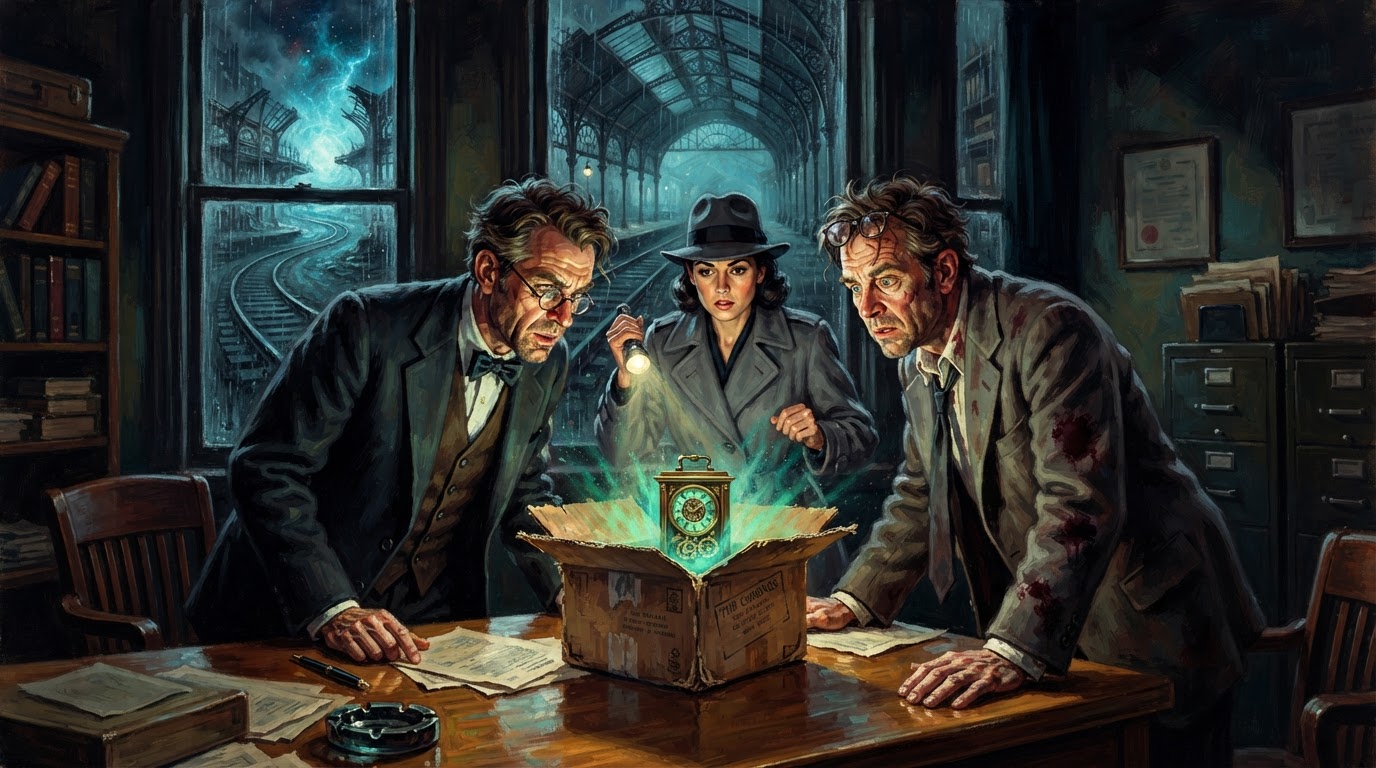
Karen moved the parcel to the center of the desk and asked both doctors to stand clear.
It was approximately the size of a loaf of bread. Ordinary cardboard. Brown string. Four postage stamps depicting a railway clock, each showing a different hour.
Except the last.
The last stamp had no hands.
The parcel ticked seventeen times and fell silent.
The doctor with the stained sleeve checked his watch.
"8:17."
The other looked toward the clock on the wall.
"Still 8:17."
"Should that be reassuring?" Karen asked.
"Ordinarily."
A sound came from inside the parcel.
Not a clock.
A train whistle, impossibly faint, as if blown at the bottom of a very deep well.
Karen cut the string with a letter opener.
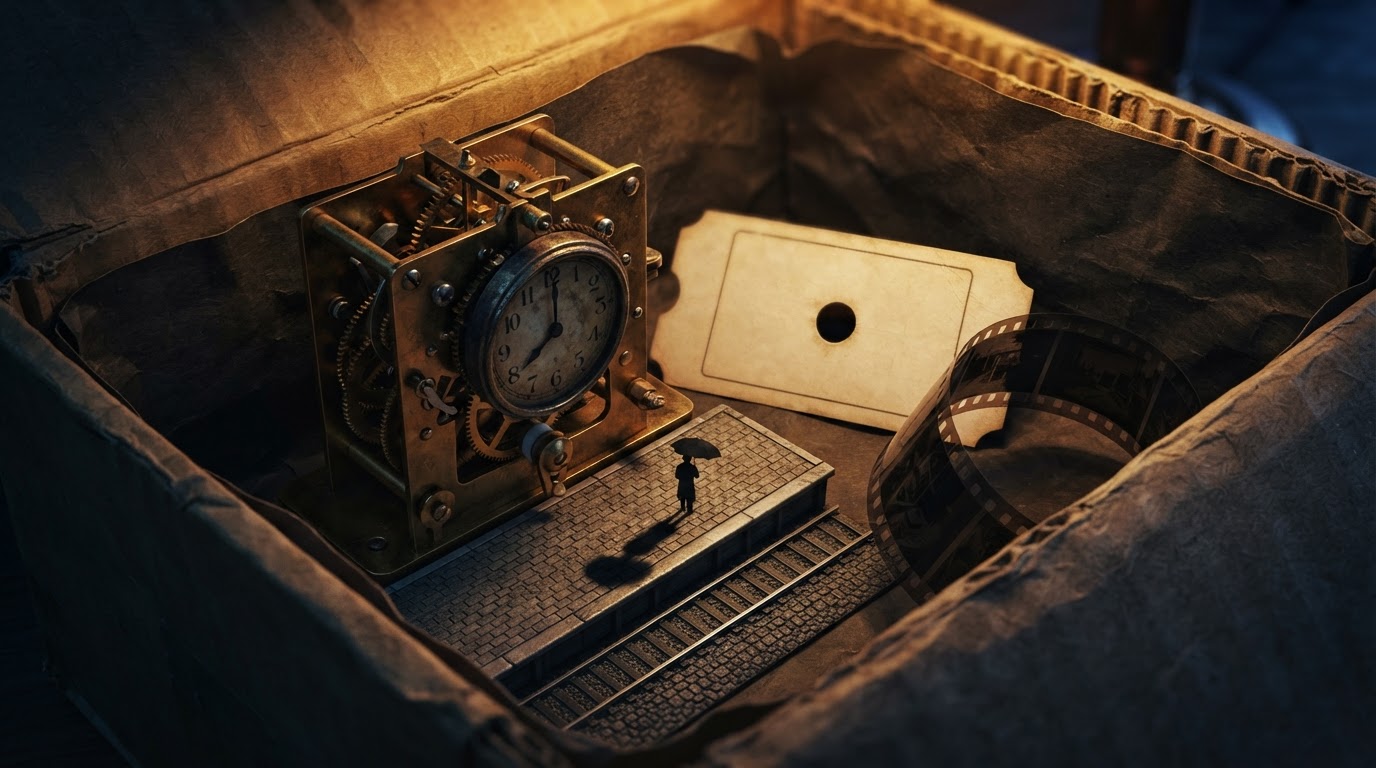
Inside was a carefully packed miniature railway platform: brass tracks, porcelain columns, two benches, and a departure board no larger than a matchbox.
A tiny mechanism moved behind the board. The clicking had come from a wheel of polished steel repeatedly striking a tooth that would not turn.
There was also an ivory ticket, a strip of photographic film, and a sealed envelope.
The ticket had a single round hole punched through it.
No destination.
No passenger name.
No date.
The envelope bore three words.
OPEN AT DEPARTURE.
Locke picked up the ticket by its edge.
"Someone has invented a railway service with absolutely no useful information."
"Perhaps it’s a metaphor," said his double.
"Then it can be late on its own time."
The miniature board flickered.
A line of tiny black letters appeared.
PLATFORM 0 — 8:12 — ARRIVAL OVERDUE.
A second line followed.
PASSENGER: UNACCOUNTED FOR.
Karen took out her notebook.
"The missing man?"
"Possibly," she said, answering her own question before either doctor could. "But we’re not calling it a fact merely because the model says so."
The bloodstained Locke leaned toward the little station.
"I know that platform."
"You’ve remembered the corridor," said Karen.
"No. Not the corridor. The smell."
"Smell?"
"Coal dust. Rain on iron. Burnt sugar from a stall. Somebody was selling sweets beside the ticket office."
He shut his eyes.
"And somebody was shouting for the last train. I remember reaching through a closing door."
His hand went unconsciously to the stained sleeve.
The other Locke watched him in silence.
For once, he had no remark.
The Film
Karen held the strip of photographic film toward the desk lamp.
Six frames.
The first showed a railway platform crowded with passengers in winter coats.
The second showed a man with a camera, his face hidden by the equipment.
The third showed a watch.
8:12.
The fourth was almost entirely black.
The fifth showed a hand gripping a train door.
There was a smear at the edge of the frame, too indistinct to identify.
The sixth showed an empty platform.
Except something about it was wrong.
The station clock had no hands.
Karen went to the window and held the film against the gray afternoon sky. The sixth negative was not empty. There was someone near the platform’s far wall, too faint to see with the naked eye.
She used Locke’s old magnifying glass.
A face appeared.
Not clearly enough to identify.
But unmistakably facing the camera.
"Is it him?" asked the bloodstained doctor.
"Someone was there. That’s what the photograph can tell us."
The miniature station whistled again.
Its model tracks began to lengthen across the desk, thin as pencil lines. One line climbed over a stack of books. Another disappeared beneath the broken coffee cup. A third reached the edge of the table and stopped, suspended in the air.
"That," said Locke, "is going to be difficult to explain to the furniture manufacturer."
Karen opened Weller’s number on the telephone.
It rang twice.
"Weller."
"We have a package from Platform Zero."
There was a pause.
"You opened it?"
"Carefully."
"Did it contain a ticket?"
"Yes."
"Any destination?"
"No."
"Don’t put one on it."
"We weren’t planning to."
"Good. An address can be a trap when it isn’t a place."
Locke pointed at the miniature track curling toward his teacup.
"Your employer has a very unfortunate grasp of geography."
Weller ignored him.
"The demolition records say the station was removed thirty years ago. No fatalities, no unexplained structural failures. The building came down properly. The missing-person report appeared in the archive last night, but its original date is unreadable."
"Can you find the photographs?"
"There’s one in the case file. A man with a camera, standing beneath the station clock."
"We have film from someone who may be the same man."
"Bring it."
"Where?"
"To the lot where the station stood. I’ll meet you there."
"And if there’s no station?" Karen asked.
"Then we’ll have a vacant lot and an excellent excuse to go home."
The call ended.
The miniature track on the desk snapped back into the box.
Locke looked at the other Locke.
"Do you drive?"
"I assume so."
"Which one of us has a license?"
They both checked their pockets.
Neither found one.
Karen took the car keys.
"Wonderful," she said. "For once, the Agency has a practical advantage."
The Station Under the Pavement
The demolished station was now a municipal parking lot.
There were twelve faded spaces, a pay machine that accepted coins no longer in circulation, and a vending machine selling crisps at prices that seemed determined to provoke civil unrest.
A small bronze plaque stood near the curb.
OLD CENTRAL STATION.
BUILT 1898. DEMOLISHED 1996.
Weller was waiting beside it with a leather briefcase and a paper cup of coffee.
He looked at the two Lockes.
"Well," he said, "that’s unfortunate."
"You’re welcome," they replied.
Weller gave Karen a small nod. She handed him the film without letting go of her evidence envelope.
He compared the second frame to the photograph in his folder.
"Same camera," he said.
"Not necessarily the same photographer," Karen corrected.
"No. But the same camera. Look at the crack in the lens housing."
The two Lockes leaned forward.
A tiny crescent-shaped crack caught the light.
The bloodstained doctor went pale.
"That sound," he said.
"What sound?" asked Weller.
"The camera shutter. It was the last thing I heard before the door closed."
Weller turned to him.
"Are you remembering it now?"
"I think so."
"All right. We record that. Nothing more."
The first Locke sighed.
"Everyone has suddenly acquired a remarkable devotion to restraint. It’s beginning to feel like a professional conspiracy."
Karen opened the cardboard box.
Inside, the model station had gone silent.
Its departure board displayed one word.
ARRIVING.
There was no train in sight.
Then the ground trembled.
Not with the heaviness of approaching machinery, but with a minute, delicate vibration—as if the parking lot itself were trying to remember how to be a railway platform.
A white line appeared between parking spaces five and six.
Paint on asphalt.
Then another.
Then two steel rails, not breaking through the pavement but becoming visible within it, like a picture developing in photographic chemicals.
A breeze carried the smell of coal dust and wet iron.
The vending machine clicked.
Its display changed from CRISPS — 75p to PLATFORM 0.
Locke studied it.
"I’ve long suspected the snack industry was concealing a deeper purpose."
A bell rang beneath their feet.
The air on the far side of the white line became the interior of the old station. Not a ghostly ruin, not a rebuilt structure, but an occupied platform: steam, lamps, travelers, and a distant news vendor shouting a headline none of them could quite hear.
Karen reached out with a pencil.
The tip crossed into the station and came back damp.
Weller stepped forward.
"Nobody crosses without documenting who is where."
Locke took the pencil.
"Quite. We mustn’t lose a perfectly good inventory."
The Passenger Who Wasn’t Lost
On the other side of the white line stood a railway porter wearing a green uniform and a cap too large for his head.
He carried a pocket watch.
It read 8:12.
"Tickets, please," he said.
Karen showed him the blank ivory ticket.
He frowned.
"This one’s been punched."
"Yes."
"But not used."
"How can you tell?"
"It hasn’t brought anyone back."
Locke bent to inspect the hole.
"Perhaps it simply wants a refund."
The porter did not smile.
"That ticket belongs to a passenger who left before he arrived. He’s been trying to return it ever since."
"Who?" Karen asked.
The porter glanced toward the clock.
"The photographer. He went to take a picture of a departure."
"Did he board the train?"
"He tried to keep someone from boarding."
The bloodstained Locke looked sharply at him.
"Who?"
"I didn’t see."
"Then how do you know?"
"Because the platform was full of people, sir, and every one of us heard him shout that nobody had to get on."
"That’s not a name," Karen said.
"No, ma’am. But it’s what happened."
A sudden shutter click came from beyond the steam.
The porter turned.
A man stood at the edge of the platform carrying an old folding camera. His features were obscured by a scarf and the camera’s shadow.
The bloodstained Locke took a step.
"I remember—"
The man raised one hand.
Not as a greeting.
As a warning.
The steam parted enough to reveal something behind him: a train standing motionless against the far platform. Its windows showed places that were not visible anywhere in the station: a summer field, a hospital corridor, a rain-darkened street, an empty schoolroom.
The doors began to open.
The man with the camera shouted, "Don’t take the train. Take the photograph."
Locke looked at Karen.
"An unusual piece of travel advice."
"Do it," said Weller.
The photographer pointed at the film strip Karen held.
"Last frame. Hold it to the lamp."
Karen lifted the film toward the station light.
The final frame, once almost empty, now contained a clear outline: a person standing between the photographer and the open train.
Not a face.
A coat.
An arm extended across the doorway.
A sleeve stained dark.
The bloodstained Locke stared.
"That’s me."
Karen shook her head gently.
"It resembles you, and it resembles the action you remember. We still don’t know when it was taken."
"Or whose blood," the other Locke added, very quietly.
The photographer lowered his camera.
"That’s why you mustn’t make the picture say more than it shows."
For a moment the station seemed to draw a collective breath.
Then a whistle blew.
The porter stepped away.
"Last call for Platform Zero!"
"Who’s supposed to board?" asked Locke.
"That’s what the ticket is for," the porter said. "A passenger can refuse. A station cannot."
Karen looked at the blank ticket, at the open doors, at the man who had waited beside them for perhaps thirty years—or perhaps less than a minute.
"Then let the refusal be recorded," she said.
She tore the ticket in half.
The train doors closed.
The windows went dark.
The station bell rang three times, a simple railway signal, and the platform began to fade beneath the travelers’ feet.
The photographer looked relieved.
He tucked the camera beneath his coat.
"Thank you," he said.
"What’s your name?" Weller called.
The photographer opened his mouth.
The old station clock moved for the first time.
8:13.
The image vanished.
There were twelve parking spaces again.
The vending machine demanded seventy-five pence.
The two Lockes, Karen, and Weller stood beside a bronze plaque in a damp parking lot.
In Karen’s hand was the original film strip.
The sixth frame was no longer dark.
The Negative
They returned to the office with two halves of a ticket, six photographs, and less certainty about the universe than Weller considered professionally desirable.
Karen placed the evidence beside the old death invoice.
"That was a station," said the first Locke.
"Yes," said his double.
"A real station."
"For some definition of real."
"And the train existed."
"For at least one very inconvenient moment."
Weller examined the sixth frame through a portable magnifier. There was the photographer, standing beside the sealed carriage. His scarf no longer obscured his face completely.
Enough details were visible to begin identification.
Not enough to complete it.
"He’s a person," Karen said. "We have evidence of him, and of an attempted departure. We can investigate from there."
Weller nodded.
"That is the beginning of a case, not the end."
The first Locke sat down at last.
"Would anyone care for coffee?"
"No," said Karen.
"Not especially," said Weller.
The other Locke looked at the broken cup on the desk.
"I think I’ll abstain."
Locke went to the cupboard anyway.
At its bottom stood a single unbroken cup, still in its saucer.
He took it down.
The bottom had a message written in pencil.
NOT THE ONE YOU WERE EXPECTING.
He looked at it for a long time.
Then he set it on the desk without comment.
Weller closed his briefcase.
"There is one additional matter. The shipping office has no record of the parcel being sent."
Karen looked up.
"And the delivery boy?"
"He’s real enough. He says he delivered it this afternoon."
"Then where did he collect it?"
"That’s the strange thing. He says the woman in white gloves paid him in exact change."
"What’s strange about that?" asked Locke.
Weller opened his palm.
A brass coin lay there, warm and slightly worn.
One side showed a train.
The other showed a camera.
There was no date.
"No railway company ever issued this," Weller said.
Locke picked up the coin.
A tiny mechanism moved inside it.
Tick.
He sighed.
"No."
Tick.
"Absolutely not."
Tick.
From the empty space above the office door came the soft click of a camera shutter.
All four turned.
A photograph fluttered slowly onto the carpet.
It showed the office exactly as it was now, photographed from the hallway.
Four adults. One desk. One parcel.
And in the open doorway, just beyond the edge of the frame, the white-gloved hand of someone holding a second camera.
On the back, in neat blue ink, someone had written:
RETURN TO SENDER — BEFORE FIRST DELIVERY.
Locke looked at Weller.
"Would you be so kind as to inform the postal service that it has become a menace?"
Weller stared at the photograph.
"I think," he said, "the postal service is the least of our troubles."
TO BE CONTINUED.
Reality is relative. Competence is optional.
Original serial fiction by Jon LaBelle · Electric Icarus Publishing · Neon Theater / Paradox Pulp.
Continue through the series: Episode 001 · Episode 002 · Episode 003 · Episode 004 · Series Index

