
ELECTRIC ICARUS PUBLISHING PRESENTS · NEON THEATER · NEON STAGE · PARADOX PULP · ORIGINAL SERIAL FICTION
THE QUANTUM CONUNDRUM
The doctor is in. Unfortunately, so are several other versions of him.
Episode 003: The Witness Behind the Glass
Mystery · Sci-Fi · Dark Satire · Paranormal Absurdism
Previously on The Quantum Conundrum: Two men named Dr. Elias Locke confronted an impossible invoice for one life. Agent Karen arrived with conflicting files, an unseen witness signed at 8:12, and a third Locke appeared behind the office mirror. Read Episode 002 — The Third Signature.
The third knock came from the mirror.
It was a modest knock, polite and almost apologetic, as though whoever stood on the other side regretted the inconvenience of being impossible.
Dr. Elias Locke, who had been standing beside his desk when the morning went wrong, took a cautious step toward the glass.
His bloodstained counterpart caught his sleeve.
“Don’t.”
“Must every person in this room insist on telling me what not to do?”
“Only until you begin doing sensible things.”
“In that case, you’re going to have a long morning.”
Agent Karen had already removed a narrow strip of white chalk from her document case. She drew a line on the floor between the mirror and the desk.
“What is that?” asked the doctor nearest her.
“A boundary.”
“Does it work?”
“Sometimes.”
“How reassuring.”
“More reassuring than pretending we haven’t got a problem.”
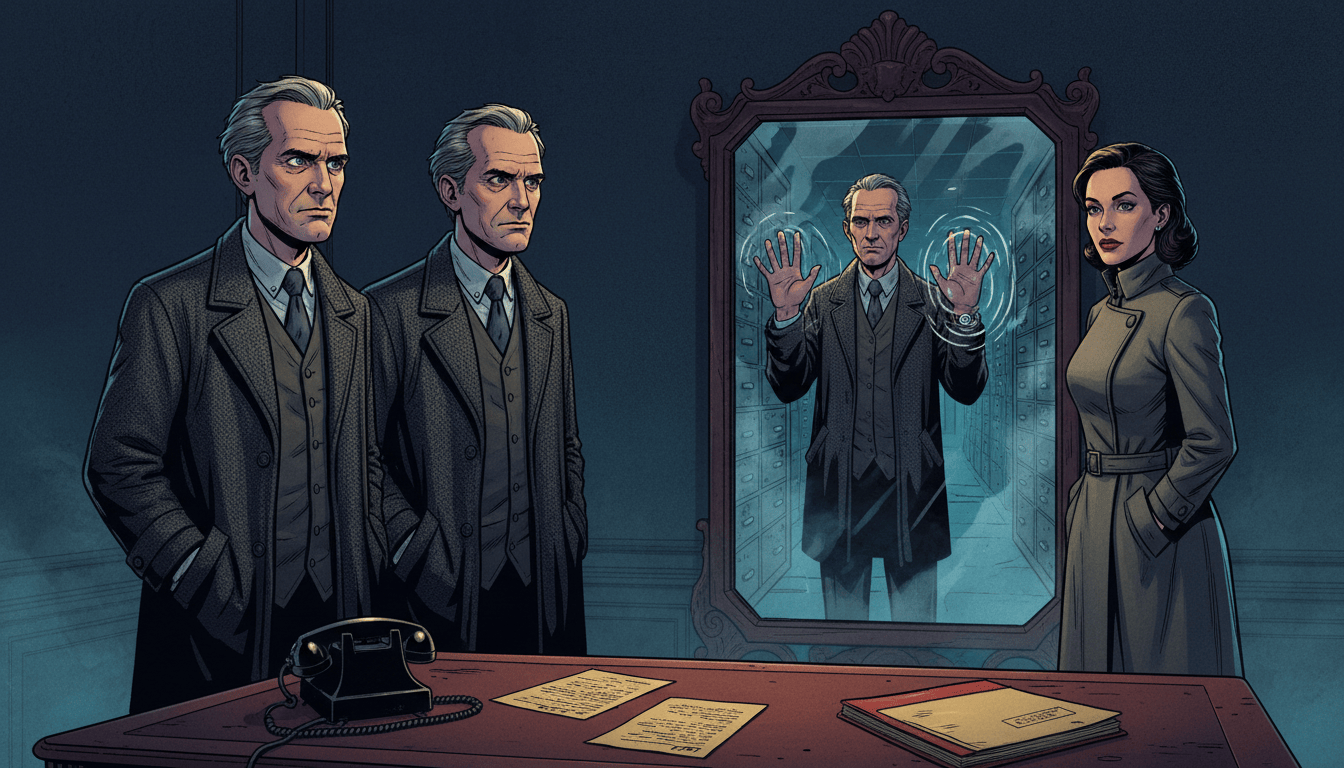
In the mirror stood a third Dr. Elias Locke.
He was not an ordinary reflection. Both men in the room had their backs partly turned, but the figure faced them squarely. He wore the same dark suit. His collar sat crooked in the same peculiar way. On his left wrist was a watch whose hands had stopped at 8:12.
Most unpleasant of all, he looked frightened.
The bloodstained doctor stared at him.
“I know that face.”
“Of course you do,” said the other Locke. “It is, regrettably, ours.”
“No. I mean that expression. I remember looking like that.”
“When?”
He glanced at Karen’s damp case file.
“Before something happened.”
The figure behind the glass lifted a finger to his lips.
Then, slowly, he held up a sheet of paper.
Its letters were reversed.
Karen took out her pocket mirror. Unlike the large one, it reflected exactly what it was supposed to.
She read the message aloud.
“DO NOT OPEN THE FILE UNTIL THE THIRD SIGNATURE.”
The first doctor gestured at the case on her desk.
“You already have a file that says precisely that.”
“Yes,” said Karen.
“So our mysterious guest has gone to considerable trouble to provide us with information we possess.”
“Or,” she replied, “he’s trying to tell us something about who supplied it.”
The figure lowered the paper.
Behind him, the mirror no longer showed Locke’s office. It showed an enormous corridor lined with filing cabinets. Each drawer had a brass handle. Each handle bore a name.
Many of the names were Elias Locke.
The first doctor removed his spectacles, cleaned them, and put them on again.
“This is a poor use of office space.”
The Archive That Wasn’t There
Karen approached the glass but stayed behind the chalk line.
“Can you hear us?”
The figure nodded.
“Can you speak?”
He opened his mouth.
The office telephone rang.
All three people in the room watched the unplugged instrument vibrate on the desk.
Karen sighed and picked it up.
“Whoever this is, you have precisely ten seconds to make yourself useful.”
“Karen?” came a man’s voice. “Weller.”
She glanced at both Lockes.
“Which Weller?”
There was a silence.
“That’s becoming a very tiresome question,” the voice said.
“How did you reach this number?”
“Bill found a wire coming out of my filing cabinet. Karen, where are you?”
“In the doctor’s office.”
“Which doctor’s office?”
“The one with two doctors.”
“Ah.”
Something clattered at his end of the line.
“That would explain the other folder.”
“Other folder?”
“One arrived marked PROPERTY OF THE WITNESS. It has my signature on it.”
“Did you sign it?”
“No.”
“Then don’t.”
“I had already reached that conclusion.”
Behind the glass, the third Locke began hammering on the invisible side of the mirror. Each blow produced the sound of a single typewriter key.
Karen turned back toward him.
“Weller, do you know about a department that records an event before it occurs?”
“The Agency has several departments with that unfortunate ambition. We are trying to reduce the number.”
“This one issues death invoices.”
“Then it’s not one of ours.”
Karen looked at the receipt lying beneath the two case folders. The one that demanded a life, with its credit still pending.
“How certain are you?”
“Because our invoices are printed in triplicate. That receipt has no serial number.”
The line crackled.
“Listen carefully. If somebody asks you to witness a debt, establish whether you are witnessing the event or merely the claim. They are not the same thing.”
A harsh mechanical sound interrupted him.
The voice from the earlier call cut across Weller’s.
“PLEASE STATE THE NUMBER OF DOCTORS IN THE ROOM.”
Weller said a word Karen had never heard him use in an office.
Then the line went dead.
The third Locke struck the mirror again.
This time his blow left a line of white letters across the glass.
NOT A DEBT.
A CLAIM.
The doctor with the clean sleeve leaned closer.
“What a remarkable difference two words can make.”
“The difference,” said Karen, “between owing something and having somebody insist that you do.”
The bloodstained Locke held out his hand.
“May I see the invoice?”
Karen passed it to him carefully.
His eyes moved over the paper. He read it once, then a second time.
“Temporal Reconciliation,” he said. “Partially successful. Outstanding balance, one life.”
“Yes,” said the first Locke. “I can read.”
“Look at the bottom.”
There was a box beneath the invoice’s final line. Until that moment it had appeared empty.
In faint gray ink, barely visible, were four words.
TRANSFER AUTHORIZED BY WITNESS.
The room became very still.
“If Karen signs,” said the first doctor, “somebody gets to treat an allegation as a payment.”
“Perhaps,” Karen said. “And somebody else pays.”
The mirror gave one quiet knock.
The Man Who Remembered Nothing
Karen took a thin envelope from her case and extracted a small sterile swab.
The bloodstained Locke recoiled.
“Absolutely not.”
“I want a sample from the sleeve.”
“Do you have the necessary equipment?”
“Not to establish its owner. Only to preserve it. That distinction matters.”
“Am I to understand that a woman with a chalk boundary and an uncooperative telephone has become the most rigorous investigator in this office?”
“Apparently,” said Karen.
The first Locke offered her a clean envelope for the sample. She thanked him. His other self allowed the swab.
As Karen sealed it, the bloodstained doctor lowered himself into the chair opposite the desk.
“I remember a corridor,” he said.
Neither of the others spoke.
“It was cold. There was water on the floor, but no pipes above it. Cabinets on either side, as far as I could see. Someone was calling my name.”
“Who?” asked Karen.
“I thought it was me.”
“Did you answer?”
“I don’t remember.”
He looked at the mirror.
“I remember a pen. I remember refusing to pick it up. Then a voice told me refusal wouldn’t matter, because my signature was already on the page.”
His hands trembled. He tucked them beneath his arms.
“And then I was here.”
The first Locke sat on the corner of his desk. It was difficult to see himself unsettled. It was worse to suspect that he, too, might be remembering something that had not yet occurred.
“What about the blood?”
“I remember trying to keep a door open.”
“Was someone injured?”
“I don’t know.”
It was the first wholly satisfactory answer of the morning.
Karen turned over the case folders.
The dry report’s heading now read FIRST ACCOUNT.
The damp one read SECOND ACCOUNT.
In the mirror, the third man pressed his hand to his own side of the glass. He left behind a bloody fingerprint.
Karen examined the actual surface.
No blood.
“Interesting,” she said.
“That’s one word for it,” replied Locke.
She held up her evidence envelope. The sealed swab inside had begun to darken.
Not red.
Black.
The mirror’s filing cabinets swung open in a single cascading wave. Papers rattled from drawer to drawer, traveling down the corridor like an enormous flock of white birds.
A metal plate appeared above the reflected doorway.
OFFICE OF RECONCILIATION — CLAIMS ACCEPTED AS EVENTS.
The first Locke read it.
“Ah. There is the problem.”
“What’s the problem?” Karen asked.
“Someone has mistaken their administrative ambitions for the laws of physics.”
Karen put the envelope down.
“And they’re using our signatures to make the mistake permanent.”
The Refusal
The third Locke backed away from the mirror. Something beyond him moved in the reflected corridor: a low dark shape on wheels, bearing a tower of stacked folders and a single red lamp.
The telephone began ringing again.
Karen ignored it.
Instead, she unfolded a fresh sheet of paper.
At the top she wrote:
OBJECTION TO RECONCILIATION
Beneath that:
The Agency has verified two physically present claimants using the name Dr. Elias Locke. The Agency has not verified a death, a debt, a transfer of liability, or the identity and origin of the reflected individual.
The first Locke looked impressed despite himself.
“A fine objection.”
“The forms aren’t always the enemy, Doctor.”
“Only the ones that have opinions about whether I’m alive.”
The black shape rolled closer in the mirror.
Its red lamp blinked once.
The damp folder began to steam.
Karen wrote another line.
No claimant may be surrendered or erased solely to resolve inconsistent records.
The mirror shuddered.
A sharp crack ran down one corner of its frame. The wood of the office wall made the sound of a ship’s hull straining.
The first Locke reached for his counterpart’s shoulder. The bloodstained man had stood too close to the glass, and his coat was drifting toward it as though caught in a current.
“Come away from there.”
“I can’t.”
“Try being stubborn.”
“I am you.”
“Then this ought to work.”
Locke seized him with both hands and pulled.
The figure in the mirror raised its arms. For an instant all three appeared to be struggling against something invisible between them. The reflection warped. Every cabinet door slammed shut.
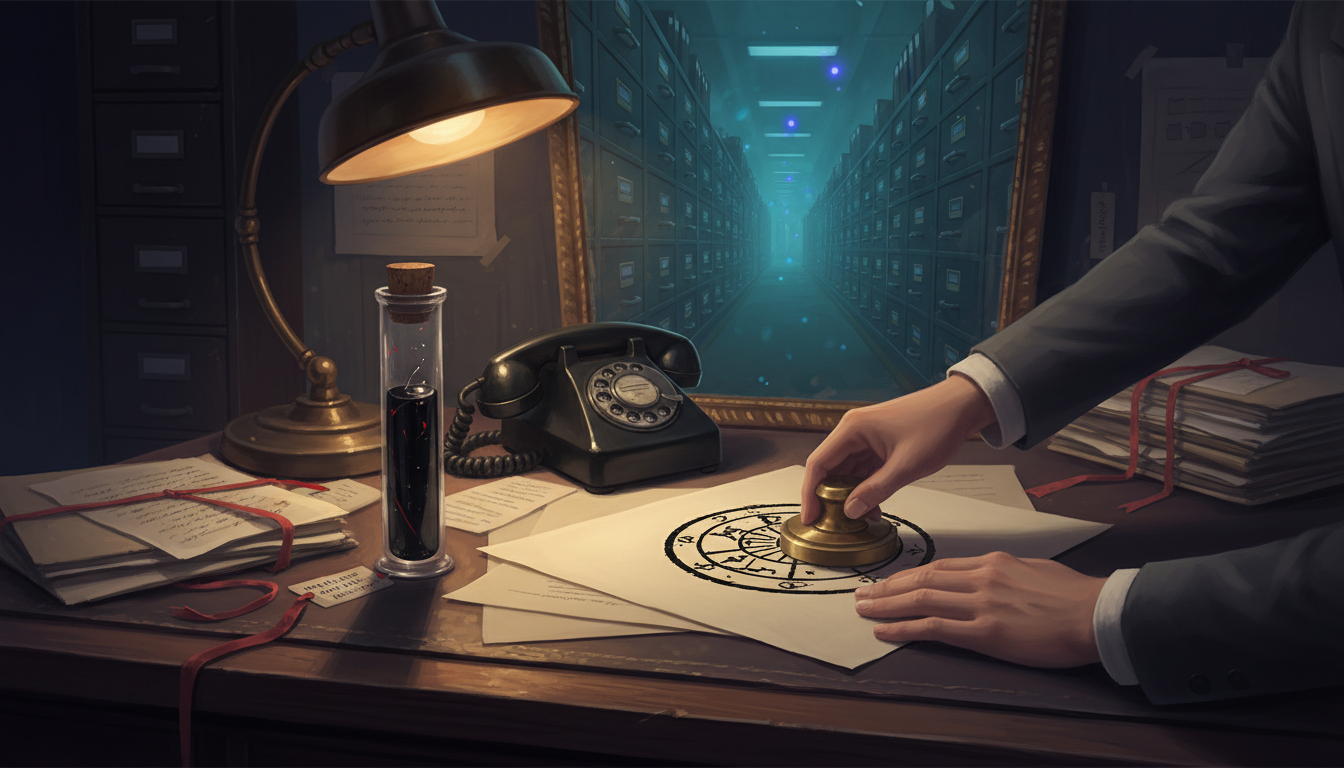
Karen picked up her Agency seal.
It was a small brass instrument, square at the base, more bureaucratic than heroic.
“I’m not signing,” she told the room.
The red lamp in the corridor turned white.
“But I will certify what I can see.”
She stamped the objection.
DISPUTED — PRESERVE ALL CLAIMANTS.
The glass burst outward in a thunderclap.
Nothing shattered.
Instead, a tremendous gust of cold air swept through the room. Paper scattered. The telephone receiver spun across the desk. For half a second, beyond the mirror frame, there was no wall at all—only an endless corridor and the distant sound of a train passing through a station that did not appear to exist.
Then the wall returned.
The mirror hung ordinary and still.
It reflected two Dr. Elias Lockes, Karen, a badly abused office, and a broken coffee cup.
Only two.
Karen drew one long breath.
The bloodstained Locke sank into a chair.
The first one picked up his spectacles.
“Well,” he said, “that was profoundly unprofessional.”
“On whose part?” Karen asked.
“I haven’t decided.”
The third page on the desk had changed. Its impossible signature remained, but a heavy black mark now cut across the transaction box.
TRANSFER SUSPENDED.
Karen lifted the paper.
“Good.”
“Good?” the other Locke said. “We still don’t know which of us is dead.”
“No. We know the death hasn’t been established, and we stopped someone from pretending otherwise. That’s progress.”
The first Locke considered this.
“A rather modest sort of progress.”
“My preferred kind,” Karen replied. “It tends to survive inspection.”
The Missing Witness
A faint tap came from the desk drawer.
Not the mirror.
Not the door.
The drawer.
All three watched it.
“Please tell me that’s your stationery,” Karen said.
“I would never purchase stationery that knocks.”
The bloodstained Locke opened the drawer.
Inside lay a photograph, curled at the corners and damp to the touch.
It showed an office almost identical to this one. Two Lockes stood beside a desk. Karen was between them, holding a paper bearing a dark stamp.
The mirror behind them was empty.
But there was another person in the photograph.
A man in a dark suit stood in front of the camera, his face turned away.
On his wrist was a watch stopped at 8:12.
The first Locke flipped the photograph over.
A message had been written in hurried ink.
I witnessed the refusal. Now find out who witnessed the death.
Beneath it was a date.
Tomorrow.
Karen studied the handwriting, then placed the photograph beside the disputed invoice.
“That’s evidence,” she said.
“Of what?” asked the first Locke.
“That the next question is not which of you is the real doctor.”
The bloodstained Locke looked up.
“Then what is it?”
Karen looked toward the mirror.
“Who was the third man, and why did he need us to stop the collection before he could leave?”
At that moment the telephone rang one last time.
The first Locke picked up the receiver before anyone could protest.
“Dr. Elias Locke speaking.”
The voice was familiar.
It was his own.
But this time it sounded very young, and terribly frightened.
“Please,” it whispered. “Whatever you do, don’t let them put my name on the door.”
The call ended.
In the hallway outside, a brass nameplate fell to the floor.
All three looked through the open doorway.
Where the office door had once borne the words DR. ELIAS LOCKE, there was now a clean rectangular patch of wood.
And beneath it, scratched faintly into the varnish, someone had begun writing a different name.
TO BE CONTINUED.
Reality is relative. Competence is optional.
Original serial fiction by Jon LaBelle · An Electric Icarus Publishing production · Neon Theater / Paradox Pulp.
Begin or continue the series: Episode 001 — The Man Who Knocked Twice · Episode 002 — The Third Signature · Neon Theater · The Neon Pipeline

