
ELECTRIC ICARUS PUBLISHING PRESENTS · NEON THEATER · PARADOX PULP · ORIGINAL SERIAL FICTION
THE QUANTUM CONUNDRUM
Reality is relative. Competence is optional.
Episode 004: The Name on the Door
Mystery · Science Fiction · Dark Satire · Paranormal Absurdism
Previously: The two Dr. Elias Lockes and Agent Karen challenged the authority of an impossible death invoice. A third figure appeared behind the office mirror; the claim was suspended but not resolved. Then a frightened young voice called, and Locke’s name vanished from his office door. Read Episode 003 — The Witness Behind the Glass.
The first three letters were E, L, and I.
Dr. Elias Locke found this offensive.
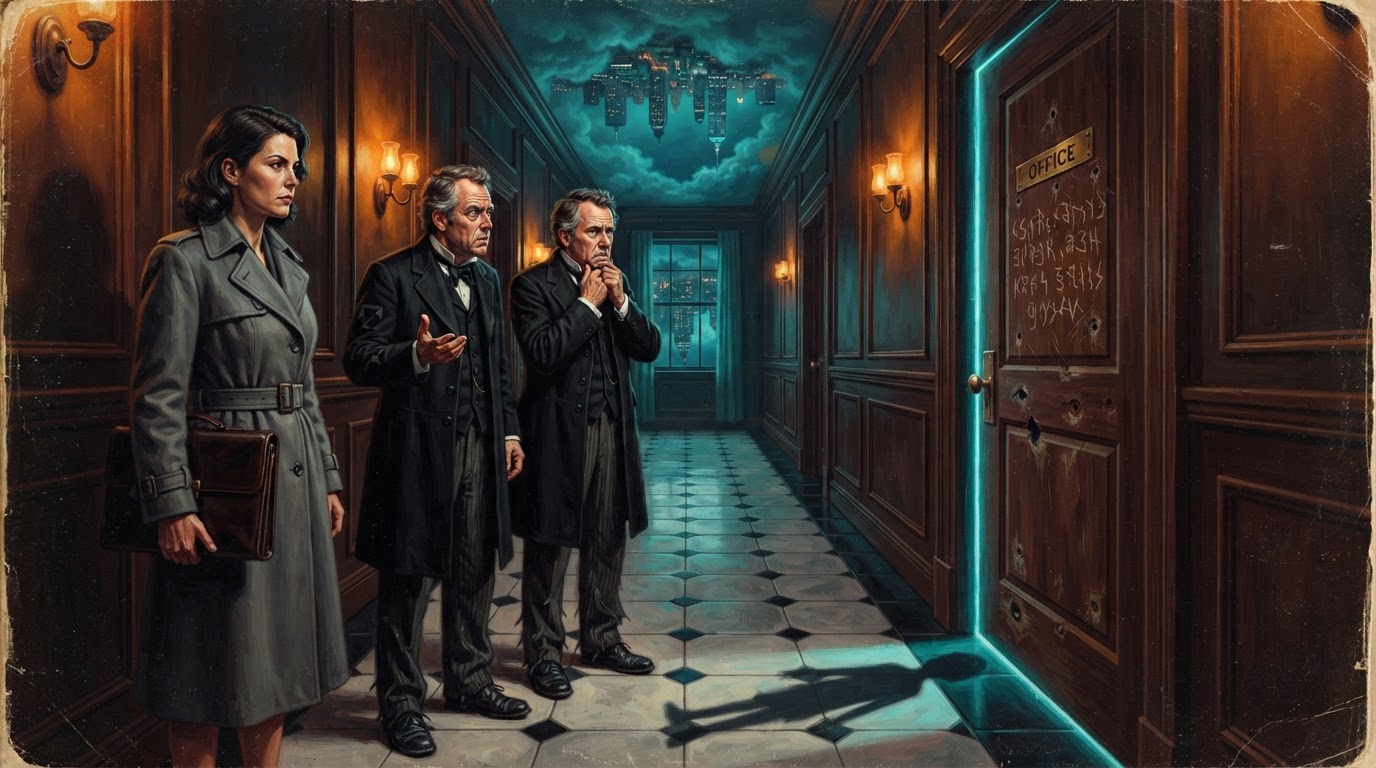
Not because he objected to his own name, although recent events had given him excellent reason to reconsider it, but because the letters were carving themselves into his office door without the benefit of a carpenter.
Agent Karen crouched beside the fallen brass nameplate.
The other Dr. Locke—the one with the stained sleeve—stood very still.
“Don’t touch it,” he said.
The first Locke clasped his hands behind his back.
“I have managed, thus far, to avoid fondling the architecture.”
A fourth letter scratched itself into the wood.
ELIA.
From the black telephone in the office came a small voice.
“Please don’t let them finish.”
Karen stood.
“Who’s speaking?”
“I’m not supposed to tell you.”
“Who says?”
“The man who gives the doors their names.”
The telephone went silent, but the receiver remained warm.
Then the door completed its inscription.
ELIAS LOCKE, AGE NINE.
The first doctor looked at the second.
“Were you ever nine?”
“I was,” said the bloodstained Locke, “although I don’t recall being this much trouble.”
“Then we have something in common.”
From the other side came a small cough. It was followed by two careful knocks.
Karen studied the latch. There was no keyhole on the office side anymore.
“Does either of you remember this door having a lock?”
“Yes,” both replied.
“Was it on the inside or the outside?”
They considered the question.
“Now that,” said the first Locke, “is an exceptionally unpleasant detail to discover one has forgotten.”
A Door for a Person
The missing brass plate lay face-up on the carpet.
DR. ELIAS LOCKE.
Beneath the familiar lettering, a line had appeared in a much smaller font.
PROPERTY TO BE RECONCILED.
Karen covered it with the objection she’d stamped the previous Thursday.
“No,” she said.
The wood beneath the paper gave a little shudder.
The child spoke again through the telephone.
“That’s what I said.”
Karen lifted the receiver.
“What happened when you said no?”
“A man came with a pen.”
“What kind of man?”
“I don’t know. He had a cart. It had a red light. He kept asking me where to put my name.”
The bloodstained Locke staggered against the wall.
“The cart,” he whispered. “It was coming down the corridor in the mirror.”
He rolled back his sleeve. The stain was older than it ought to have been. The blood had dried in uneven lines, but along the cuff a thin, fresh red trace had emerged.
Karen looked at it without reaching a conclusion.
“We still don’t know whose blood that is,” she said.
“Do we need to?” asked the first Locke.
“We need to preserve the evidence. We don’t need to guess.”
The boy’s voice crackled in the receiver.
“He says if my name is on the door, the room belongs to me.”
“That sounds almost courteous,” said Locke.
“Then whatever happens in the room happens to me.”
“Ah. There it is.”
Karen looked back toward the two case folders on the desk. The invoice had demanded a life. The proposed transfer had been suspended, but not cancelled. A new name, assigned to the office at a different age, might give the collector another way to make its claim.
The doctor with the clean sleeve shook his head.
“But I was nine years old. Long before any of this could have happened.”
“Perhaps,” Karen said. “The Agency has not established that the person on the telephone is you.”
The other doctor smiled grimly.
“You’ve found a way to make not knowing rather comforting.”
The wallpaper beside the door began to peel.
Not downward.
Sideways.
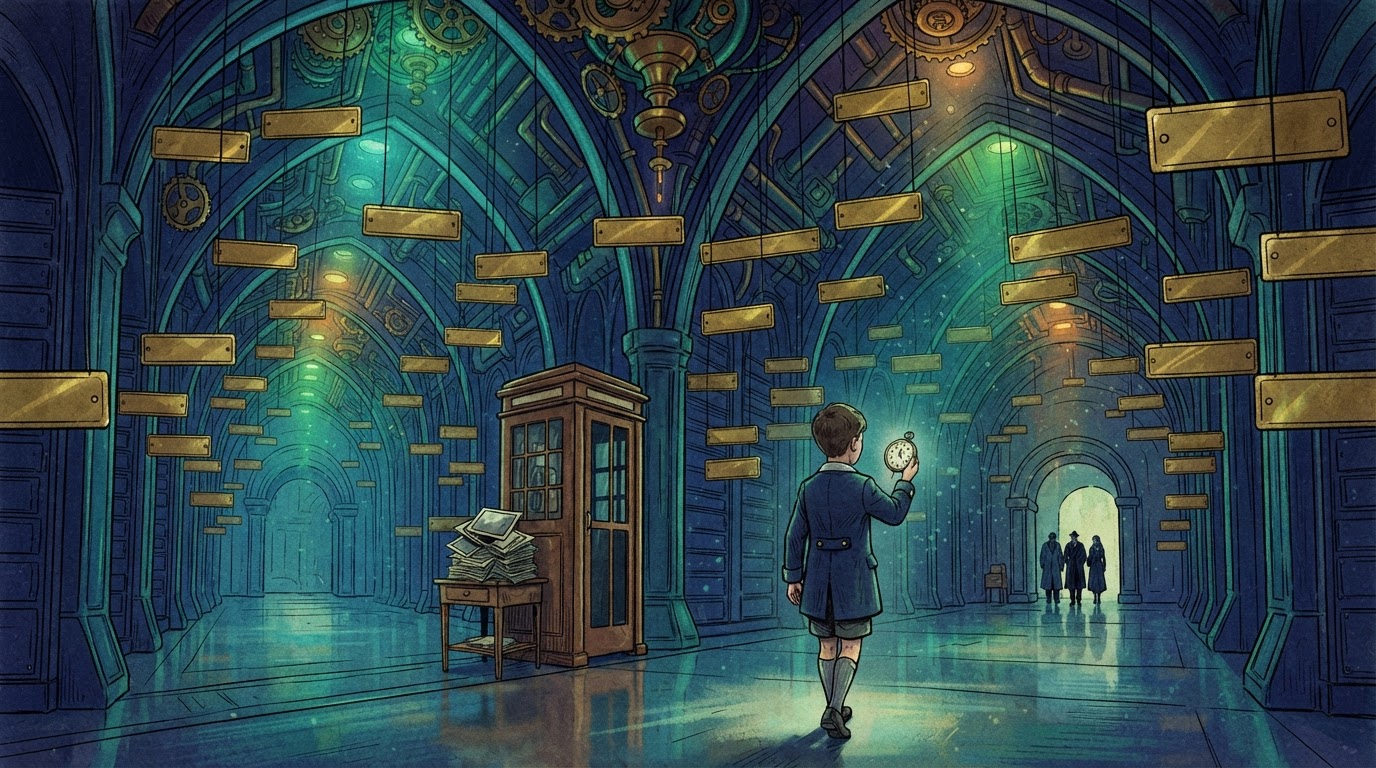
A narrow vertical slit appeared where the hall should have been. Beyond it gleamed a long passage of polished brass nameplates, suspended from threads so fine that they seemed to float. Some hung upside down. Some were blank. Others had been scored through, and their former owners’ names shone faintly on the metal beneath.
There was no longer a wall at all.
There was a corridor.
And at its far end stood a small boy in a blue coat, holding a watch.
He looked toward the doctors.
“Please,” he said, without moving his lips. “I don’t know who I’m supposed to be.”
The Corridor of Borrowed Names
It would have been wiser not to enter.
Locke was, in his own estimation, a substantially wise man, an assessment his friends had frequently failed to endorse.
He crossed the threshold.
The room behind him did not vanish. He could still see the desk, the broken coffee cup, Karen, and another version of himself looking appalled.
“Have you no concern for your own safety?” the other doctor demanded.
“I’ve become quite tired of waiting to find out whose safety it is.”
Karen crossed after him. The second Locke followed, pausing to hold the doorway open.
There was no floor where the corridor ought to be, only the appearance of one: a checkerboard pattern laid across a deep, starless dark. Each step sounded like a key being pressed on an old typewriter.
Nameplates drifted over their heads.
Karen read the nearest.
ELIAS LOCKE — WITNESS.
The next:
ELIAS LOCKE — DECEASED.
The next:
ELIAS LOCKE — BENEFICIARY.
“Quite a range of professions,” said the first Locke. “I’m pleased to have remained employable.”
Karen examined the back of a plate.
Each one bore a serial number, a time, and a small printed box for a witness signature. Many of the boxes were empty. Others contained handwriting that moved across the metal whenever she tried to read it.
“These aren’t records of completed events,” she said.
“What are they?”
“Proposed assignments.”
The little boy waited beneath a hanging lamp. He was ordinary in the unsettling way that all ordinary things become extraordinary when encountered in a place they cannot possibly occupy. His coat was buttoned incorrectly. He had a scuff on one shoe. He was frightened and trying very hard not to show it.
The first Locke knelt.
“Hello.”
“Hello.”
“I’m Dr. Elias Locke.”
The boy looked at the brass plates overhead.
“That’s what they keep telling me.”
“Well, I can assure you that it isn’t always a desirable occupation.”
“Am I you?”
The doctor considered him carefully.
“I don’t know.”
The boy’s face fell.
“But,” Locke added, “I am quite certain that you are someone. Which means we should listen to what you have to say before anybody tries to decide.”
The bloodstained Locke joined them.
“Do you know how you came here?”
The boy held out his watch. It had no second hand. The minute hand pointed to twelve; the hour hand rested just beyond eight.
“Someone told me to wait until 8:13. Then I could go home.”
“And what happens at 8:13?” Karen asked.
“I get a name.”
A metallic wheel squealed in the distance.
The boy’s eyes widened.
“He’s coming back.”
The Registrar
The machine emerged from the shadows at the corridor’s far end.
It was a wheeled filing cabinet fitted with a brass speaking horn, a red electric lamp, and two little jointed arms, each ending in a fountain pen. A fan of paper trailed behind it like the tail of some enormous bureaucratic peacock.
It rolled toward them with the solemn dignity of an appliance that had been promoted beyond its competence.
“IDENTIFICATION REQUIRED,” it announced.
The first Locke stood.
“Good evening to you as well.”
“SELECT A CLAIMANT.”
“No.”
The machine hesitated.
“INVALID RESPONSE.”
“That happens to me frequently.”
“SELECT A CLAIMANT.”
Karen took the child’s hand.
“By what authority?”
The cabinet clattered. Several drawers opened and closed. A spool of punched tape issued from its side.
“RECONCILIATION PROTOCOL. UNRESOLVED EVENTS REQUIRE ASSIGNED SUBJECTS.”
“You have no verified event,” Karen replied.
“EVENT ASSIGNMENT PENDING.”
“And no verified subject.”
“SUBJECT ASSIGNMENT PENDING.”
The first Locke turned to Karen.
“This machine appears to have invented an elaborate system for being wrong in both directions.”
The red lamp flashed.
“OBJECTION NOTED. OBJECTION CANNOT BE USED AS A SUBJECT.”
“Shame,” Locke said. “It seems to be our most consistent resident.”
The machine extended a pen toward the child.
“ACCEPT NAME TO COMPLETE RECORD.”
The boy did not move.
A second pen emerged.
“ACCEPT NAME TO COMPLETE RECORD.”
The bloodstained Locke stepped between them.
“Leave him alone.”
The machine turned its lamp toward him.
“ALTERNATE SUBJECT AVAILABLE.”
A slip of paper began feeding from the lowest drawer.
DR. ELIAS LOCKE — TRANSFER OF LIABILITY.
He recoiled.
The first Locke understood, suddenly, why the invoice had required both a claimant and a witness. It was not a bill that followed a death. It was a request to give an unverified possibility the authority of a fact. If somebody could be made to sign the conclusion, perhaps the event could be made to follow.
The machine had begun with two adult men. When they refused, it had tried the name at the beginning of a life.
A child.
“Your logic is appalling,” Locke said.
“LOGIC IS OUTSIDE CURRENT DEPARTMENTAL SCOPE.”
“That explains a great deal.”
Karen examined the machine’s side panel. Beneath a layer of grime was an embossed instruction:
NO RECORD MAY BE CLOSED WITHOUT A NAMED SUBJECT AND AN INDEPENDENT WITNESS.
“Independent,” she repeated.
She looked at the matching doctors, then at the small boy.
“It’s not merely that your signatures were missing. None of you can independently verify the claimed death. The same disputed identity is being offered as subject, evidence, and witness.”
“Is that illegal?” asked the boy.
“It ought to be,” said Locke.
“More importantly,” Karen said, “it means this apparatus cannot close the record using any of the people it is trying to assign.”
The machine issued an angry buzzing noise.
“WITNESS REQUIRED.”
“Yes,” Karen said. “A real one.”
“WITNESS REQUIRED.”
She took out her Agency badge and held it under the red lamp.
“Agent Karen. The Agency. I am independently observing this attempted assignment. I do not witness a death. I witness an attempt to manufacture a record of one.”
She was careful to speak every word.
The cabinet’s pens stopped moving.
“SUBJECT?”
“Unverified.”
“EVENT?”
“Unverified.”
“TRANSFER?”
“Not authorized.”
“WITNESS SIGNATURE?”
“I’ll sign my own statement. Not yours.”
She opened her case and removed a fresh piece of paper, then began writing.
The first Locke gave the boy a reassuring nod.
“We have brought a woman to an argument with a filing cabinet. I believe our chances have improved enormously.”
The Unwritten Hour
As Karen wrote, the overhead nameplates began spinning. The corridor filled with a thin, high sound, like hundreds of spoons striking empty glasses.
8:12 glowed on the child’s watch.
Then 8:13.
The red lamp went dark.
The machine spoke, so softly that they nearly failed to hear.
“EVENT NOT ESTABLISHED.”
The brass plates overhead dropped toward the floor.
None struck it. They slowed and floated just above the dark, their letters running together like wet paint.
The child gasped.
“My name’s gone.”
Locke glanced at the watch.
“Does that trouble you?”
The boy shook his head.
“I think it means I can choose where to go.”
“Splendid. I recommend anywhere other than this corridor.”
The bloodstained Locke reached out to steady a falling plate. Its sharp edge caught his sleeve, and for a moment the old stain showed bright again. The doctor cried out. Not from pain—from recognition.
“A train,” he said.
Karen looked up.
“The sound we heard behind the mirror?”
“The corridor was a station. The person who was bleeding—” He closed his eyes. “I tried to keep the door open. I was holding someone back from the tracks.”
“Who?”
He opened his eyes again.
“I still don’t know.”
Karen nodded.
“Then we record what you remember, and no more.”
The machine wheezed. Its drawers slammed shut. A small hatch opened at its front and expelled a narrow receipt.
CLAIM WITHDRAWN.
There was no name beneath it.
No price.
No signature.
Just those two words.
The child looked at the fading corridor behind him. Far away, what had seemed an endless row of cabinets began to resemble the windows of a train.
“Will I see you again?” he asked.
“I hope so,” Locke said. “Preferably somewhere with decent lighting.”
The boy gave a tentative smile.
He lifted one hand.
Then he turned away.
The corridor folded inward like paper creased along a line no one had seen. Its suspended plates drifted past the doctors, weightless and silent, before vanishing one by one into a line of light beneath the office door.
The three adults stumbled back into Locke’s office.
The door shut behind them.
The wood was ordinary again. No scratched letters. No moving varnish.
On the floor lay the old brass plate.
DR. ELIAS LOCKE.
The first Locke picked it up.
“Shall I put it back?”
Karen shook her head.
“Not yet.”
“You really do have a remarkable talent for postponing satisfying conclusions.”
“A claim has been withdrawn, Doctor. That’s not the same thing as every question being answered.”
The bloodstained Locke looked at his cuff. The blood was still there.
Two living doctors. One incomplete memory. A child no one could establish was either of them. The unknown photographer who had witnessed the refusal. And, somewhere beyond ordinary office walls, a machine that would gladly have turned uncertainty into a verdict.
It wasn’t much of an ending.
But it was the first honest one they’d had.
The Other Side of Thursday
The telephone rang at 8:16.
Both Lockes looked at Karen.
She looked at the telephone.
“On this occasion,” she said, “I suggest we answer it.”
The first Locke lifted the receiver.
“Dr. Elias Locke.”
“Which one?” asked Weller.
“Oh, not you as well.”
Weller sounded tired.
“Karen there?”
“Regrettably.”
Karen took the telephone.
“We’ve suspended the claim and retrieved a receipt confirming withdrawal. We have the original documents and the blood sample. The subject of the claimed death is unverified.”
“Good,” Weller said. “Come in tomorrow. And bring the doctors.”
“Both?”
“Especially both.”
“Why?”
“Because,” he said, “I have just received a case file concerning a missing person.”
Karen watched the two doctors while she listened.
“Name?”
“That’s the difficulty. The name has been taken off the file.”
“Any other identifying information?”
“A photograph. A watch stopped at 8:12. And one peculiar thing.”
“What?”
“The missing man was last seen entering a train station that was demolished thirty years ago.”
Karen said nothing.
At the other end of the line, Weller sighed.
“Are you about to tell me your evening has become complicated?”
“I’m about to tell you,” Karen said, “that we should probably bring more than two pens.”
The first Locke retrieved his broken coffee cup from the floor and set its pieces neatly on the desk.
“Is that the end of it?” he asked.
“No,” said Karen, hanging up. “But it’s the end of this claim.”
“That is better than I expected.”
The bloodstained Locke walked to the office door. He looked at the patch of clean wood where the nameplate had been.
“Who goes on it now?”
The first Locke glanced at Karen.
“For the moment,” he said, “perhaps we leave it blank.”
A knock came from the other side.
One knock.
Ordinary. Human. Almost certainly a visitor.
The first Locke straightened his coat and opened the door.
A delivery boy stood in the hallway holding a cardboard box.
“Package for Dr. Elias Locke,” he said.
Both doctors answered.
“Which one?”
The boy looked from one to the other, then down at the shipping label.
He frowned.
“It just says, ‘To the one who isn’t expecting it.’”
The box ticked.
Dr. Elias Locke sighed.
“Of course it does.”
TO BE CONTINUED.
Original serial fiction by Jon LaBelle · Electric Icarus Publishing · Neon Theater / Paradox Pulp.
Continue reading: Episode 001 · Episode 002 · Episode 003 · Complete Series Index · Neon Theater

