
ELECTRIC ICARUS PUBLISHING PRESENTS · NEON THEATER · PARADOX PULP · ORIGINAL SERIAL FICTION
THE QUANTUM CONUNDRUM
Episode 006: The Return Address
Mystery · Science Fiction · Dark Satire · Paranormal Absurdism
Previously: Two Dr. Elias Lockes, Agent Karen, and Weller investigated a ticking parcel from Platform Zero and an impossible railway station. A photograph arrived showing the office before it had been taken, with a white-gloved hand holding a second camera. Its reverse bore the instruction: RETURN TO SENDER — BEFORE FIRST DELIVERY. Read Episode 005 — The Parcel from Platform Zero.
The photograph was still falling when the doorbell rang.
Dr. Elias Locke looked at the picture on the carpet. It showed the four adults in his office, taken from a position that had apparently been occupied by an invisible photographer. At the edge of the frame a white-gloved hand held a second camera. On the reverse, someone had written: RETURN TO SENDER — BEFORE FIRST DELIVERY.
The doorbell rang again.
"Before we answer," said Agent Karen, "everyone take one step away from the door."
"I have spent five Thursdays taking steps away from things," Locke replied. "Eventually I shall have walked backward into retirement."
His bloodstained double moved beside him. Weller placed the brass coin, stamped with a train on one face and a camera on the other, into an evidence envelope.
Karen opened the door.
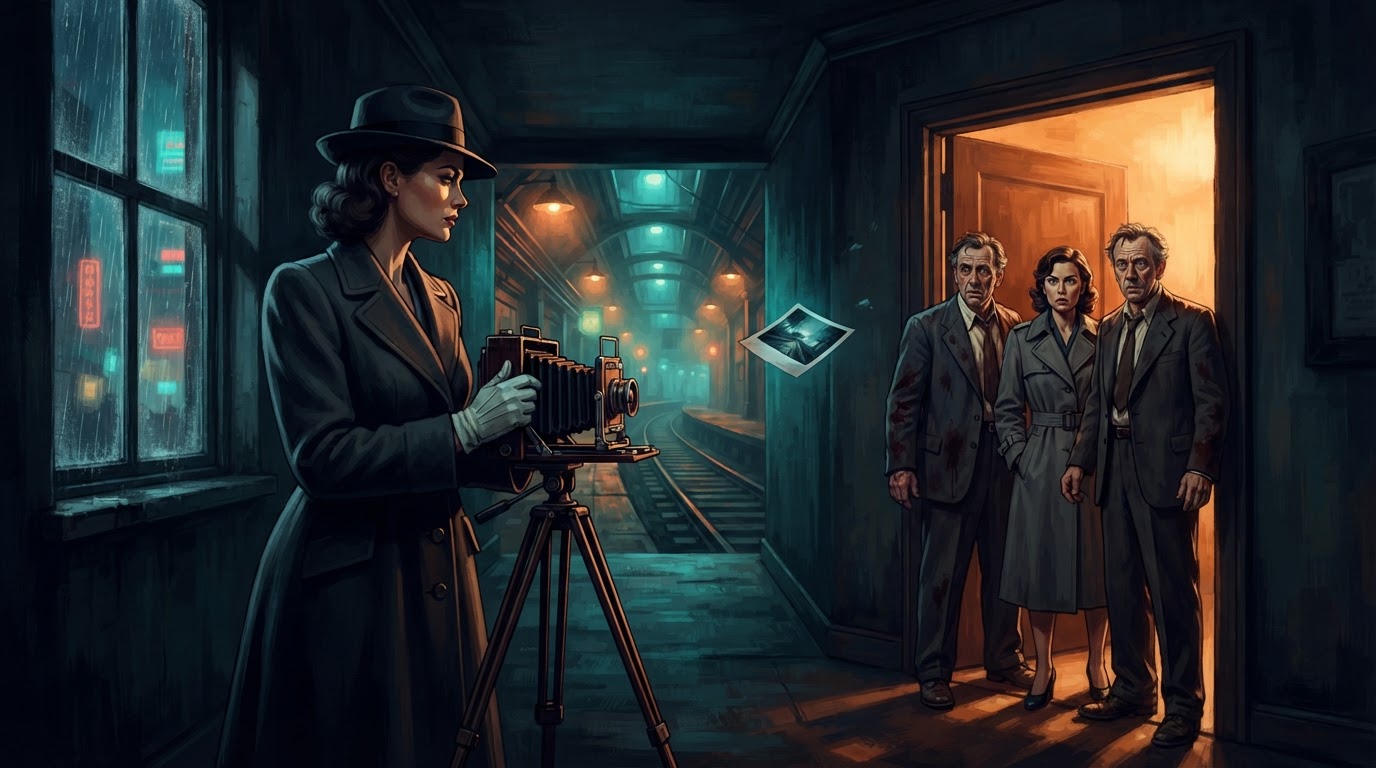
A woman stood in the corridor wearing a dark coat and white gloves. Rain beaded on the shoulders of her coat. Under one arm she held a folding bellows camera large enough to photograph a wedding and disapprove of the marriage.
"Good evening," she said. "I’ve come to collect a return."
"From whom?" Karen asked.
"That," the woman said, glancing past her at the two Lockes, "depends on who received it."
The first doctor raised his hand.
"I should like to register a complaint with the postal service."
"I am not the postal service."
"Then I should like to register a complaint with whoever impersonates it."
The woman smiled. She did not cross the threshold.
"Good. You have not mistaken an address for permission to enter. That’s a promising start."
A Person at the Door
Karen displayed her badge.
"Your name?"
"Miss Ada Mercer. Courier and photographic conservator."
"Can you verify either occupation?"
Ada produced a small card bearing a portrait, a name, and the name of a company that no one in the room recognized. Weller copied the details into his notebook.
"Verification pending," he said.
"Naturally."
"Did you send the parcel from Platform Zero?"
"I arranged for its delivery."
"From where?"
"From a place the delivery boy could reach."
"That’s not an answer."
"It is a partial answer. I have no intention of improving it by inventing the other half."
Karen studied her.
"Why the white gloves?"
"Because old negatives do not forgive fingerprints, and certain kinds of mail are rather more sensitive."
Locke folded his arms.
"Are we discussing the laws of physics or the preferences of stationery?"
"Both, Doctor. Unfortunately."
Ada pointed toward the photograph on the floor.
"You have one that arrived before it was exposed. May I see it?"
Karen retrieved the picture by its edges.
"Only from here."
Ada nodded. She didn’t reach across the threshold.
Weller observed that her gloves were clean and dry, although the coat was wet. That was strange; it was not an explanation.
Ada looked at the photograph for several seconds.
"Ah," she said softly. "So the second camera has been used."
"Is it yours?" asked the bloodstained Locke.
"It’s the one I’m carrying. I have not yet made that exposure."
The first Locke regarded her with wounded patience.
"Then why has the universe gone to the trouble of developing it?"
"Because a photograph can be offered as an instruction rather than a record. The problem is that people often obey what they believe they have seen."
Karen glanced at the old death invoice. Its claim had been withdrawn, but the paper remained in her file, properly labeled as evidence of an attempted claim.
"Someone once tried that with a death certificate," she said.
Ada’s expression changed.
"Then you know why I came."
The Camera’s Objection
They invited Ada inside, on condition that the camera remained in view and no one touched the shutter without agreement.
The woman placed it on the desk.
Two lens assemblies occupied its front. One faced the room; the other faced backward through a small prism. The camera had two shutter cables and a brass lever shaped like a railway signal.
"Why two lenses?" Locke asked.
"One records what the photographer sees. The other records the position from which the picture is meant to be interpreted."
"A most unnecessary complication," he said.
"You have two doctors with the same name standing before me."
"Point taken."
Ada opened the rear compartment.
A glass plate slid out. It was blank.
Then she turned the camera around. Through the rear window the plate appeared to contain an image: Locke’s office, empty except for a small cardboard parcel.
"Is that tomorrow?" the other Locke asked.
"No claim of that kind has been established," Ada said.
Karen looked interested.
"You sound like one of ours."
"I have met your Agency before. It tends to arrive after the paperwork has already caused the disaster."
Weller coughed.
"That’s unfair."
"Then consider it an unverified allegation."
The camera clicked without anyone touching it.
The image vanished.
Ada shut the compartment immediately.
"That is precisely why I do not leave it unattended."
"What happened?" Karen asked.
"A suggestion was recorded."
"By whom?"
"I don’t know."
"Then we should be careful not to treat it as a prediction," Karen said.
Ada gave her the first genuine smile of the evening.
"Exactly."
The Unsent Letter
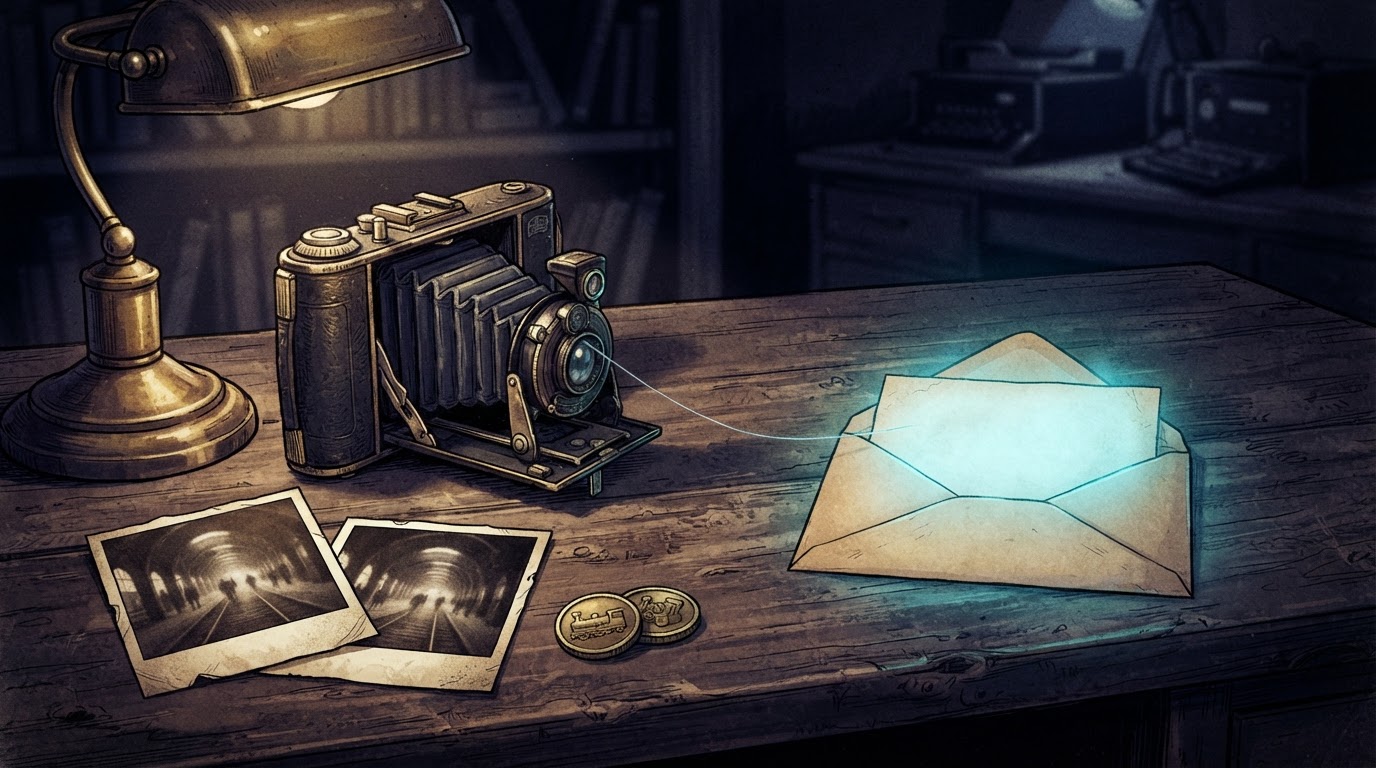
In the original parcel, tucked beneath the miniature platform, was an envelope everyone had overlooked.
Karen checked it against her evidence notes. The envelope had not been there when she first inventoried the contents. She made a new entry rather than changing the old one.
It was blank on both sides.
Ada handed her a small glass magnifier.
"Try the back."
Under magnification, a faint pattern emerged: not letters, but perforations, like holes cut into a railway ticket. There were six in one line and a seventh just below.
Weller laid the film strip from Platform Zero beside it.
Six photographs.
Six holes.
The seventh marked a position outside the frame.
"So this envelope is addressed to a seventh photograph," he said.
"Or to whatever belongs in that position," Karen replied.
Locke looked at the holes.
"An absence with postage. At last, a product suited to this office."
Ada opened her bag and removed a small brass device resembling a pocket printing press.
"I was asked to return the envelope to its sender. But I cannot do that until someone establishes where it came from."
"Who asked you?" Weller said.
"A note, inside the envelope. It was there when I received it."
"Where is the note now?"
"There wasn’t one when I opened it."
Weller stared at her.
Ada continued, patiently.
"I am telling you what I observed at two different moments. I am not claiming the moments agree."
Karen wrote that down.
The first Locke picked up the brass coin with a pair of tongs.
It ticked once.
The camera answered with a tiny metallic click.
The seventh perforation in the envelope began to shine.
A rectangular image appeared on its surface.
An empty bench at Platform Zero.
A camera rested on the seat.
Beside it lay a pair of white gloves.
The bloodstained Locke leaned forward.
"Where is the photographer?"
"Not in that frame," Karen said.
"That’s not what I asked."
"I know."
The scene on the paper began to move. A shadow crossed the station wall and an unseen hand lifted one glove from the bench.
Ada shut her printing device.
The image stopped.
"That image wasn’t there before," she said.
"And what does it mean?" asked Locke.
"It may be an instruction for someone to retrieve an object. It may be an account of something that happened. Or it may be a picture designed to make us perform an action."
"Which one?"
"That’s what we must find out before we take the action."
A Controlled Experiment
Karen drew three columns in her notebook.
OBSERVED.
CLAIMED.
UNKNOWN.
Beneath OBSERVED she wrote that the camera had clicked, a new image had appeared, and the coin had ticked.
Beneath CLAIMED she wrote that the envelope had to be returned before its first delivery.
Beneath UNKNOWN she wrote the sender, the nature of the camera, and whether the image represented an event, possibility, or instruction.
"We need a test," she said.
Locke sat up.
"At last. Science has received its invitation."
"Not a dangerous one," Weller added.
Karen took two blank index cards and a blue pencil. She wrote a word on one card, sealed it in an ordinary envelope, and asked Weller to put the envelope in his pocket. No one else saw the word.
Ada positioned the double-lensed camera on the desk, pointing toward the chair opposite it.
"Now what?" asked the first Locke.
"We ask the camera for the contents of Weller’s pocket," Karen said.
She pressed neither shutter.
Nothing happened.
"Try turning the brass coin," Ada said.
Weller rotated it once.
The backward-facing lens produced a pale image on the plate: Weller sitting in the chair, holding an opened envelope with a word plainly visible.
Locke leaned in.
"Excellent. It can tell us the answer."
Karen covered the image.
"No. First we’ll check the envelope."
Weller opened the envelope from his pocket.
The word was LANTERN.
The photograph showed ANCHOR.
Locke blinked.
"A disappointing oracle."
"An informative one," Karen said. "It produced an image. It did not accurately tell us what was written."
Ada frowned thoughtfully.
"Turn the plate over."
On its other side, the image showed Weller holding the envelope closed.
"And now?" she asked.
Karen wrote under OBSERVED: The camera produced at least one inaccurate apparent answer.
Under CLAIMED she added: Images may depict a different arrangement than the one observed.
She left UNKNOWN unchanged.
"We cannot use this machine to establish a fact solely from its pictures," she said.
The bloodstained Locke looked relieved.
"Then perhaps it can stop telling us who we are."
Locke regarded the camera as if it had personally insulted him.
"One ought not to purchase a camera that lies."
"Most cameras tell the truth about what reached the lens," Ada said. "This one makes it difficult to establish where the lens was."
The Sender’s Condition
There was a knock from the empty cupboard.
Everyone looked toward it.
"Please tell me the crockery hasn’t acquired legal representation," Locke said.
Ada went pale.
"Don’t open that."
"Why?"
"Because it’s where the return address is going to appear."
"Going to?" Weller asked.
"That is the claim I was given. I have not verified it."
Karen approached the cupboard. She did not open it.
From within came the scratch of a pencil.
Then a piece of paper slid through a seam no wider than a fingernail.
It was folded into quarters.
Weller photographed it with his ordinary camera before Karen unfolded it.
There were only two lines.
RETURN THE FIRST PHOTOGRAPH, NOT THE PARCEL.
DO NOT LET THE RECIPIENT BECOME THE SENDER.
Locke studied the note.
"An instruction that refuses to identify its author. How fashionable."
Ada pressed a hand against her camera.
"The parcel was always only a carrier. If the wrong person returns it, the address changes. And the person who receives it may be made responsible for having sent it."
"Like the invoice," said Karen.
"Similar mechanism," Ada said, "but we haven’t established that the same person or agency is involved."
The bloodstained Locke looked toward the first photograph, the one depicting all four adults before the courier had appeared.
"That’s why it says before first delivery."
Weller considered the words.
"No," he said. "That’s what it claims. We don’t yet know why."
Locke gave him an approving nod.
"At last, Agent Weller, you speak a language I can endure."
Karen laid the photograph flat.
The face of the image showed the office from the hall.
The reverse bore its instruction.
She set the coin beside it and turned it once.
In the picture, the white-gloved hand at the edge of the frame vanished.
A second image appeared beneath the first, printed on the same paper.
It showed the hallway empty.
The brass nameplate on the office door was missing.
And on the floor, just beyond the threshold, stood a little boy in a blue coat.
His watch read 8:12.
Karen and both Lockes stared.
"That photograph wasn’t in the earlier record," she said.
Ada looked toward the camera.
"No. But the other side of the plate might always have been capable of producing it."
"Is it the boy from the corridor?" whispered the bloodstained Locke.
"It resembles him," Karen said. "That is all we can say."
The second Locke leaned close enough to see the child’s face.
Then he straightened.
"He’s holding something."
In the picture, the boy’s left hand gripped a strip of film.
Seven frames.
Not six.
The Seventh Frame
Ada looked at the strange envelope, then at the new image.
"May I try something?"
Karen nodded once.
Ada placed the envelope behind the original six-frame negative. She lined up the perforations. The seventh hole extended beyond the end of the strip, as though a missing piece had been cut away.
Weller examined the cut edge.
"Clean severance. A blade."
"Can we locate the missing frame?" asked the bloodstained Locke.
"Perhaps," Karen said. "But a hole in an envelope isn’t proof that the missing film exists."
Locke opened a drawer and produced a little box of photographs from his earlier investigations.
"Nevertheless," he said, "there is something to be said for looking."
He had barely spoken when the camera shutter clicked.
A fresh photograph slid from under the device.
It showed the same desk, but from a very low angle. A single gloved hand reached toward the drawer Locke had just opened.
On its wrist was a watch stopped at 8:12.
Ada stared at the photograph.
"My gloves don’t have that cuff."
Weller examined the visible hand.
"Then it may not be yours."
"Nor is this a picture we’ve established was taken," Karen added.
The bloodstained Locke removed his coat and laid it beside the photograph.
The left sleeve was cut in one place, where the brass nameplate had caught it at Platform Zero. The edge of the cuff in the picture looked similar, but the photograph did not show any blood.
The first doctor took a careful breath.
"If we’re quite finished comparing ourselves to impossible stationery, perhaps we could try a more ordinary question."
"Such as?" Weller asked.
"Who gave Ada the parcel?"
Ada hesitated.
"A woman at the sorting office."
"But you’re the woman in white gloves," Locke said.
"Yes."
"Are you also the woman who handed it over?"
"I remember receiving it. I do not remember handing it to myself."
For the first time, she seemed genuinely afraid.
Karen closed her notebook.
"Then we do not force the answer."
Delivery Refused
A clock struck from somewhere outside the building.
Eleven.
The old telephone rang. Weller answered.
"Agency."
A faint voice, distorted by distance or machinery, said, "Was the return accepted?"
"Who is speaking?"
"Was the return accepted?"
Weller glanced at Karen.
"No. The evidence is in protective custody. No return has been authorized."
There was a click.
Then a pause long enough to be mistaken for silence.
The voice returned.
"THEN THE RECIPIENT REMAINS UNASSIGNED."
The line went dead.
The first Locke smiled grimly.
"I don’t care for that tone, but I approve of the conclusion."
Ada looked at the door.
"That should have stopped the route from closing. For now."
Karen filed the photograph, the note from the cupboard, and the new image under separate evidence numbers. She kept the withdrawn death invoice in its previous folder. Two different incidents, two different records; similar appearances were not proof of a shared origin.
The camera had gone quiet.
The brass coin no longer ticked.
The envelope’s seventh perforation was dark.
"Well," said Locke, "I believe we’ve earned a cup of coffee."
"Are we sure?" asked his double.
"Of very little. But I am sure I would like one."
Weller put away his notebook.
"Tomorrow, we look for the other frame."
"And the original photographer," Karen said.
"And the person who paid the delivery boy," added the bloodstained Locke.
Ada drew on her gloves.
"And perhaps," she said, "the photograph of the moment before I received the parcel."
Locke studied her.
"What do you expect to find?"
"I don’t know. That’s why I came."
For the first time that evening, everyone seemed satisfied with an answer.
Ada left the camera behind as evidence. Karen escorted her into the hall.
When they returned, a small cream envelope lay on the desk.
The first Locke picked it up.
"Did someone leave this here?"
"No," said Karen.
Weller checked the evidence photographs he had taken when Ada arrived. The envelope was not on the desk in those images.
It had no stamp.
No destination.
No sender.
Inside was a single strip of undeveloped film.
Seven frames long.
The first six were blank.
The seventh showed a doorway opening into a room that none of them recognized.
And in the room, seated at a desk beneath a lamp, was a man looking directly into the camera.
He wore the face of Dr. Elias Locke.
On his desk stood a brass nameplate.
PHOTOGRAPHER.
The first Locke looked at his double.
His double looked back.
"Well," said one of them.
"Yes," said the other.
Neither had the faintest idea which one had spoken first.
TO BE CONTINUED.
Reality is relative. Competence is optional.
Original serial fiction by Jon LaBelle · Electric Icarus Publishing · Neon Theater / Paradox Pulp.
Continue reading: Complete Series Index · Episode 005 · Neon Theater

