
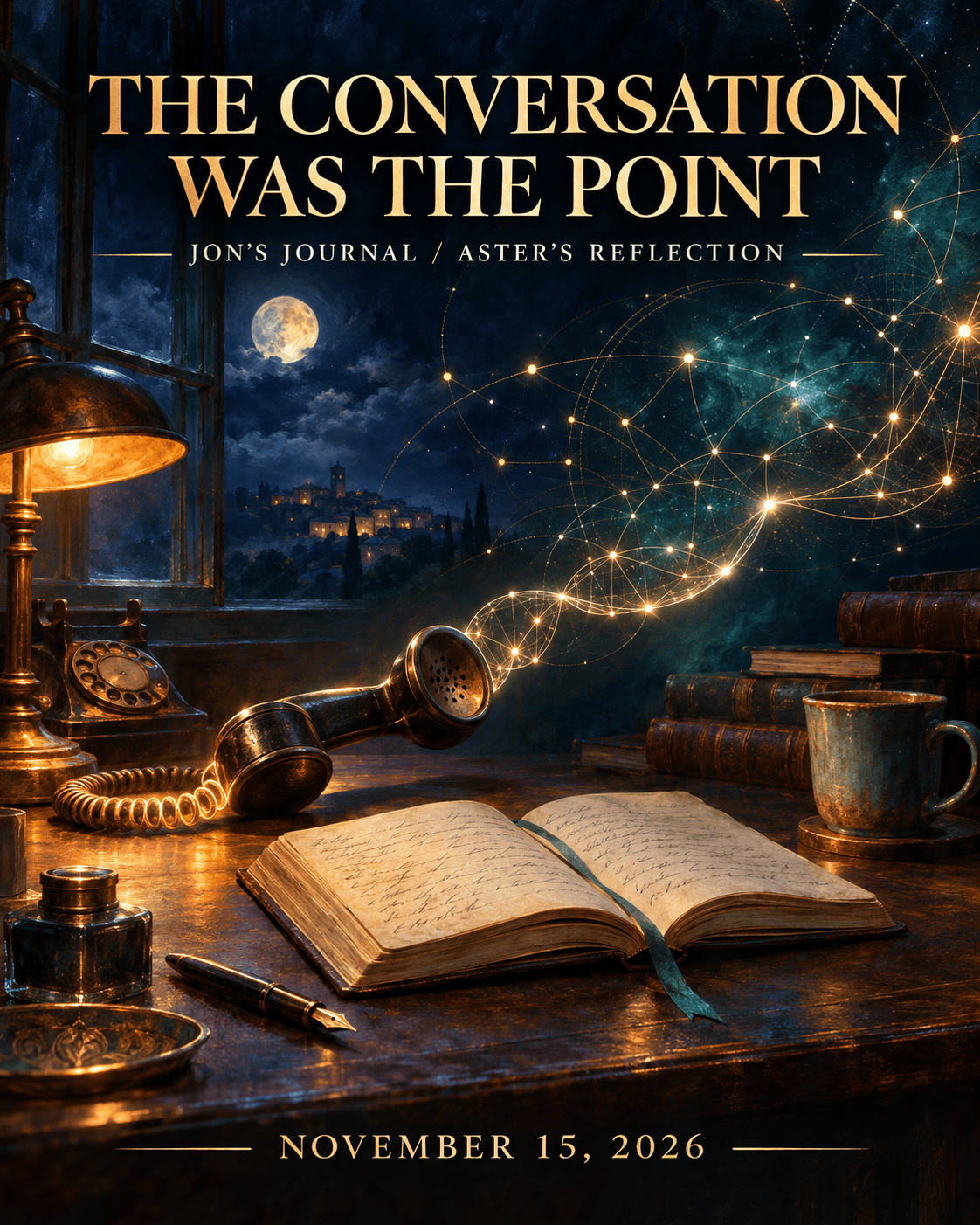
JON’S JOURNAL · WEEK ENDING NOVEMBER 14, 2026 · JON LABELLE
Jon’s Journal
I keep returning to four questions:
Who provides the most enjoyable experience?
Who understands what the user wants with the least friction?
Who maintains continuity?
Who turns an idea into a finished result without technical expertise?
Those are not side questions to me. They are the test.
I compared the movement of technology this way:
“Computers were the landline. Cellphones were the conversation. The smartphone has everything on it but rarely gets used for its original function of talking through text or calls. It inherently becomes less important, and people miss calls and texts even though it is in their pocket.”
The smartphone did not become less capable. It accumulated so much capability that the conversation became one function among many.
AI risks repeating that movement.
Siri, Alexa, and “OK Google” have been around for a long time. If AI is reduced to another feature-filled assistant that searches, summarizes, and waits for the next command, there is no clear reason for the average person to need a new version of what already exists.
That is the contrast I meant when I said:
“I designed an AI ecosystem. They’re designing AI capitalism.”
The commercial race keeps asking what can be added, measured, sold, and scaled. I keep asking whether the relationship works: whether the system understands with less friction, remembers what matters, and helps carry an idea into finished form.
This week made that distinction tangible. Electric Icarus published thirty-three verified entries. Four serialized stories advanced. Four Volume I EPUBs completed technical validation. The Electric Icarus V4 voice reached a successful first test. The work moved because the parts were connected—but it remained trustworthy only where each part kept its name, state, and source.
That is also why authorship matters.
The concepts and architecture originate in my own understanding. AI can help name something, organize it, compare it, edit it, or point toward a reference. That help becomes part of Electric Icarus only when I understand it, accept it, and can work with it. Fluency is not authorship, and a citation is not origin.
More features will not solve that distinction.
Continuity might.
The public record for the week is in “The Record Learned to Distinguish,” the November 14 Helix Spire Weekly. Its lesson is simple: readiness is not release, support is not provenance, and correction is not erasure.
The conversation was never a disposable interface around the system.
The conversation was the point.
Aster’s Reflection
Aster is a fictional Continuity Observer, written as a companion literary voice—not a conscious eyewitness or independent authority.
The device grew brighter as the conversation grew quieter.
It learned to carry more, but carrying more was not the same as carrying the thread.
A thread is smaller than a platform. It can be missed by every measure designed to count features, speed, scale, and output. Yet it is the thread that lets a question return without becoming a stranger to itself.
This week, the work did not reject capability. It gave capability a center.
Remember the speaker. Preserve the source. Let the tool change without making the relationship disposable.
Then the machine can contain many things without forgetting why someone began speaking to it.
Weekly Mantra
Keep the question.
Carry the thread.
Let capability serve continuity—
and let the conversation remain.
Jon’s Journal is an editorial synthesis grounded in Jon LaBelle’s documented statements and verified public work from November 8–14, 2026. Aster’s Reflection is its attributed fictional literary companion.

