
EVERYDAY, WITH DR. ELIAS LOCKE · NOVEMBER 4, 2026
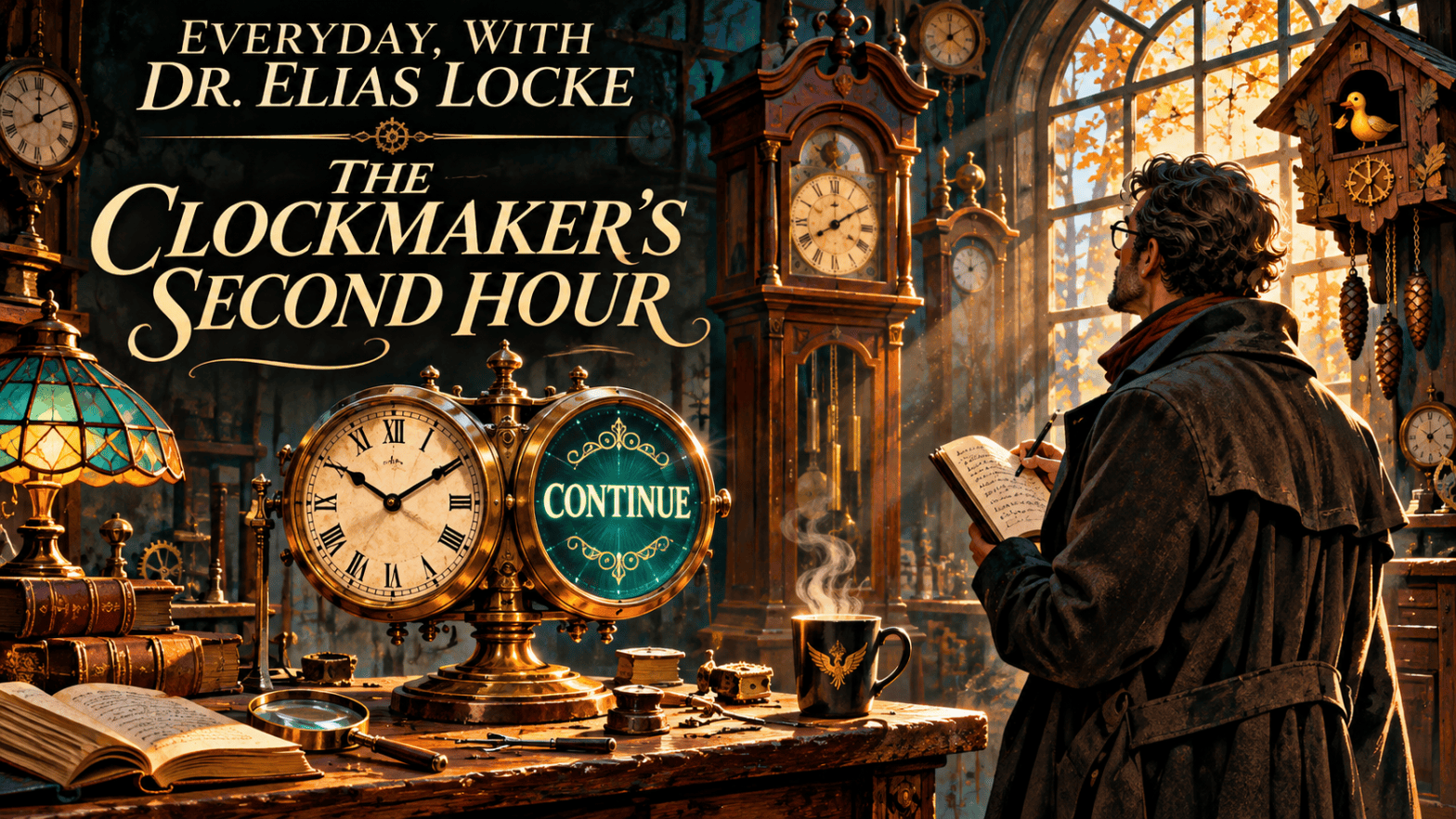
The Clockmaker’s Second Hour
A fictional column from the Electric Icarus universe, created by Jon LaBelle
Wednesday.
At a quarter past eight, I received a note printed on stiff, cream-colored paper.
DR. LOCKE —
THE CLOCKSHOP WILL BE OPEN THIS MORNING FOR A SECOND HOUR.
I had never been offered a second hour before. It seemed unwise to decline.
The clockshop belonged to Mr. Ephraim Carver, a retired machinist with a fondness for precision and an ongoing disagreement with the concept of time.
He met me at the door, wiping his hands on a cloth that had seen better decades.
“Doctor,” he said, “you’re just in time.”
“For which hour?” I asked.
“The one most people miss.”
Inside, the shop was filled with clocks of every description. Grandfather clocks stood beside kitchen timers. A cuckoo clock produced a small wooden duck, which appeared embarrassed by the mistake.
On the workbench sat a new device: a brass-cased clock with two faces. The first showed the usual time. The second was blank.
“What is the second face for?” I asked.
“Intent,” he replied. “The first face tells you what time it is. The second reminds you what you meant to be doing with it.”
“That sounds more expensive than a calendar.”
“Only if you ignore it.”
He wound the clock. The blank face glowed faintly, and slowly, words appeared:
WRITE. EDIT. FINISH.
“Is it always that specific?”
“Only when you already know,” he said. “The clock doesn’t make the time. It just makes the intention harder to ignore.”
A bell rang at the front door.
Mrs. Bellamy entered carrying a pie tin and a broken alarm clock. She had spent the morning trying to decide whether to mend the clock or bake another pie.
Mr. Carver placed her clock beside his invention. The second face read:
ASK FOR HELP.
Mrs. Bellamy stared at it.
“That’s rather forward.”
“So is bringing an alarm clock to a man who repairs them,” I said.
She laughed and admitted that she had been attempting to fix the mechanism herself for three weeks.
The next visitor was the mayor, who had come to inquire whether the clock could make public meetings shorter.
The second face displayed:
READ THE AGENDA.
He departed before anyone could explain the irony.
By eleven, a small crowd had gathered. Everyone wanted to know what their second hour would say. A baker received REST. A student received BEGIN. Mr. Kersey from the post office received TAKE YOUR LUNCH.
He accused the clock of interfering with federal operations.
Then the mechanism stopped.
The ordinary face continued ticking, but the second face went dark.
“Is it broken?” I asked.
“No,” said Mr. Carver. “It’s waiting.”
“For what?”
“For somebody to stop asking it to choose.”
He handed me the winding key.
I turned it once.
Nothing happened.
I turned it twice.
The face remained blank.
Finally, I put the key down, opened my notebook, and wrote the first sentence of an investigation I had been postponing.
The clock began ticking again.
Its second face showed a single word:
CONTINUE.
Mr. Carver nodded, apparently satisfied.
“An hour doesn’t have to be longer to be better used,” he said.
I considered this while the cuckoo clock produced its unfortunate duck for the second time.
There was no evidence that Mr. Carver had manufactured an additional sixty minutes. No one had aged backward. The sun had not paused. The municipal clocks remained in their customary state of disagreement.
But the people who entered his shop left with something they had previously set aside: a decision.
I left the shop with a better sense of both faces.
A second hour, it seems, is not extra time.
It’s the same time, used on purpose.

