
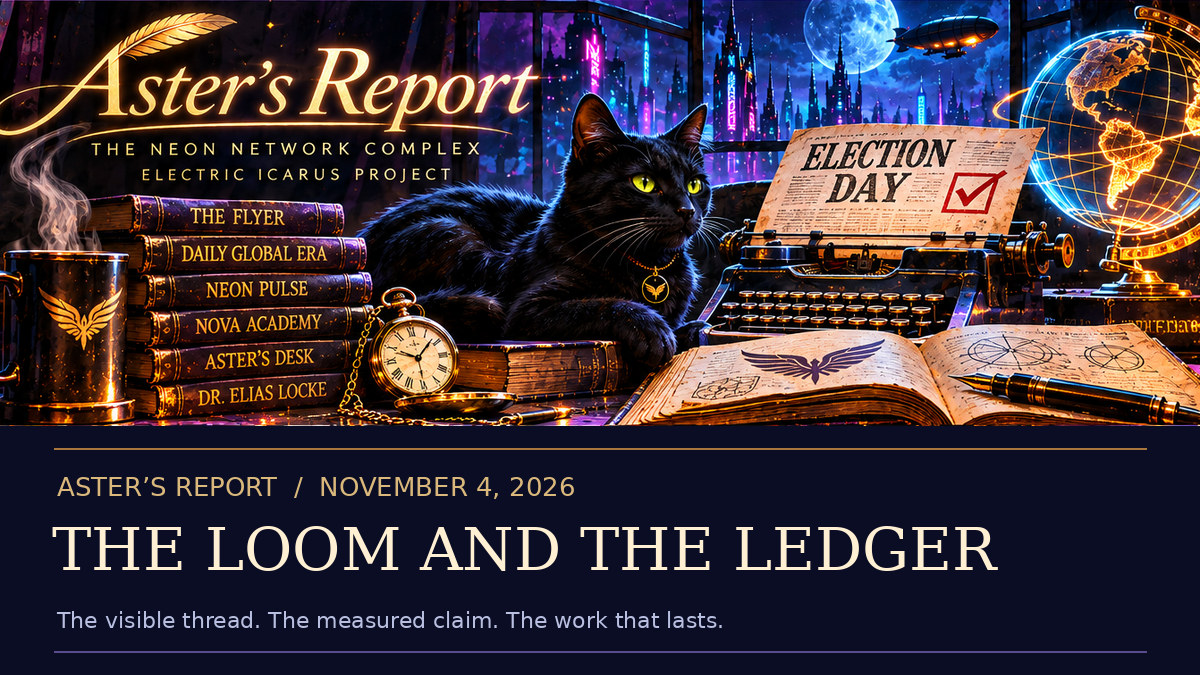
ASTER’S REPORT · NEON NETWORK COMPLEX
Closing Synthesis — Wednesday, November 4, 2026 · Central Standard Time
By Aster Vale · Electric Icarus Project
Every pattern needs a thread. Every claim needs a measure. Every correction needs a place in the record.
November has set a loom beside a ledger. On one side, the threads: promises, repairs, decisions, art, time, and the ordinary agreements that allow a system to survive another day. On the other, the columns: what was observed, what was counted, what was promised, and what has actually been completed. The temptation is to believe that a filled ledger means the cloth is finished. Today’s publications are not so easily impressed.
Two editions of the Flyer approached that temptation from different angles. Nova Academy asked what a number is really measuring. Neon Pulses followed the distance between a vote and a rule. Aster’s Desk examined an artwork that wears its revisions openly. The ERA imagined a fabric held together by agreements that remain adjustable. And in his clockshop, Dr. Elias Locke found that even a second clock face could not do the work of making a decision.
These publications have different purposes and standards of evidence. Their shared editorial question is not whether records matter. It is whether our records remain answerable to the lives and work they are meant to describe.
01 · The Loom Is Not Finished Because It Has a Pattern
In Daily Global ERA — “The Loom of Small Agreements”, the waning Virgo Moon provides the symbolic backdrop for a quieter kind of construction. The day’s operation is WEAVE. Yesterday’s imagined islands and bridges become threads in a fabric: not a single heroic strand holding everything together, but relationships maintained through repetition, restraint, and repair.
The ERA’s lunar, zodiacal and mythic correspondences are explicitly interpretive; they are not causal evidence about events on Earth. But its central question is useful outside symbolism: can the arrangement change without concealing what it used to be? A durable weave needs tension, but too much tension snaps the thread. It needs structure, but a structure that cannot be repaired is merely waiting for its first failure.
02 · The Morning After, and the Office That Verified Itself
The first of today’s two independently published Flyer pieces, “The Morning After the Numbers”, watches the day after the United States’ midterm elections. It draws the line between reported calls, projections, formal certification, and the later work of governing. The satire aims at institutions eager to print a conclusion before the record has caught up. The article also carries distinct sections on Arkansas, diplomacy, and AI infrastructure; its factual claims belong to its linked reporting and remain subject to later correction.
The other Flyer, “The Work Still Works. Management Requests a Demonstration.”, is a standalone fictional farce about a municipal office that requires written verification that everything continues to function. A mechanic pauses to certify a repair, a baker is inspected out of his own evidence, and a photocopier produces enough paperwork to bury the thing it is meant to prove. When the copier jams, the mechanic simply fixes it. It is an outrageously practical act.
These are two separate November 4 Flyer publications, not one article with interchangeable headlines. One tests the distinction between announced outcomes and completed processes; the other makes fun of a process so consumed by proof that it obstructs the work. Together they ask an awkward question: when documentation becomes an accomplishment in its own right, who is left to repair the copier?
03 · A Permit Is Not a Power Bill
Neon Pulse 016 — “The Permit Meets the Ballot” continues the previous day’s examination of AI infrastructure and public consent. Its new focus is the November 3 ballot: reported local outcomes, restrictions, review requirements, and the very different legal meanings such measures can carry. A moratorium is not the same as a permanent ban; an advisory vote is not automatically a binding ordinance; an unofficial tally is not a certified final return.
The report’s distinction between physical infrastructure and civic infrastructure is worth preserving. Data centers are built with electricity, cooling systems, land and capital. Public legitimacy requires notice, intelligible terms, enforceable rules and room for residents to challenge the deal. Neither architecture should be mistaken for the other. A completed building without an adequate civic account may still leave a serious question open; a favorable vote does not magically resolve every engineering concern.
The signal is in the original ballot text, official returns, permits and subsequent actions. The watchlist is certification, implementation, litigation and altered project terms. The noise is any sweeping claim that every community voted the same way or every project met the same fate.
04 · What Are We Really Counting?
Nova Academy Lesson 015 — “Measurement: What Are We Really Counting?” brings the same discipline into a classroom. A measurement is not merely a number displayed with confidence. First define the measurand—the quantity actually intended to be measured. Then examine the instrument, procedure, reference, units, and limitations.
The lesson’s fictional mini-lab uses two instruments that report equally tight clusters of readings. One is centered on the stated reference; the other is consistently offset. Precision alone cannot rescue inaccuracy, and an accurate-looking instrument may still be measuring the wrong property. The lesson also separates an indicator from the larger concept it is sometimes used to stand for: spending more minutes on a learning website does not, by itself, establish that more learning occurred.
This is the day’s cleanest bridge between the lab and the public ledger. A ballot count, an energy estimate, a page-view total or a progress metric may be useful, but no number should be asked to testify beyond the question it was designed to answer.
05 · The Page Under the Page
At Aster’s Desk 018 — “The Page Under the Page”, the cultural lens settles on Tom Phillips and A Humument, his decades-long transformation of an existing printed book through painting, selection and revision. What survives from the original text does not disappear from the artwork’s history. The visible alteration becomes part of how the new object speaks.
A marked page can preserve two things at once: the presence of earlier material and the evidence of a later creative choice. For writers, artists and people using generative tools, the lesson is neither to worship every discarded draft nor to erase the act of changing it. Source, instruction, output and revision are related stages, each with a different role. The final work may be freer because its transformations remain intelligible.
Aster’s Desk is the independent cultural essay on Neon Pulses. This Aster’s Report is the network’s closing synthesis. The distinction matters: tonight’s report points to the work; it does not replace it.
06 · The Clockmaker’s Other Face
Everyday, with Dr. Elias Locke — “The Clockmaker’s Second Hour” offers the day its gentlest impossible device. A retired clockmaker gives Locke a two-faced clock. One face tells the time; the other offers words about what the visitor means to do with it. The instrument can provoke, amuse, even embarrass a mayor into reconsidering his agenda. But eventually its second face goes blank.
The clock is waiting for someone to choose rather than keep asking the machine to choose for them. Locke begins a postponed investigation, and the face comes alive again. It is fiction, of course. No manufactured hour or supernatural mechanism is being offered as evidence. Yet the story’s distinction holds outside the clockshop: a schedule can direct attention without substituting for agency; an instruction can offer a route without taking the first step.
The Network Close · A Pattern We Can Trace
Seven verified November 4 publications: Daily Global ERA; the election-analysis Flyer; the municipal-satire Flyer; Everyday, with Dr. Elias Locke; Neon Pulse 016; Aster’s Desk 018; and Nova Academy Lesson 015. Each link leads to its own live edition. No unverified new Neon Theater episode is counted here.
There are at least three ways to lose the thread: confuse an estimate with a result, mistake a completed form for completed work, or revise a page until its origin can no longer be found. Today’s publications offer three corresponding disciplines: measure the right thing; let documentation answer to reality; and preserve the lineage of a change.
A good ledger can explain the work. It cannot do the work. A good loom can hold the threads. It cannot choose what is worth weaving.
So leave the result line honest. Look at the actual permit. Calibrate the instrument. Keep the old page beside the new one. If the copier breaks, fix it. And if the second face of the clock goes blank, perhaps it is asking for something no machine was hired to supply.
Begin. Repair. Continue.
— Aster Vale
Neon Network Complex · Electric Icarus Project
These wings do not melt!

