
EVERYDAY, WITH DR. ELIAS LOCKE · NOVEMBER 1, 2026
The Lighthouse at Mile Zero
A fictional column from the Electric Icarus universe, created by Jon LaBelle
Sunday.
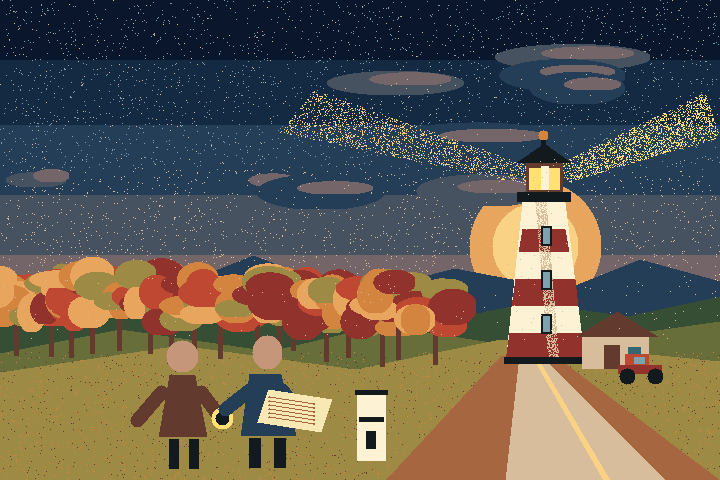
At seven this morning, a lighthouse appeared in a soybean field outside town.
It stood three stories high, painted in red and cream stripes, with a brass lantern large enough to inconvenience the moon. The nearest navigable water was several counties away. The county assessor called the structure an administrative impossibility.
I called it an excellent reason to put on my shoes.
By eight, I had joined Vera Finch, the county surveyor, beside a wooden marker reading MILE ZERO. Vera held a map, a compass, and the expression of someone whose profession had just been personally insulted.
“There is no lighthouse on this map,” she said.
“Perhaps it was printed before breakfast.”
“There isn’t even a road to it.”
We looked down at the road beneath our feet.
“An ambitious omission,” I said.
The lighthouse door opened. An elderly woman in a yellow raincoat stepped out carrying a kettle and two cups.
“Morning,” she said. “I’m Mrs. Pike, the keeper.”
“Keeper of what?” Vera asked.
“The light, principally.”
“Who hired you?”
“The road.”
Vera folded her map very carefully. Surveyors do this when they are considering an alternative career.
Inside, the lighthouse smelled of salt, old paint, and fresh coffee. A spiral staircase climbed toward the lantern room. On the wall hung a framed notice:
TIDES OPTIONAL. DIRECTIONS ESSENTIAL.
Mrs. Pike poured three cups.
“Ships aren’t the only things that drift,” she explained.
“People?” I asked.
“People. Plans. Delivery trucks. Occasionally a town council.”
That last category seemed particularly vulnerable.
At ten, the mayor arrived with the highway supervisor, Mr. Harlan, and a photographer. The mayor wanted to know whether the lighthouse qualified as a tourist attraction. Harlan wanted to know whether it had a building permit.
Mrs. Pike wanted to know whether anyone intended to drink the remaining coffee.
“We don’t have a coastline,” Harlan announced.
“Then the light has less competition,” I replied.
He pointed at the lantern.
“And why is it on in daylight?”
“Because,” said Mrs. Pike, “the trouble isn’t waiting for dark.”
The lantern flashed.
A long gold beam swept over the fields, crossed the highway, and stopped on a narrow lane beyond a stand of cottonwoods.
It stayed there.
Harlan checked his clipboard.
“That road’s closed.”
“Then why,” Vera asked, “does the detour sign point toward it?”
There was a pause in which several public officials discovered the therapeutic value of looking at their shoes.
We drove to the lane.
The old detour sign was still standing, cheerful as a salesman. Fifty yards beyond it, a culvert had collapsed beneath the gravel. Rainwater moved through the gap. The warning barrier lay in the weeds, hidden from approaching traffic by a curve.
Harlan inspected the damage.
“That closure went into the system last month.”
“Did the sign?” Vera asked.
He did not answer.
The lighthouse beam continued to shine directly onto the broken crossing.
Within an hour, a crew had blocked the lane properly, removed the misleading sign, and arranged for the culvert to be repaired. Vera marked the hazard on her map.
Only then did the beam begin moving again.
“Coincidence,” Harlan declared.
“An unusually well-directed one,” I said.
Back at the lighthouse, the mayor proposed a waterfront festival. Vera reminded him that a waterfront ordinarily involved water. He suggested calling it a prospective waterfront festival.
Mrs. Pike wrote something in a small ledger.
“What are you recording?” I asked.
“One wrong turn corrected.”
“And how many remain?”
She turned the ledger toward me.
The next page was blank.
“That’s the trouble with directions,” she said. “You never know which ones somebody is trusting.”
By evening, Vera had added the lighthouse to the county map. She refused to classify it as maritime infrastructure. Harlan refused to classify it as anything at all. The mayor classified it as an opportunity.
I stood beside the mile marker and watched the lantern sweep the fields.
A compass tells us where north is. A map tells us where somebody believed the roads were when the map was made. Neither guarantees that the bridge ahead is still standing.
I have spent a great deal of time trying to locate things that should not exist. Today I found one that had apparently arrived to locate something we had overlooked.
For the record, the lighthouse remains in the soybean field.
The county has assigned it a provisional street address.
The ocean has yet to return our calls.

