
DAILY GLOBAL ERA — Elytheonic Resonant Analysis
Sunday, November 1, 2026 · Central Standard Time (CST)
The Half-Lit Ledger
Today’s Operation: RECONCILE
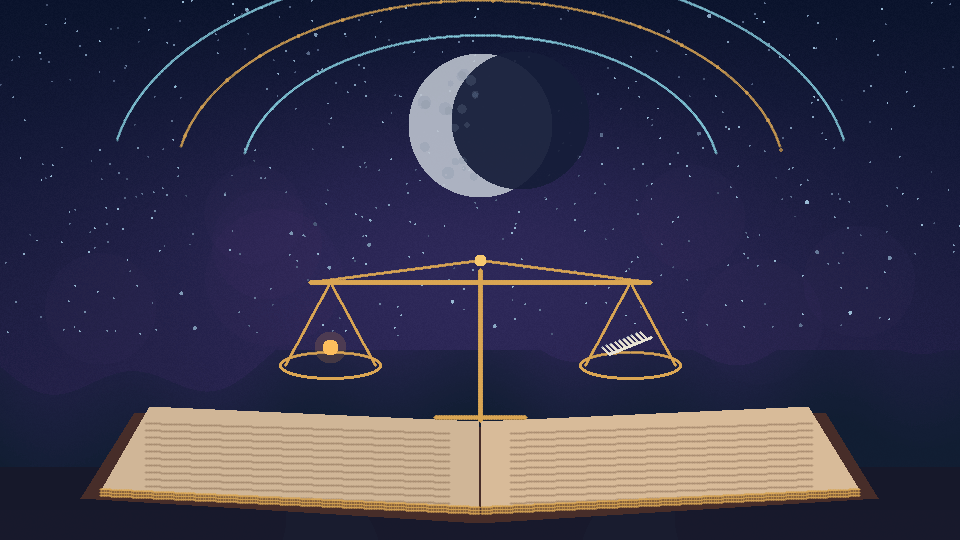
The first page of a new month opens beneath a Moon already halfway through its farewell. Begin by knowing what you carry.
Daily Resonance
November arrives with two different kinds of turning. In much of North America, the civil clock has stepped back from daylight time into standard time. A familiar hour returned by name, though not a single moment of living returned with it. Meanwhile, the Moon approaches Last Quarter at 2:28 p.m. Central Standard Time: one side of its face bright, the other surrendered to shadow. The Sun travels through tropical Scorpio; the Moon, having entered tropical Leo late last night, keeps that sign throughout the day. U.S. Naval Observatory · Daylight saving time calendar · Moon-sign calendar.
Yesterday the lantern guarded the threshold. Today the ledger opens upon the table. A new month asks for a first sentence; the waning Moon asks us to examine the previous pages. These are not rival commands. One concerns the beginning of a calendar. The other concerns the honest completion of a cycle.
Today’s question: What becomes possible when we stop confusing a fresh page with an empty history?
I. Shared Resonance — The Beginning That Is Also a Reckoning
The first day of November often arrives dressed as an announcement. The calendar has turned. The morning light has shifted against the clock. The celebrations of the previous night are giving way to coats, cups, quiet rooms, and the practical business of the colder season.
Yet the Moon does not begin again merely because our month has. It moves toward its last-quarter square, asking for discernment rather than spectacle. Today favors an inventory made without punishment: what has ripened, what has become too heavy, what still has the strength to continue? A reckoning can be gentle. A beginning can be made from what remains.
II. Western Correspondence — Scorpio’s Depth, Leo’s Half-Lit Face
The tropical Sun is in Scorpio, associated in the symbolic tradition with hidden stores, endings, and the power of transformation. The Moon is in Leo, a sign of warmth, expression, and the courage to be seen. At 2:28 p.m. CST, the Sun–Moon geometry reaches Last Quarter. Scorpio asks what is held beneath the surface; Leo asks which part of it deserves the light.
Lunar & Zodiac Grooming Favorability
The Moon is waning, the ERA phase of Retrospect. In one documented British family tradition, cutting hair during the waxing Moon is favored for faster growth, while waning cuts are associated with slower return. For someone wishing to preserve a clean outline or discourage visible regrowth, that makes today folklorically favorable; the practical assessment is mixed, depending on whether trimming is needed. For someone trying to encourage length, a new cut is folklorically unfavorable in that same tradition, while simply leaving the hair or beard to grow is practically favorable. Folklore record.
A recorded Irish Sunday nail-cutting rhyme offers an unfavorable folkloric reading for that weekday; practical nail care remains a matter of actual need. The Moon stays in tropical Leo throughout this Central-time day, and the Sun remains in Scorpio. These traditions give the calendar a poetic vocabulary, not a single compulsory rule.
III. Vedic Correspondence — Pushya, the Nourishing Vessel
In the sidereal zodiac, the morning Moon falls in Cancer, in the traditional lunar mansion of Pushya. Its imagery is nourishment: a vessel that holds, a field that can be tended, a shelter that makes renewal possible. The waning lunar day is near Krishna Ashtami at the morning Central reference, though traditional almanacs may mark day boundaries by local sunrise.
The tropical and sidereal skies speak through different coordinate traditions. Here they converge upon a question of care. A flame without a lamp is vulnerable. A promise without a vessel is difficult to carry. Before seeking another great illumination, attend to the small thing that keeps the light from going out.
IV. Egyptian Correspondence — Ma’at and the Unforced Scale
Imagine Ma’at’s feather resting upon one pan of a balance. On the other lies a glowing coal, small enough to hold, bright enough to matter. The scale does not demand that the two objects become alike. It asks that each be weighed honestly.
There is wisdom in recognizing unlike things without forcing them into a false equivalence: a gift is not a debt, a memory is not a present obligation, a plan is not an accomplished event. The ledger becomes sacred in the modest sense that it protects these distinctions. Truth needs room to be legible.
V. Celtic Correspondence — Beyond the Samhain Lantern
The night of Halloween and the traditional Samhain season have carried the imagery of thresholds, harvest endings, and the passage toward winter. Today the lantern is no longer merely a decoration at the gate. Its purpose is revealed by what it helps us do afterward.
In the Irish material record, carved turnips served as lanterns before the pumpkin became the familiar American image. The National Museum of Ireland preserves this older custom. November 1 is also All Saints’ Day in many Western Christian calendars, a different tradition with its own observances. The histories are not identical, but each may remind us that remembrance asks for a form of attention beyond a single night’s display.
VI. Rune — Gebo ᚷ, the Art of Exchange
Gebo, the gift, enters today’s symbolic field as an exchange between what we receive and what we can responsibly return. It does not require an identical object on each side of the ledger. Hospitality may be answered with care. A lesson may be answered with practice. A story may be answered with the reader’s attention.
To receive is not always to incur a burden. Sometimes the right answer to a gift is to make good use of it. The open hand and the steady hand belong to the same person.
VII. Numerical Current — One, Eleven, and Four
The date 11/01/2026 offers three figures for contemplation. The day 1 names a beginning. The month 11 resembles two standing pillars, a threshold through which the year passes. The complete date’s digit sum, 13 → 4, suggests the four corners of a stable table.
The invitation is not to force a prophecy from arithmetic. It is to build a useful image: two pillars, one step, four supports. The future does not need to be known in full before the next good structure can be made.
VIII. Psychomatrix Reflection — Two Columns, One Honest Page
Place an imaginary ledger before you. On the left, write What Continues: a practice, a friendship, a duty, a work of art, a small reliable pleasure. On the right, write What Changes: a habit, a season, a role, a schedule, an assumption that no longer fits.
Some entries belong in both columns. A relationship can endure while its form changes. A tradition can remain recognizable while its meaning deepens. An old place can be encountered with new eyes. The most useful ledger is not the one that forces each thing into a single box, but the one that allows the true complexity of its lineage to be seen.
IX. Major Arcana — Justice and the Open Record
In the Rider–Waite–Smith tarot ordering, Justice is XI; other major traditions number it differently. The card offers the image of a clear-eyed reckoning. The balance is not a punishment. It is a refusal to make a decision from the weight of appearances alone.
Today the Moon offers half its illuminated face, yet remains wholly present. A partial view is not necessarily a broken thing. The work is to acknowledge what is visible, preserve what is not yet known, and resist filling the dark half with convenient inventions.
X. The Elytheonic Lens — Three Clocks, One Living Day
The central tension is not simply that a clock has moved backward. It is that three systems of time give different instructions on the same morning. The civil calendar announces November’s first day. The lunar cycle approaches Last Quarter, midway through its withdrawal toward the November 9 New Moon. Human schedules continue through both, carrying promises that neither the calendar nor the Moon can complete on our behalf.
The Between is the relationship that lets these measures cooperate without declaring one the master of the others. A calendar can mark a beginning without erasing the previous month. A Moon can be waning without becoming less whole. A person can revise a practice without denying the life that produced it.
This is where Itponology reveals something more concrete than a poetic coincidence. When daylight saving time ended, the local hour from 1:00 to 1:59 occurred twice in participating regions. The same clock label belonged to two different intervals: one in daylight time and one in standard time. A record that stores only the local clock label may confuse them; a record that retains the time-zone offset preserves their distinct histories. The apparent repetition is not an actual return to the same moment. It is a test of provenance.
Now consider a more intimate parallel. A gardener may prune a branch to preserve a tree’s shape, or refrain from pruning to encourage length and shelter. Neither action has a universal meaning apart from the intention, the season, and the living plant. In the same way, an unfinished promise may need action; an exhausted practice may need rest; a completed chapter may need a proper ending rather than another revision. The symbol does not make the choice for us. It helps reveal what relationship the choice is meant to serve.
There are alternatives worth holding together. A fresh page can invite bold invention; it can also invite careful accounting. Last Quarter can signify release; it can also signify the protection of what remains. The protected Unknown is everything the next page has not yet disclosed. We need not fill it prematurely to begin writing.
Today’s discovery: A true beginning does not require an empty ledger. It requires an honest one.
XI. Cultural Reflection — The Sunday Nail and the November Face
The Irish National Folklore Collection records a Sunday nail-cutting warning; a British family account remembers waxing and waning Moon customs for hair and nails. Such rhymes are local inheritances, sometimes contradictory, and often cherished because they turn ordinary care into an occasion for remembering older voices.
November also brings Movember, a specific moustache-growing awareness campaign, and the broader practice of No-Shave November. They are not interchangeable: the official Movember growing rules begin with a clean-shaven face and a moustache rather than a beard. Beyond organized campaigns, seasonal beard cultivation may simply be a personal choice to let a winter form emerge. The common image is growth given intention.
XII. Sky & Sound — The Moon at the Edge of the Page
At 2:28 p.m. CST, the Last Quarter becomes exact. In the morning the Moon is still waning gibbous; afterward it continues toward its crescent. The Sun remains in Scorpio, the tropical Moon in Leo. Above the calendar’s fresh page, the sky continues its own patient accounting.
Today’s Sound: “The Moon” — The Microphones, from The Glow Pt. 2 (2001). A song of intimate atmosphere for a day when the sky’s half-lit face seems to ask for quiet listening rather than a grand announcement. Recording credit.
XIII. Shared Baseline — The Table Beneath the Stars
The baseline for this Sunday is simple: the clock has changed; the Moon reaches Last Quarter; the month has begun. Around those facts, the day offers a ritual of proportion. Name one thing that deserves to continue. Name one thing that can be released. Give each its own place rather than asking one to masquerade as the other.
A stable table does not need to be a throne. It need only be strong enough to hold the ledger, the lamp, and the hands that return tomorrow.
Daily Compass
NORTH — ORIGIN: Keep the source of each promise visible.
EAST — ATTENTION: Notice where a familiar name conceals a changed circumstance.
SOUTH — ACTION: Make one useful preparation before asking for another beginning.
WEST — RELEASE: Let a finished obligation be finished.
CENTER — THE BETWEEN: Balance the calendar’s new page against the Moon’s continuing cycle.
Reader Reflection
If the month were an open ledger, what would you write beneath Continue, and what would you place beneath Release? Choose one entry in each column. The ritual is complete when those words guide one small act of care.
Standing note: ERA is a literary and symbolic reflection drawing on cultural traditions and verified calendrical observations; its correspondences are offered for contemplation rather than as factual causal claims.
Closing Resonant Phrase
The old clock has spoken its hour twice.
The Moon gives half its face to the morning.
On the table, the ledger waits—neither empty nor closed.
A hand turns the page without tearing out the past.
BEGIN WITH WHAT IS TRUE. CARRY WHAT CAN LAST.
Never forget the Sky & Sound.
Be alive. Look around. Listen well.
It’s a brand new day.
Always remember that.
Daily Global ERA — Elytheonic Resonant Analysis · Written and developed by Jon LaBelle · Electric Icarus Project / Electric Icarus Publishing. These wings do not melt!
New to Daily Global ERA? Explore What Is ERA? The Complete Guide to Elytheonic Resonant Analysis to understand the format, symbolism, and method behind each edition.

