
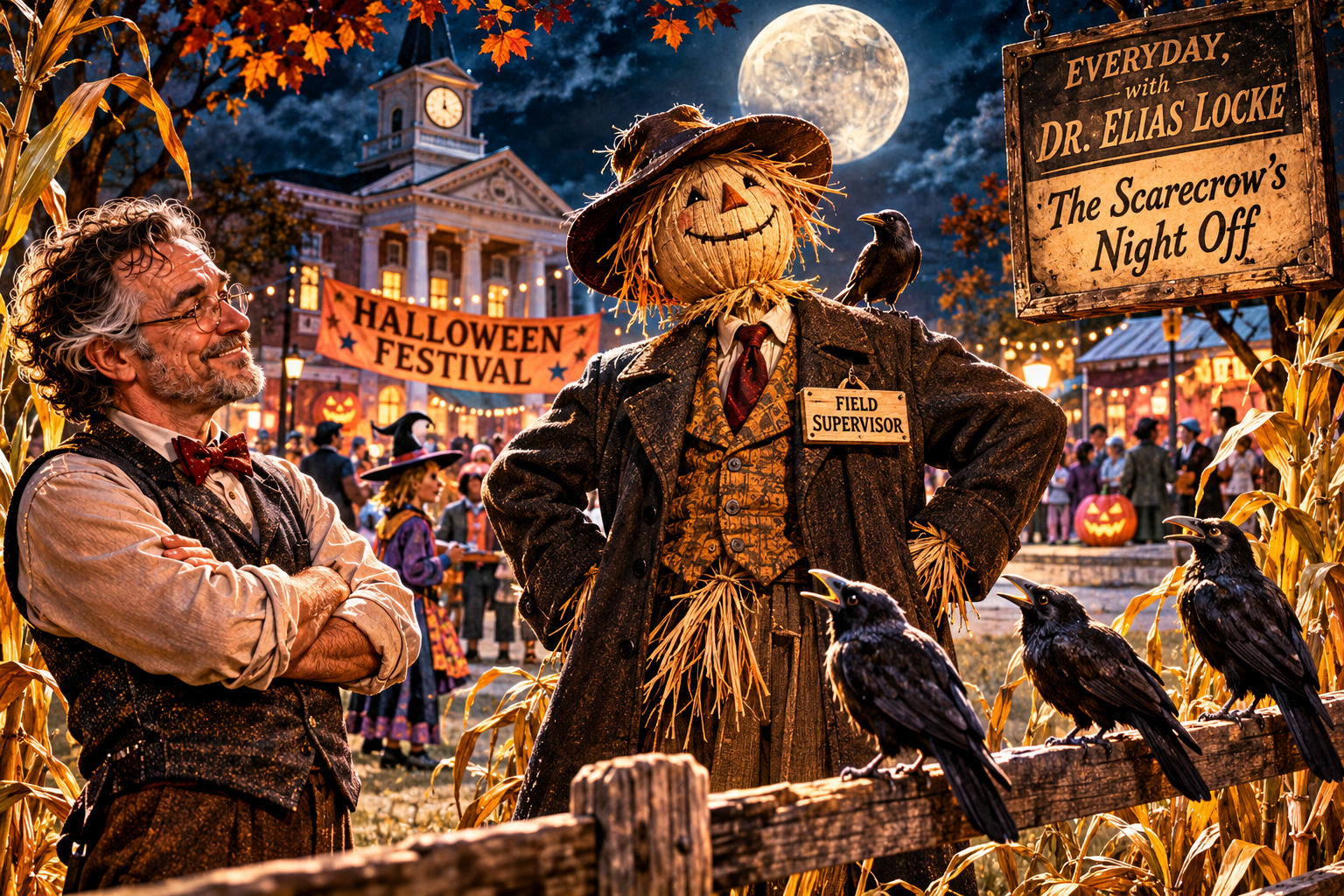
EVERYDAY, WITH DR. ELIAS LOCKE · OCTOBER 31, 2026
The Scarecrow’s Night Off
A fictional column from the Electric Icarus universe, created by Jon LaBelle
Saturday. Halloween.
At half past eight this morning, I received a telephone call from a farmer who claimed his scarecrow had abandoned its post.
This was unusual, though not nearly as unusual as the farmer’s second complaint.
“It left a note,” he said.
“What did it say?”
“Gone to town. Back when appreciated.”
I asked whether the handwriting was legible.
“Better than mine.”
By nine, I was standing in a cornfield beside an empty wooden cross, examining a pair of muddy bootprints and a straw hat that had apparently been left behind in protest.
The farmer, Mr. Tibbett, was deeply concerned.
“Crows have been getting into my corn.”
“Have they?”
“Three of them are sitting on the fence right now.”
I looked toward the fence. Three crows watched us with the expression of gentlemen attending a poorly organized committee meeting.
“Perhaps they’re conducting an exit interview,” I suggested.
Mr. Tibbett did not appreciate this.
We followed the footprints into town, where Halloween preparations were already underway. The courthouse lawn was covered with decorations, children were rehearsing elaborate demands for candy, and the mayor was attempting to explain why the annual costume competition needed seventeen categories.
We found the scarecrow standing outside the general store.
It wore a borrowed overcoat, polished shoes, and a necktie made from an exceptionally handsome strip of burlap.
A small cardboard sign hung around its neck.
NOT A SCARECROW TODAY.
Mr. Tibbett folded his arms.
“You’re supposed to be frightening birds.”
The scarecrow turned its stitched face toward him.
“I’ve been doing that for six years.”
Its voice sounded like dry leaves being shuffled by an elderly librarian.
“And?”
“And I’d like to try something else.”
The mayor approached, delighted.
“Excellent costume!”
“Thank you,” said the scarecrow.
“Very convincing.”
“I’ve had practice.”
Within minutes, the scarecrow had entered the costume competition under the name Mr. October.
It won Best Historical Figure, although nobody could agree which historical figure it represented.
It also won Most Authentic Costume, which caused a procedural dispute when the judges discovered that the costume was, in fact, its ordinary body.
“Then it isn’t a costume,” declared the mayor.
“Neither is your suit,” replied Mr. October, “but you wear it to pretend you’re in charge.”
I considered awarding it a doctorate.
By afternoon, the crows had arrived.
They gathered along the courthouse roof, watching Mr. October dance with a group of children who had decided that a talking scarecrow was considerably less remarkable than an adult willing to dance.
Mr. Tibbett approached me with a worried expression.
“They’re going to eat the entire harvest.”
“Perhaps,” I said. “Have you considered negotiating?”
“With crows?”
“They’ve demonstrated an interest in organized labor.”
One crow descended and landed beside the scarecrow.
It tilted its head.
The scarecrow tilted its head in return.
For a moment, the two regarded each other across a distance that seemed older than farming.
Then the crow dropped a single kernel of corn at the scarecrow’s feet.
“What’s that supposed to mean?” asked Mr. Tibbett.
Mr. October picked up the kernel.
“I believe,” it said, “they’re offering to share.”
The farmer looked toward his fields.
For six years, he had employed a creature whose entire purpose was to frighten other creatures away. He had never asked whether the arrangement suited any of them.
That evening, the scarecrow returned to the farm.
Not because it had been ordered back.
Because it had been invited.
The following morning, Mr. Tibbett discovered the crows perched along the fence, making an extraordinary amount of noise whenever anything approached the cornfield.
They were not eating the harvest.
They were guarding it.
Mr. October stood among the stalks wearing its new overcoat and a small wooden badge reading FIELD SUPERVISOR.
I cannot say whether this arrangement will survive the winter.
I cannot even explain how a collection of straw, burlap, and borrowed clothing developed a preference for municipal festivities.
But I have learned something about costumes.
Sometimes we wear them to pretend to be somebody else.
And sometimes we take them off long enough to discover that the role we were given was never the whole of who we could become.
I suspect the crows understood that before any of us.
They usually do.

