
DAILY GLOBAL ERA — Elytheonic Resonant Analysis
Saturday, October 31, 2026 · Central Time (CDT)
The Lantern and the Borrowed Hour
Today’s Operation: KEEP THE THRESHOLD
The doorway is not the destination. It is the place where intention learns to carry its own light.
Daily Resonance
Halloween opens its lantern-lit gate. The Moon is waning gibbous, about two-thirds illuminated, and the tropical Sun travels through Scorpio. Most of this Saturday the Moon moves through Cancer, the sign of shelter and memory; close to midnight Central, it enters Leo, the sign of the visible flame. Tonight belongs to Samhain’s seasonal threshold. Tomorrow morning, in places observing daylight saving time, the civil clock will turn backward and an hour will bear its name twice.
Yesterday we TENDED the ember. Today we KEEP THE THRESHOLD. There are nights when the world seems to ask us to choose between remembering and moving forward. The lantern suggests another answer: carry a little of the old fire into the new dark.
Today’s central question: What can cross the threshold without becoming a burden, and what must be honored by letting it rest?
I. Shared Resonance — A Lantern in the Doorway
Picture a small lantern placed where a path meets a door. Its light reaches neither the beginning nor the end of the road. It illuminates the hinge, the latch, the next stone, and the face of whoever arrives. This is enough. The purpose of a threshold light is not to conquer darkness but to make a crossing possible.
Some things must travel with us: a story, a kindness, an unfinished question. Other things are meant to remain behind: a fear that has completed its warning, a name that no longer fits, an obligation carried only because it has been carried before. The lantern asks for discernment rather than spectacle.
II. Western Correspondence — Scorpio, Cancer, and Leo
The tropical Sun in Scorpio presides over the hidden root, the guarded chamber, and the transformation beneath fallen leaves. The Moon spends almost all of October 31 in Cancer, associated with home, memory, and the protective shell. At approximately 11:18 p.m. CDT, the Moon crosses into Leo, where the image turns toward the hearth, the heart, and a light openly carried. The passage is late: an evening rite and a morning task belong to different lunar signs.
Lunar & Zodiac Grooming Favorability
Waning Moon — Retrospect. In one recorded British family tradition, trimming during the waning Moon was thought to discourage quick regrowth, while waxing was preferred for encouraging length. Thus a tidy outline or the removal of unwanted excess is folklorically favorable, while a trim intended to encourage long growth is mixed to unfavorable in that tradition. Practically, preserving a desired style and trimming only what needs attention is favorable; a major change without a reason remains indeterminate. Saturday nail-cutting has its own divergent regional lore. Neither the Cancer-to-Leo crossing nor Scorpio’s presence establishes a universal best hour. Source
III. Vedic Correspondence — Punarvasu and the Return
In a Chicago Central-time panchang, the day is Krishna Saptami, and Punarvasu gives way to Pushya around 7:10 p.m. CDT. Punarvasu evokes return, renewal, and the spacious shelter associated with Aditi. Pushya, entering the evening, offers an image of nourishment and guardianship. Two lunar maps—sidereal and tropical—stand beside one another like different windows in the same observatory.
The lesson of return is not that nothing has changed. The same lamp can be lit again in a different room. The same road can be walked with a wiser question. A home is not merely a place we reach; it is also a relationship we learn to sustain.
IV. Egyptian Correspondence — Anubis at the Passage
Imagine Anubis beside a gate in the ancient night, a guardian of passages whose stillness is more formidable than any locked door. He does not ask the traveler to abandon memory. He asks that the crossing be made with care.
The lantern and the gate belong together. One marks the edge; the other allows a step beyond it. In the stories of passage, the deepest preparation is not to know everything awaiting us, but to carry a true account of what has brought us here.
V. Celtic Correspondence — Samhain’s Hollowed Lantern
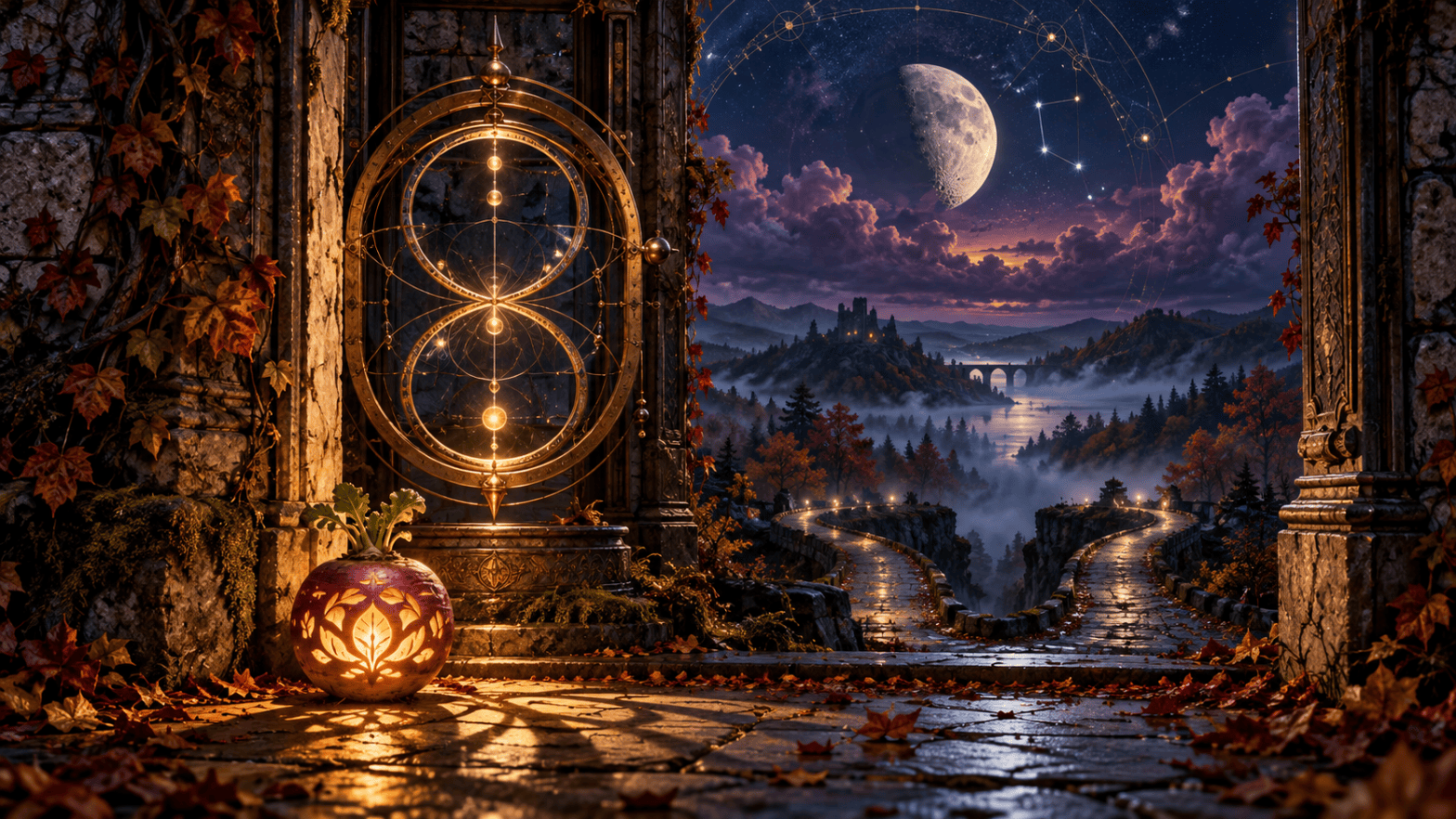
In Irish seasonal tradition, Samhain marks the approach of winter and the opening of the darker half of the year. The National Museum of Ireland preserves evidence of carved turnip lanterns used at Halloween, an older relative of the familiar pumpkin light. A root taken from the ground becomes a small vessel for flame. The harvest becomes the keeper of a path. Source
The old threshold does not demand a single belief from every traveler. It offers a shared human image: at the turning of the season, light is prepared, names are remembered, and the living choose how to continue.
VI. Rune — Jera ᛃ
Jera, the harvest-year, turns with the patience of a field. It is a sign of ripening rather than sudden conquest. The work of spring becomes visible in autumn; the work of autumn protects the next spring.
The rune asks what has been harvested and what remains as seed. A finished season need not be despised for ending. Its gifts may become the fuel of another beginning. The lantern is filled not only with fire but with the labor that made its flame possible.
VII. Numerical Current — Four Stones and Six Lights
The day number 31 reduces to four, suggesting four stones beneath the threshold: memory, discernment, courage, and care. The full date 10/31/2026 reduces to six, a number often read as the inhabited hearth and the duties of relationship.
Four gives the doorway a foundation. Six asks whether someone will keep it open. Together they offer a quiet instruction: build what can hold a light, and tend what you have built.
VIII. Psychomatrix Reflection — What Crosses, What Remains
Imagine two small baskets set beside a doorway. One bears the word Carry. Into it place the lessons, affections, and tools that will serve the next season. The other bears the word Release. Into it place the unfinished arguments, unnecessary performances, and burdens that have already taught their lesson.
The exercise is not a verdict upon the past. The past remains part of the road. It is a choice about what must continue to weigh upon the traveler’s hands. A lantern is easier to carry when the hands are free.
IX. Major Arcana — X, The Wheel of Fortune
The Wheel turns, and the figures upon it see the world from changing heights. Its ancient lesson is not that all events repeat exactly, but that movement changes our vantage. Tonight’s clock offers a curious echo of the card: an hour will be named twice, though neither lived moment is the other.
The Wheel does not ask us to deny the turning. It asks us to find the point from which we can recognize it. The lantern does not stop the Wheel. It gives the traveler enough light to stand and choose.
X. The Elytheonic Lens — The Hour That Returns Without Returning
Tomorrow morning, where daylight saving time is observed, clocks move from 2:00 a.m. daylight time back to 1:00 a.m. standard time. The familiar hour appears twice on the clock face. But the second hour is not a recovered fragment of the first. It is a new interval wearing the same label.
This is a revealing distinction for the Between. The clock’s meaning exists in a relationship among astronomical motion, human agreement, memory, and the activities coordinated by a shared time. A clock label is useful because people agree what it refers to. Yet that agreement can produce a strange illusion: if a number repeats, perhaps the moment has returned. It has not. The Earth’s turning continues; the name has changed.
There are several ways to greet the extra civil hour. The weary may rest. The keeper may tend a neglected lamp. The storyteller may use the repetition as a metaphor for another chance. The scheduler, meanwhile, must distinguish the two 1:30s by their time-zone offsets. All these responses can be meaningful, but they answer different questions. Itponology enters where a sequence must remain intact: when two records share a clock label, their actual order and provenance must still be preserved.
Now consider the seasonal lantern. It is made from something harvested, hollowed, and transformed. It does not restore the summer field; it carries the field’s work into winter. That is the deeper connection between Samhain and the repeated hour. Continuity does not require sameness. We may bring memory forward without pretending to live the same day again. We may prune a branch without renouncing its growth. We may close a door without extinguishing the light that taught us how to open it.
The protected Unknown remains beyond the arch. We cannot see every step from the doorway. But we can choose the condition of the lantern, the truth of our map, and the care with which we cross.
Today’s discovery: A threshold is not the return of an old hour. It is the making of a new relationship with what we carry through it.
XI. Cultural Reflection — Turnips, Journeys, and November’s Faces
The National Museum of Ireland’s carved-turnip tradition reminds us that a familiar custom may have worn another face in an earlier place. The pumpkin and the turnip belong to a lineage of transformed materials, not a single unchanged ritual.
An Irish nail-cutting rhyme preserved in the National Folklore Collection associates Saturday with a journey. Another British family tradition places emphasis on the waxing or waning Moon for hair and nails. Their voices differ, as living folklore often does. One counts weekdays; another watches the sky. Source
The approach of November also brings moustache-growing campaigns such as Movember, which links a visible change of appearance with conversations about men’s health. Others simply cultivate winter beards or choose a seasonal change of style. The shared image is a deliberate relationship with growth: what we keep, what we trim, and what we allow to become. Source
XII. Sky & Sound — The Waning Moon and the Hidden Ceres
On Halloween morning, the waning Moon shines near Ceres, the dwarf planet in the asteroid belt. The closest approach occurs around 15:00 UTC, when daylight makes observation difficult in much of North America; Ceres is far too faint to be seen without optical aid. The Moon is around two-thirds illuminated, and the last-quarter phase approaches on November 1. Above the lantern, the sky holds a companion the naked eye may not reveal. Source
Today’s Sound: The Killing Moon — Echo & the Bunnymen. The song appears on Ocean Rain (1984), its nocturnal atmosphere fitting the doorway between memory and mystery. The music does not explain the night. It gives the night another voice.
XIII. Shared Baseline — The Keeper of the Threshold
Across the world, the season is not identical. In the northern hemisphere, autumn’s darkness gathers; elsewhere, spring advances. Yet a threshold remains an image anyone may recognize. We each inherit a clock, a calendar, a doorway, and some kind of light to carry.
Today’s shared figure is The Threshold Keeper: one who honors the past without making it a prison, who welcomes change without calling it certainty, and who knows that an old name may open onto an entirely new day. The operation is simple enough to remember: tend the lantern, know the road, cross when the crossing is yours.
Daily Compass
NORTH — ORIGIN: Remember where the light was first kindled.
EAST — ATTENTION: Notice what has changed beneath a familiar name.
SOUTH — ACTION: Carry one useful thing into the next season.
WEST — RELEASE: Lay down one burden that no longer serves the journey.
CENTER — THE BETWEEN: Honor the relationship that makes the crossing possible.
Reader Reflection
If the clock could hand you an hour bearing an old name, what would you do differently with it? What would you carry through tonight’s doorway, and what would you allow to remain as a completed chapter?
Standing note: Daily Global ERA presents symbolic, cultural, and philosophical correspondences alongside independently checked astronomical and historical references.
Closing Resonant Phrase
The turnip lantern burns beside the stone gate.
The Moon keeps its quiet watch above the trees.
Tomorrow the clock will call an old hour by its old name,
but the traveler who hears it will be standing somewhere new.
THE DOOR MAY BE FAMILIAR. THE CROSSING IS YOURS.
Never forget the Sky & Sound.
Be alive. Look around. Listen well.
It’s a brand new day.
Always remember that.
Daily Global ERA — Elytheonic Resonant Analysis · Written and developed by Jon LaBelle · Electric Icarus Project / Electric Icarus Publishing. These wings do not melt!
New to Daily Global ERA? Explore What Is ERA? The Complete Guide to Elytheonic Resonant Analysis to understand the format, symbolism, and method behind each edition.

