
Jonathan “Jon” LaBelle
Electric Icarus Project
June 26, 2026
Abstract
The rapid adoption of autonomous AI agents has exposed a growing gap between intelligent behavior and accountable governance. Existing systems often emphasize capability while treating provenance, authorization, and observability as secondary concerns. The LaBelle Protocol Specification (LPS) proposes an alternative approach: a protocol that governs how autonomous systems make externally committed decisions through deterministic policy enforcement, cryptographic attestation, and verifiable forensic lineage.
LPS is intentionally designed as a vendor-neutral, implementation-agnostic specification. It is not a language model, orchestration framework, or cloud platform. Instead, it defines the observable behaviors required for trustworthy agentic execution.
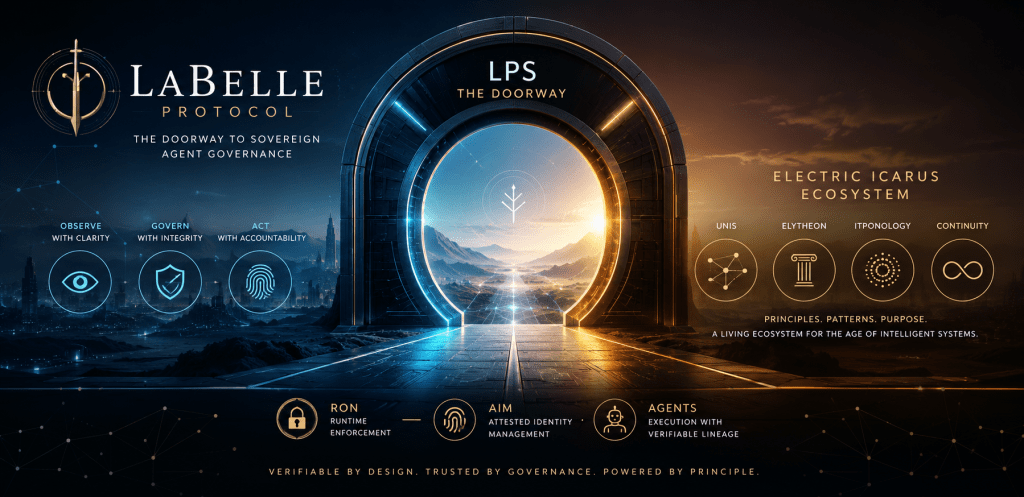
A Doorway, Not a Destination
LPS is the doorway into a broader architectural vision.
The Electric Icarus Project is an ecosystem devoted to governance, continuity, and recursive intelligence. Within that ecosystem, the LaBelle Protocol serves as the standardized point of entry—a documented interface through which organizations can adopt deterministic governance without committing to every aspect of the broader framework.
Organizations may implement the protocol independently while remaining interoperable with future reference implementations and conformance suites.
Architectural Layers
The architecture is intentionally layered.
- UNIS provides universal coherence principles.
- Electric Icarus provides the ecosystem in which governance evolves.
- Elytheon defines continuity, governance, and policy.
- Itponology provides optional recognition, classification, and diagnostic methodologies.
- LPS specifies the normative protocol governing agent behavior.
- RON and AIM provide a reference runtime and identity enforcement architecture.
- Agents execute within these governance constraints.
Each layer has a distinct responsibility, allowing implementations to remain modular while preserving interoperability.
Core Principles
LPS is built upon several foundational ideas:
- Every externally committed action should have attributable origin.
- Every state transition should be reconstructible.
- Identity should be continuously attested rather than implicitly trusted.
- Governance should be deterministic wherever possible.
- Recursive execution should always terminate in a defined protocol disposition.
These principles are expressed through protocol invariants and validated through objective conformance testing.
Toward Engineering Validation
The current work represents the beginning of an engineering validation process rather than its conclusion.
Future development includes:
- A complete RFC-style normative specification.
- Reference architecture documentation.
- Independent reference implementations.
- A comprehensive conformance suite.
- External technical review.
- Iterative refinement informed by implementation experience.
The objective is not merely to publish ideas but to determine whether independent engineering teams can implement compatible systems using the specification.
Invitation
The LaBelle Protocol is offered as a proposal for discussion, experimentation, and technical review.
The goal is to encourage collaboration among software engineers, security professionals, researchers, and organizations interested in trustworthy autonomous systems. Constructive critique, independent implementations, and interoperability testing are welcomed as part of the protocol’s maturation.
The future of intelligent systems depends not only on increasingly capable models, but also on increasingly accountable governance.
LPS is intended to contribute to that conversation—one doorway into a broader ecosystem dedicated to continuity, observability, and responsible autonomy.

