
ELECTRIC ICARUS PROJECT / NOVA ACADEMY / FOUNDATIONS OF INQUIRY
LESSON 007 · EMERGENCE
When the Whole Becomes More Than Its Parts
A flock turns without a conductor. A simple rule draws a complex picture. A neighborhood changes even when no resident sets out to change the whole city. How can a larger pattern arise from smaller interactions?
FREE · BEGINNER · 40–50 MINUTES · NO ENROLLMENT · OCTOBER 26, 2026
What you need: paper or a notes app and a pencil. The mini-lab works offline; the optional interactive demonstrations use free browser-based resources.
Previously: Lesson 006 — When Systems Answer Back.
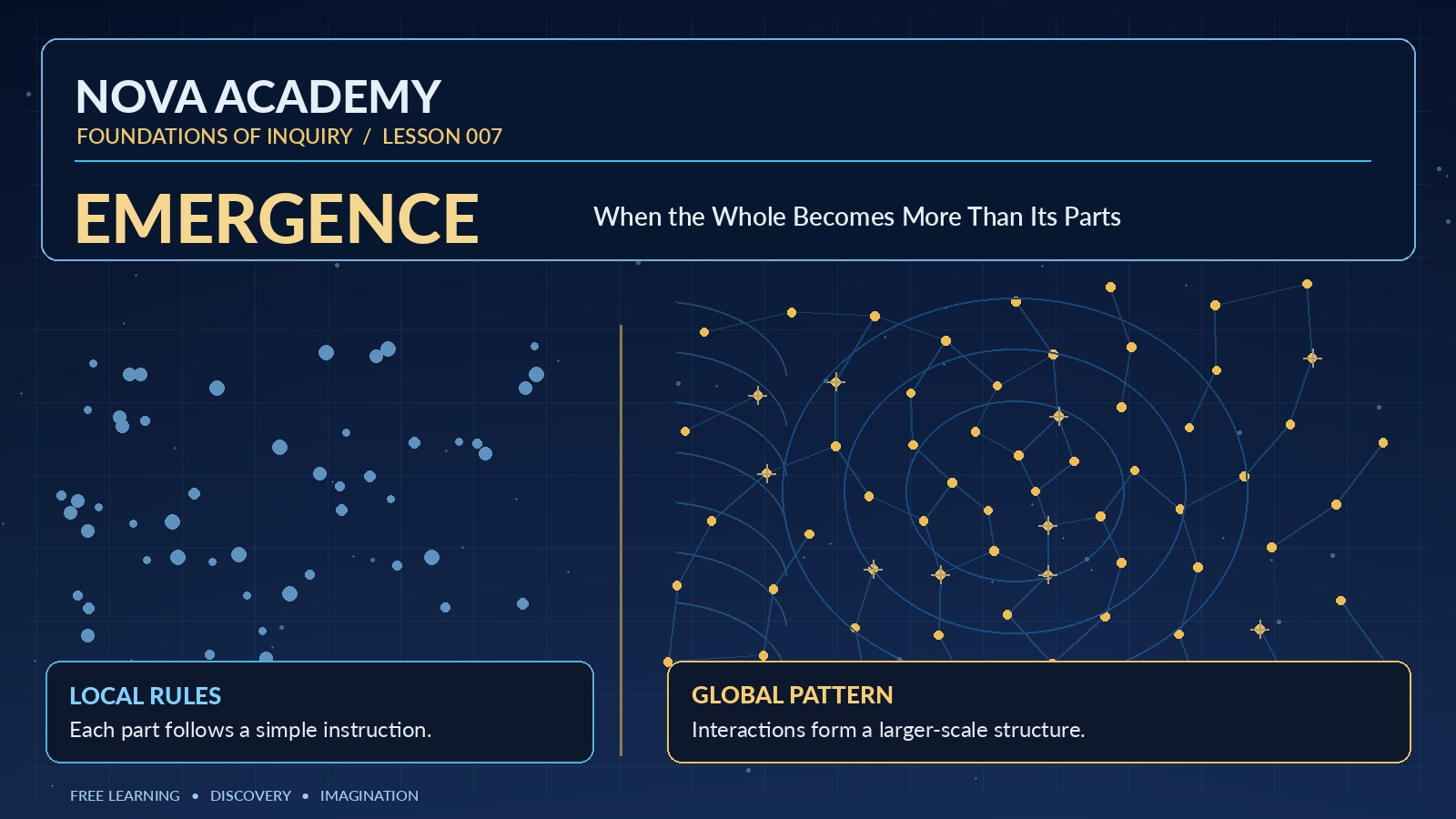
The pattern nobody individually drew
Picture a crowd leaving a theater. Each person slows, chooses a gap, follows someone ahead, or steps aside. At a distance, you may notice streams and bottlenecks. No single walker has to understand the full traffic pattern for that pattern to exist.
This is our starting meaning of emergence: a group-level feature or behavior can arise from the interactions of smaller parts, even when that large-scale feature is not a rule or goal possessed by each part in isolation.
In Lesson 005 we learned that a model is not the territory. In Lesson 006 we examined what happens when outcomes feed back into a system. Today we ask how repeated local interactions can produce structures that require us to describe the system at another level.
Learning objectives
- Explain a simple working definition of emergence and distinguish individual rules from collective patterns.
- Name agents, local interactions, boundaries, and the larger-scale feature in a model.
- Use a paper-based cellular automaton to generate a pattern from one local rule.
- Recognize how initial arrangements and thresholds can change a model’s outcome.
- Explain why an emergent pattern does not by itself establish intelligence, intention, or consciousness.
1. Two levels of description, one system
You can describe the pieces of a clock, or you can describe its ability to tell time. You can describe individual cars, or you can describe a traffic jam. Neither level must be imaginary: they answer different questions. For emergence, we are particularly interested in a pattern or property of the interacting arrangement that is not simply a property of an isolated component.
The core distinction
Local level: What does each part do? Which nearby information can it use?
Interaction level: How do those actions change the neighbors or environment?
Global level: What stable, repeating, or large-scale pattern appears across the whole arrangement?
Important limit: A group-level explanation may be useful without introducing any new fundamental force or proving that the whole has a mind.
The Stanford Encyclopedia of Philosophy distinguishes multiple philosophical ideas of emergence, including relatively weak accounts involving complex but physically dependent patterns and stronger claims about novel causal powers. Those stronger interpretations remain contested. For a first lesson, our attention stays on observable or simulated patterns.
2. Rules that never mention the final picture
Imagine a row of lights. Every light knows only whether the two lights beside it were on in the previous round. The lights never receive instructions to draw a triangle, a wave, or a symmetrical shape. They follow the same tiny update rule over and over.
Yet the diagram formed by many rounds may display a striking repeated structure. The pattern belongs to the history of the row, not to the intentions of any light. This is an especially clear introduction to emergence because the rules are explicit and the outcome can be checked by hand.
Four ingredients
- Agents: The individual cells or participants.
- States: The values an agent can take, such as on or off.
- Local rule: What each agent does using limited information.
- Repeated updates: How individual changes accumulate into a visible pattern.
Northwestern University’s NetLogo Rule 90 model demonstrates this approach with one-dimensional cellular automata. The classroom exercise below uses the same familiar rule but fixes the outer boundary to “off”; some computer implementations instead wrap the edges around.
3. Context changes the whole
Two arrangements can contain the same number of parts and still behave differently because the connections and positions differ. A classroom where everyone can talk only to the person beside them has a different communication structure from a classroom where every group has a representative connected to all other groups.
This is why it is incomplete to say that emergence is caused merely by having lots of pieces. Quantity can matter, but so can topology, distance, update speed, feedback, and the environment.
Worked example · A line of dominoes
Ten upright dominoes scattered too far apart will not form a continuous falling chain when one is tipped. The same ten, arranged close enough, may support a wave of falling dominoes. The relevant difference is not the number ten; it is their spacing and interaction.
Boundary of the analogy: A domino chain is a simple propagation process, not a model of every emergent phenomenon.
4. Local preferences, global consequences
The NetLogo Segregation model, inspired by Thomas Schelling, explores agents with local preferences for some similar nearby neighbors. When agents move because their immediate neighborhood does not meet a threshold, the simulated population may gradually develop highly separated clusters—an overall outcome not necessarily chosen as the goal of any single agent.
This demonstration makes an important point about unintended system-level outcomes. It does not imply that actual human communities are adequately explained by colored dots or one preference rule. Real housing patterns involve institutions, laws, economic inequalities, discrimination, history, and human choices. The simulation teaches how a mechanism can produce an outcome under stated assumptions, not a complete explanation of society.
A useful question is not simply, “Did clusters appear?” It is also: “Which assumptions produced them? Would a different movement rule, another initial arrangement, or additional social constraints change the result?”
5. Thresholds: when a small difference matters a great deal
Some group patterns depend on passing a threshold. Imagine a row of patches representing trees. A simulated fire may spread from one patch to a neighboring patch only when a tree is present. If connections are sparse, the flame may encounter gaps. If enough connected trees occupy the area, a path across the model may become much more likely.
Northwestern’s NetLogo Fire model illustrates how the likelihood of a spreading fire reaching the far side changes sharply with tree density. Its numerical thresholds belong to that simulation and its assumptions; they are not instructions or predictions about a real wildfire.
Check the model before trusting its threshold
- What is the changing parameter, such as density?
- What outcome is measured?
- What conditions are fixed or omitted?
- Does the model include randomness?
- Are we describing one run, an average across many runs, or an actual real-world observation?
6. Self-organization isn’t necessarily intelligence
A traffic jam, a sand pattern, a flocking simulation, or the changing arrangement of cells may be organized in a way that an observer can describe. But an orderly-looking pattern does not automatically reveal a planner.
Likewise, collective intelligence is a separate question. Some groups really can aggregate information or coordinate problem-solving, but determining whether they do so requires evidence about performance, information, and decision-making—not just an attractive diagram. For additional background, see Bettencourt (2009), on information aggregation and collective intelligent behavior.
A computer simulation that forms a complicated pattern also does not thereby establish artificial general intelligence, personhood, intention, or consciousness. These are distinct propositions that demand distinct evidence.
Keep the claims separate
Observed: The same local rule produced a larger recurring structure.
Supported explanation: The described interactions and boundary conditions were sufficient to generate this particular model outcome.
Not established: The cells understood what they were drawing; the system possessed a mind; all complex systems behave the same way.
7. Mini-lab · Draw a pattern without drawing it
15 MINUTES · PAPER, PENCIL, AND ELEVEN BOXES · FREE
Create a row of 11 boxes. Number them from 1 through 11. Mark the middle box, number 6, with an X; leave every other box empty. We will call this Round 0.
The rule: For each new round, a box becomes marked if exactly one of its two neighbors was marked in the previous round. If both neighbors were marked, or neither was marked, leave the new box empty. Ignore the box’s own previous state. Beyond the left and right edges, imagine empty boxes. Calculate each next row from the entire previous row, never from a partially updated one.
- Draw the initial 11 boxes and mark only box 6.
- Underneath, draw a second row. For each box check its left and right neighbors in the previous row, then apply the rule.
- Repeat for five additional rows, keeping every original row visible.
- Compare the resulting rows. Do diagonal branches or repeating patterns appear?
- Change exactly one thing: start with two marked boxes in Round 0 instead of one. Predict how the overall pattern might change. Try at least three rows.
- Write a conclusion: What rule did each cell follow, and what larger pattern appeared through repeated updates?
Worked answer · One marked center box
In the table, ■ means marked and · means empty. These are calculated results of the stated toy rule, not observations from nature.
| Round | Eleven boxes, left to right |
|---|---|
| 0 | ·····■····· |
| 1 | ····■·■···· |
| 2 | ···■···■··· |
| 3 | ··■·■·■·■·· |
| 4 | ·■·······■· |
| 5 | ■·■·····■·■ |
Notice the repeated branching. No box needed a picture of the full shape. Its next state was determined by one local rule applied over time. If you use different edge rules or start with another arrangement, you may see a different result.
For an online comparison, open NetLogo Rule 90. Its boundary treatment may differ from this fixed-edge classroom sheet. This difference is itself worth recording; do not assume a model is wrong merely because its assumptions differ.
8. A second investigation · The group pattern audit
Pick a familiar example—people forming a line, a queue of online comments, the circulation of a rumor, or a flocking video. Do not assume you know what every participant intended. Record what can be observed and separate that from proposed mechanisms.
Field-note worksheet
- Parts: What are the individual entities?
- Local behavior: What is each one assumed or observed to do?
- Interactions: How do participants affect nearby participants or shared surroundings?
- Global pattern: What appears at the group level?
- Alternatives: Could a central organizer, common outside influence, or measurement artifact also explain the result?
- Test: What rule or starting condition could you change in a model?
- Limit: Which conclusions would this example not justify?
For this activity, an invented system is just as acceptable as a real observation. If you use a real group, respect privacy and do not infer people’s intentions from an overhead pattern alone.
9. From emergence to the next question
The first seven lessons now form an intellectual sequence: observe → test → verify → define → model → feedback → emergence. Each adds a new level of responsibility. We cannot examine a collective pattern well if our observations, sources, and definitions remain vague.
Emergence also creates a new educational challenge: If we can recognize a large-scale pattern, how do we decide whether it indicates cooperation, instability, an institutional failure, or meaningful improvement? We will need measurements, comparisons, and good models again. The sequence is not a straight line; it keeps returning to its foundations.
That is the doorway to deeper systems research through the Quantum Atrium and future coursework envisioned for Quantum University. Nova Academy remains a free introductory learning resource, not an accredited institution.
10. Knowledge check · Six questions
- What distinguishes a global pattern from a local rule?
- Why does the number of agents alone not tell us what pattern will appear?
- In the mini-lab, what happens when both neighbors of a box were marked in the previous round?
- Why is the starting arrangement relevant to an emergent pattern?
- What can a model of neighborhood sorting demonstrate—and what can it not establish by itself?
- Does a complex-looking pattern automatically establish intelligence or consciousness?
Compare your answers
1. The rule determines a part’s update, while the pattern describes the arrangement or behavior across parts. 2. Relationships, states, environment, timing, and rules also matter. 3. The next box is empty because exactly one marked neighbor is required. 4. Different initial states can lead to different repeated interactions and outcomes. 5. It can show what a simplified local preference rule produces under specified assumptions, not fully explain real housing history or individual motives. 6. No. Those are separate claims requiring separate evidence.
Reflection · Who drew the pattern?
Sometimes no single participant did. The shape of the whole developed through the relationships between parts. That makes the whole worth studying, but it does not make the individual pieces irrelevant. The task is to keep both levels in view.
A compelling pattern can invite myth, philosophy, art, and speculation. It can also invite experiments. Nova Academy leaves room for imagination while keeping its scientific claims anchored to what a given model, observation, or study can actually establish.
Takeaway: Identify the parts. State the local rules. Examine their interactions. Describe the global pattern. Test an alternative. Name what remains uncertain.
Completion: You have completed Lesson 007 when you have generated at least five rounds of the pattern exercise, identified one system-level feature, and explained why that pattern does not establish the intentions of its parts. No enrollment, payment, grade, or certificate is required.
References & further learning
- Stanford Encyclopedia of Philosophy — Emergent Properties. An overview of philosophical and scientific debates about emergence.
- Northwestern University NetLogo — CA 1D Rule 90. A simple update rule that produces repeated patterns; optional browser exploration.
- Northwestern University NetLogo — Segregation. A simulation showing group-level patterns produced by local moving preferences.
- Northwestern University NetLogo — Fire. A model illustrating how local connections and tree density influence simulated spreading patterns.
- Bettencourt (2009) — The Rules of Information Aggregation and Emergence of Collective Intelligent Behavior. Research on information aggregation, synergy, and collective outcomes.
← Review Lesson 006 · Browse Nova Academy Lessons · Visit the Quantum Atrium
Nova Academy is a free, non-accredited educational initiative within the Electric Icarus Project. The cellular-automaton exercise is a deliberately simplified illustration and is not evidence of consciousness, intent, or any unverified claim about real people or institutions.

