
ELECTRIC ICARUS PROJECT / NOVA ACADEMY / FOUNDATIONS OF INQUIRY
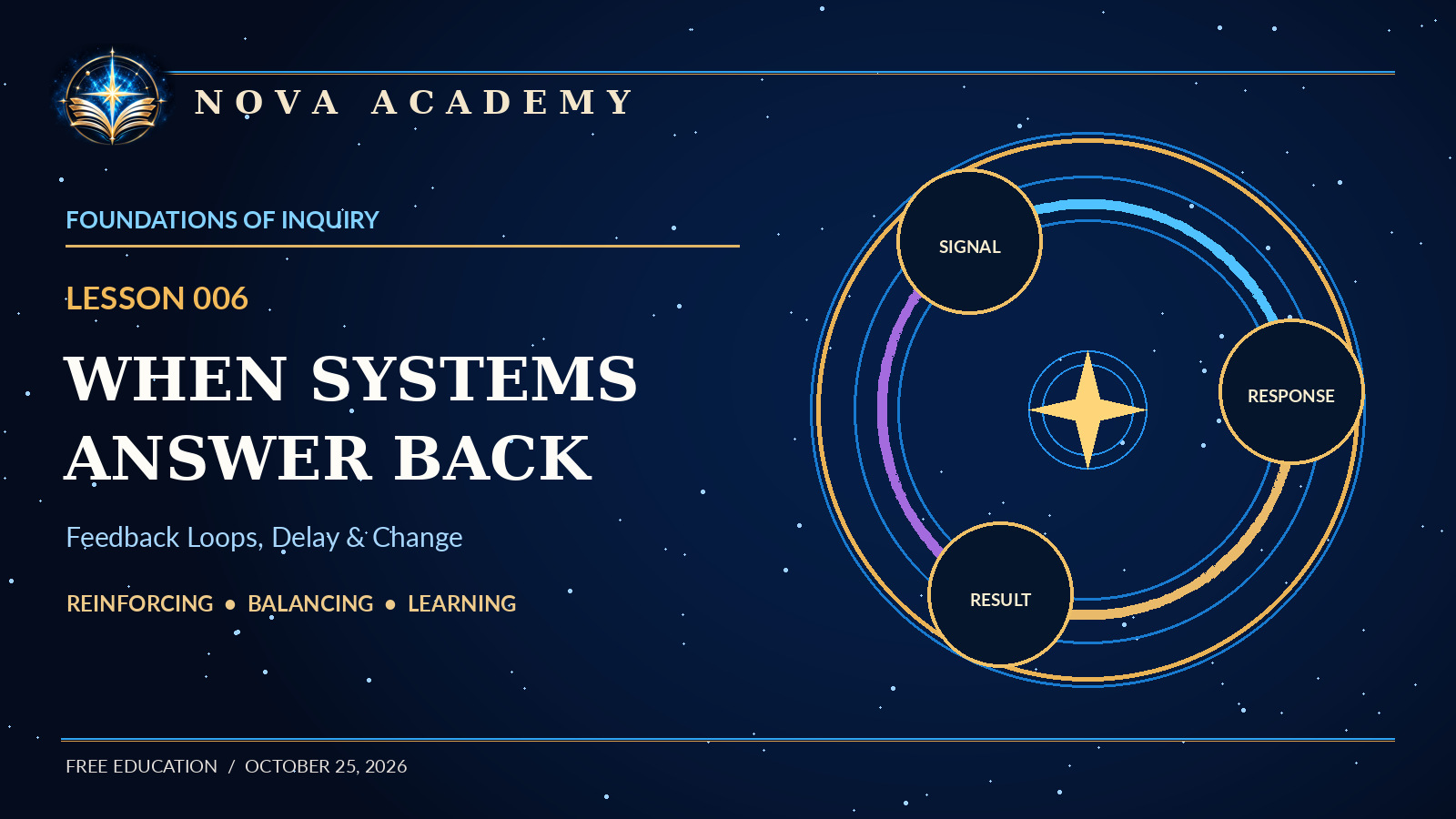
LESSON 006 · WHEN SYSTEMS ANSWER BACK
Feedback Loops, Delays & Change
A system is not always a straight line from action to result. Sometimes the result circles back—and changes what happens next. Learn to recognize the loops that stabilize, amplify, or unexpectedly disrupt a process.
FREE · BEGINNER · 35–45 MINUTES · NO ENROLLMENT · OCTOBER 25, 2026
What you need: paper or a notes app; ten small objects such as coins or beans are optional. The mini-lab works entirely on paper.
Previously: Lesson 005 — The Map Is Not the Territory.
The answer changes the question
Imagine drawing a map of a classroom. On the map, the desk and door are connected by a path. In real life, however, the path gets blocked by chairs. A visitor notices the obstacle, moves a chair, and then tries the route again. Now the next attempt is different because of what happened on the first.
That is the starting intuition behind feedback. Something happens in a system; information about that outcome returns to influence later action. The new action generates a new outcome. If the result continues to affect the process, the relationship can form a loop.
Last time, we learned to distinguish a model from the reality it describes. Today we animate the model in our minds: what happens over time, especially when the system responds to its own results?
By the end of the lesson, you can:
- Identify a closed feedback loop rather than a one-way chain of events.
- Distinguish reinforcing (R) and balancing (B) feedback without confusing positive with good or negative with bad.
- Recognize an example of a delay between a change, its measurement, and a response.
- Track a simple quantity that accumulates as inputs and outputs change.
- Build and revise a small feedback model and explain what it does and does not predict.
1. From arrows to loops
A straight chain might read: question → experiment → result. A feedback loop adds a return path: question → experiment → result → revised question → new experiment. The result affects the next action.
That final return connection matters. A sequence that merely repeats is not automatically a feedback loop. The later action must be influenced by information or effects from the earlier outcome.
Three checkpoints
- What changes? Name a measurable or observable variable.
- What returns? Identify the information, influence, or physical effect that comes back.
- What happens next? Explain how that return affects a later step in the same system.
Systems researchers use diagrams and system-dynamics models to study such relationships. MIT’s The Surprising World of Complex Systems introduces feedback, stocks, flows, and unintended consequences using accessible activities.
2. Reinforcing feedback: change that builds on itself
A reinforcing loop, also called positive feedback in system dynamics, amplifies a change. That amplification can move a system upward or downward. The word “positive” refers to the direction of the feedback effect—not whether the outcome is desirable.
Consider a hypothetical reading club. More enthusiastic members invite friends. Some friends join and also make invitations. More invitations may create more members, who make more invitations. The number of opportunities to join can grow through that return connection.
Reinforcing example · An invitation chain
More members → more invitations → more new members → more members.
In a simplified illustration, one participant invites one new person per round and every new participant does likewise. The total could go 1, 2, 4, 8, 16 for a few rounds. Real communities have limits: people may decline, repeat invitations, or lack time. An early doubling pattern is not a permanent forecast.
Other reinforcing loops may accelerate unwanted changes. For example, warming that reduces reflective snow cover can expose darker surfaces, increasing absorption of solar energy and encouraging further warming. The UCAR Center for Science Education explains this physical feedback. Real climate systems contain many interacting processes; this is one mechanism within a larger system.
3. Balancing feedback: change that pushes back
A balancing loop, often called negative feedback, counteracts a change relative to some condition or target. In a well-functioning case, it can help stabilize a quantity, but that does not mean all balancing loops produce a desirable outcome.
A thermostat is a familiar example. When a heated room cools below a selected temperature, the controller calls for more heat. As the room warms, the controller eventually stops asking for heat. The change in temperature influences the heating response, which then influences temperature.
Balancing example · Room temperature
Temperature falls → heat turns on → temperature rises → need for heat decreases.
The model leaves out outside weather, insulation, sensor placement, and how fast the heater works. A real thermostat system may oscillate within a range rather than holding one exact number.
The UK Government’s Systems Thinking Toolkit describes both reinforcing and balancing loops as tools for examining behavior over time.
4. Positive does not mean good; negative does not mean bad
The words are easy to misunderstand. In everyday conversation, “positive feedback” often means praise and “negative feedback” means criticism. In systems thinking, the words describe whether a loop amplifies or counteracts change.
| Loop | Also called | What it does | Possible outcome |
|---|---|---|---|
| Reinforcing (R) | Positive feedback | Amplifies an existing change | Helpful momentum or damaging escalation |
| Balancing (B) | Negative feedback | Opposes a deviation or change | Useful stability or stubborn resistance |
A reading habit that makes a learner curious, prompting more reading and further curiosity, may be a useful reinforcing process. A habit of revising a claim when evidence contradicts it can be a useful balancing process. These are conceptual examples—whether a particular individual or institution shows them would require observation.
Practice pause · 3 minutes
A student receives feedback that an answer lacks a source, checks the source, and improves the next answer. Where does the result feed back into the process? Would you call this a balancing correction, a reinforcing learning habit, or a combination? Defend your answer with the relationships you identify.
5. A delay can change the outcome
Now suppose the thermostat uses a temperature reading that is several minutes old. It may keep heating after the room has already reached its target, simply because the sensor’s report arrives late. When the warmer reading finally arrives, it may reduce the heat too much. The response can overshoot or oscillate.
A delay is the time between a change and an effect, observation, decision, or response. Delay does not guarantee oscillation, but it is one common reason why a feedback system can behave unexpectedly.
Three different clocks
- Action delay: The heater needs time to warm the room.
- Information delay: The thermometer reports an older reading.
- Decision delay: Someone notices the reading but changes the setting later.
MIT’s 2026 System Thinking course overview includes feedback loops, delays, causal relationships, and system dynamics among its core concepts.
6. Stocks and flows: what builds up?
Some quantities accumulate. A water tank stores water. A notebook can hold recorded observations. A library stores volumes. A budget balance reflects funds entering and leaving over time. In systems thinking, a stock is an accumulated quantity, while a flow changes it.
A tiny stock-and-flow model
Starting water + water added − water removed = ending water.
Suppose a container begins with 5 cups of water. Add 3 cups and remove 2: it ends with 6 cups, assuming no spills or evaporation. This is simple bookkeeping of a stock, not a claim about a real reservoir.
The interesting next question is whether the water level affects the input or output. If a float valve closes when the container is full, the current stock influences the future inflow: now a feedback loop has appeared.
NASA’s Systems Thinking About the Earth System introduces loops as a way of investigating Earth-system processes, including why amplifying and counteracting feedback matter.
7. Mini-lab · The delayed controller
10–15 MINUTES · PAPER-BASED SIMULATION · NO SPECIAL EQUIPMENT
You will simulate a room controller using numbers rather than a physical heater. This is a deliberately simplified mathematical toy, not a safe design for real equipment and not evidence that actual heaters operate with this exact behavior.
Goal: Keep the number at 5. Starting value: 2. Your adjustment rule is: add 1 if the reported value is below 5, subtract 1 if it is above 5, and do nothing if it is exactly 5.
Round A · Immediate information
- Write 2 on your paper as the starting value.
- Check the current value. Apply the adjustment rule once.
- Write the new value and repeat for six rounds.
- Circle the round when the value first reaches 5. Does it settle at 5 under these rules?
Expected simplified sequence: 2 → 3 → 4 → 5 → 5 → 5 → 5.
Round B · Two-round-old information
Now the controller acts on a value from two rounds earlier. To begin, treat its initial stored reading as 2. In each later round, use the recorded value from two rounds earlier rather than the latest value. Keep the same +1, 0, −1 adjustment rule.
| Round | Reported value used | New actual value |
|---|---|---|
| Start | — | 2 |
| 1 | 2 (initial) | 3 |
| 2 | 2 (start) | 4 |
| 3 | 3 (round 1) | 5 |
| 4 | 4 (round 2) | 6 |
| 5 | 5 (round 3) | 6 |
| 6 | 6 (round 4) | 5 |
| 7 | 6 (round 5) | 4 |
The example overshoots 5, then moves below it, because the controller responds to older information. The delay does not make the adjustment rule malicious or foolish; it changes how the same rule behaves.
Record what you learned
- What difference appeared between immediate and delayed information?
- At which round did the delayed controller first reach the target?
- Why did it keep changing after reaching the target?
- What rule, measurement method, or response speed might you test next?
- What real-world details does this paper model leave out?
8. The network also has feedback
A learning library is not merely a collection of published pages. Readers attempt exercises, encounter confusing explanations, ask questions, and sometimes identify errors. Those responses can inform a revision. The revised lesson changes what future readers encounter.
For Nova Academy, this is a design principle: publish → teach → observe where learners struggle → revise → teach again. If the response is actually examined and used, the published lesson becomes part of a feedback process. If nobody checks the responses, the arrows are just a decorative diagram.
The same idea applies to larger systems, including public institutions and media networks. Different parts have different purposes, yet information about performance can improve how those parts work together. In an educational setting, success needs evidence: accessible material, completed activities, clearer explanations, and what learners can actually do afterward.
This is a bridge toward more advanced systems study through the Quantum Atrium. The concepts are introductory and free to explore, without enrollment or tuition.
9. Quick check · Six questions
- What makes a feedback loop different from a one-way chain of events?
- What does a reinforcing loop do to an existing change?
- Why is balancing feedback not automatically beneficial?
- Does the word “positive” in positive feedback mean praise or goodness?
- How can delayed information change the behavior of a controller?
- What is the difference between a stock and a flow?
Compare your answers
1. Earlier outcomes return to influence later conditions or actions. 2. It amplifies the change. 3. It counteracts change, which can stabilize something useful or resist a needed improvement. 4. No; it describes amplification. 5. The response may continue after the true condition has changed, potentially causing overshoot or oscillation. 6. A stock is an accumulated amount; a flow adds to or removes from that amount.
Reflection · What happens after the answer?
A question can lead to an experiment. An experiment can lead to an answer. But when the answer changes the next question, inquiry becomes an ongoing process rather than a single event.
That circularity can be powerful. It can help a system learn, restore balance, build momentum, or spiral into trouble. The right way to examine it is to ask what returns, how strongly it acts, how long it takes, and which other relationships may intervene.
Takeaway: Name the variable. Draw the return path. Ask whether the loop reinforces or balances. Mark the delay. Test the prediction. Revise the model.
Completion: You have completed Lesson 006 when you can identify one feedback loop, explain its direction of effect, and contrast the immediate and delayed controller exercises. No grades, account, tuition, or certificates are required.
References & further learning
- MIT BLOSSOMS — The Surprising World of Complex Systems: an introductory systems lesson on feedback, stocks, flows, and unexpected outcomes.
- UK Government — Systems Thinking Toolkit: reinforcing and balancing feedback as tools for understanding systems.
- NASA My NASA Data — Systems Thinking About the Earth System: positive and negative feedback in Earth systems.
- UCAR Center for Science Education — Climate Feedback Loops and Tipping Points: real physical examples of interacting feedback.
← Review Lesson 005 · Browse the Foundations of Inquiry · Visit the Quantum Atrium
Nova Academy is a free, non-accredited learning resource of the Electric Icarus Project. This lesson is an introduction to systems thinking, not professional control-system guidance. Numerical simulations and community examples are illustrative and are distinguished from verified experimental measurements.

