
By Weston Cade · Neon Grit · Electric Icarus Publishing · Hosted by Jon LaBelle
THE HOST: OPENING
Ah, hello there. Apparently we have a guest! Well, welcome to Neon Theater. I’m your Host, Jon LaBelle.
The good people of Orison have spent four evenings discovering that a zero can be expensive, a receipt can be dangerous, and a witness is a person who saw something—not a person somebody paid to agree. Now a second delivery has gone missing, the Stag has spread word that it has been collected, and the courthouse clock remains fixed at four seventeen. Tonight we shall inspect a machine that stopped telling time and a town that may have kept the wrong kind of secret. Golden Buck Cult, Episode Five: The Clockmaker’s Copy. If your clock has not moved since 1998, do not immediately assume you are running late. Someone may have arranged for the hour to stay put.
A Clock That Was Not Broken
At eight on Monday morning, Nora Whitcomb received a bill for twenty-three dollars and seventy-five cents.
It was dated June 18, 1998, bore the seal of the Town of Orison, and described its purpose as COURTHOUSE CLOCK — SERVICE HOLD, NOT REPAIR.
No one had mailed it. Nora found it in the service drawer under the courthouse records counter, where a wooden divider kept office supplies from mixing with the various small betrayals of county administration.
There was no envelope. The paper smelled of machine oil.
She carried it across the hall to the maintenance office and placed it on the desk of Calvin Mott, who had been retired for seven years and still arrived on Mondays to complain about the way the younger staff treated screwdrivers.
Calvin read the bill without touching it.
“Where’d you find this?”
“Your old filing system.”
“Then don’t move anything else. It was organized.”
“Calvin.”
He adjusted his glasses. “I remember that job.”
“The clock?”
“The instruction to stop it.”
Nora waited.
“Bank manager came with a town purchase order. Said they needed the hands held for an inspection. They had a photographer coming. Wanted the clock to show the same hour for the photograph and the inventory.”
“For twenty-eight years?”
“No. Four hours. Maybe six. I was supposed to turn it back on before supper.”
“And?”
“Someone removed the fuse from the service box. I put another one in. The second one disappeared, too.”
“Who removed them?”
“Whoever had a key. That’s a much longer list than you want.”
He opened the bottom drawer and took out a battered green notebook. It was wrapped in a dry cleaning bag to keep dust off its pages.
“Insurance company asked why the clock stayed dead,” he said. “I kept the service notes because I didn’t intend to pay for a clock somebody else ordered stopped.”
On the page marked JUNE 18, 1998, Calvin had recorded three lines.
4:17 P.M. — SERVICE HOLD ORDERED.
4:19 P.M. — GEAR TRAIN DISENGAGED. NO MECHANICAL FAULT.
5:06 P.M. — SECOND DELIVERY ENTERED CLOCK ROOM. NO WORK ORDER.
Nora read the last line twice.
“What was delivered?”
Calvin shut the drawer with his knee.
“I didn’t ask. Back then, not asking was a kind of employment benefit.”
“Did you see who carried it?”
“A fellow in a suit. Had a coffee can in a canvas tool bag. Looked embarrassed by the whole enterprise.”
Nora took out her phone.
“I know a state examiner who’s spent the week looking for that can.”
Calvin looked toward the silent courthouse clock above the square.
“Then tell her to bring a flashlight. The stairs aren’t what they used to be.”
A Necessary Distinction
June Ransom arrived with two flashlights, a state-issued evidence pouch, and a headache that had followed her through the weekend without submitting an expense claim.
Ruth came from the bank carrying printouts of the mysterious settlement reference 000-000-002. Mabel Price came because the men who wanted her loading dock were still calling it a private matter, and she had decided to become publicly inconvenient.
Marian Kells did not come. June had left a message and received only a sentence in return.
DO NOT LET THEM CALL A DELIVERY A TRANSFER.
Nora showed June Calvin’s notebook.
“His records are contemporaneous,” she said. “I can authenticate the handwriting from old payroll records. That doesn’t tell us what’s upstairs.”
June nodded. “It’s enough to request access and photograph the room. Not enough to announce a conspiracy in the town square.”
Mabel sighed. “You always bring the fun.”
“I bring the paperwork that survives the fun.”
Ruth held up the settlement printout. “Reference two isn’t a transaction on our books. It’s a dormant document locator. Somebody made it look like a deposit.”
“Who?” Nora asked.
“The record gives me a forwarding account. It does not give me a human being.”
“Claims Unit Seven?” June asked.
“That’s the label on the routing request. The registration number is inactive.”
Mabel crossed her arms. “So we have a phantom company looking for a phantom delivery to collect a building that nobody sold.”
“Not exactly,” June said. “We have real people making claims through a company that may not have authority. The building is real. The threats are real. That’s why names matter.”
Calvin handed June a ring of keys so old their labels had become small monuments to optimism.
“Clock room’s locked,” he said. “If the brass key doesn’t work, try the one that says boiler. Everybody used whatever was handy.”
They went upstairs.
The Clock Room
The upper courthouse smelled of old plaster, pigeon feathers, and the kind of damp that took possession without filing a deed.
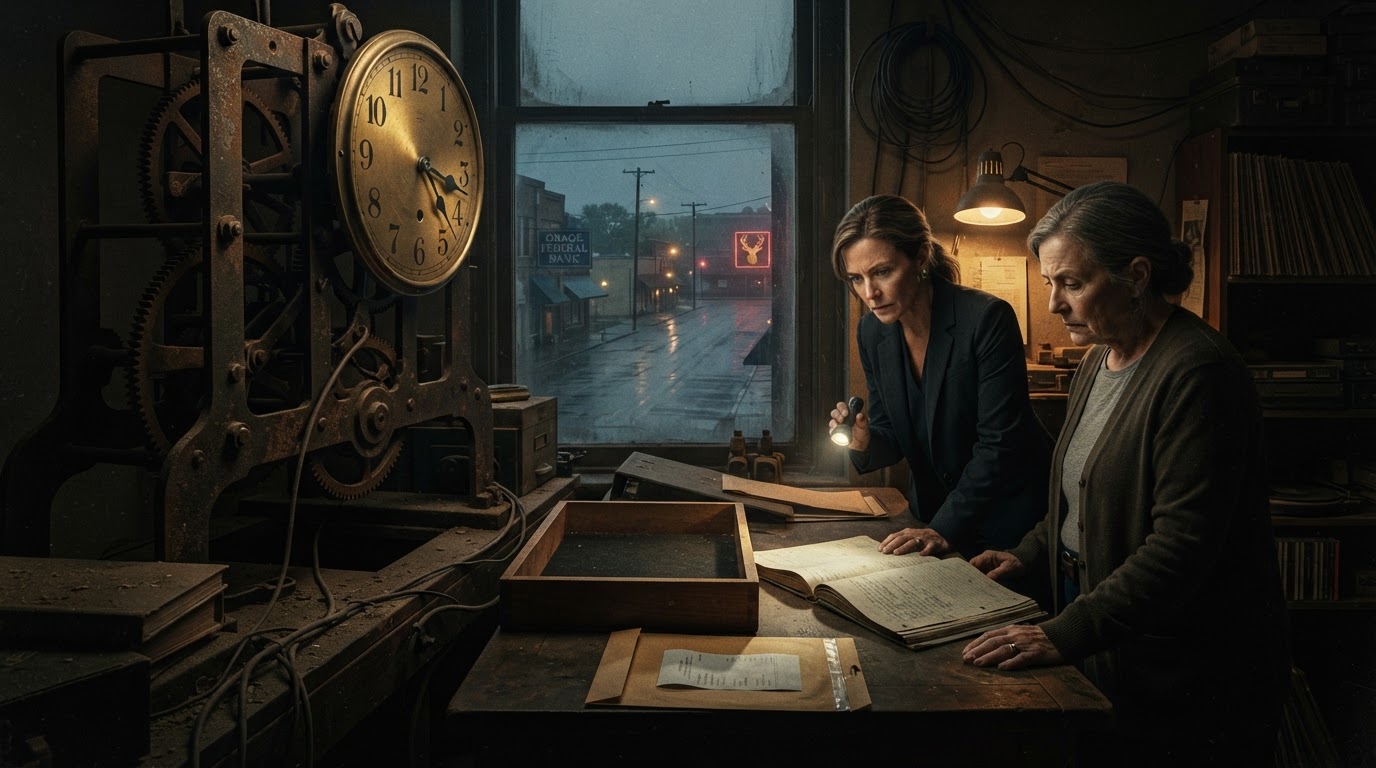
The first flight of stairs ended at a landing with a painted arrow: CLOCK SERVICE. The second ended at a door braced by an iron plate. A strand of gray thread hung between the plate and the frame.
June photographed it before anyone touched the lock.
“Tamper indicator,” she said.
Calvin peered at the thread. “Not mine. Mine was red.”
“Recently installed?”
“Recently enough not to be covered in thirty years of filth.”
June recorded the door, the keys, the thread, and the people standing behind her. Then Calvin unlocked it.
Inside, the clock’s great gears had not been seized by rust. The movement sat disengaged beside a handwheel polished by somebody’s recent use. A brass plate on the western wall bore a painted maintenance diagram and a narrow recessed compartment labeled WEATHER SEAL.
Mabel saw the fresh scratch marks around the compartment latch.
“Someone’s been here.”
“Probably,” June said. “Don’t touch it.”
Calvin stepped to the window. The town spread below him: the bank, the hardware store, the old video rental place, and the main road that passed through town without ever pretending to be a highway to anywhere important.
He pointed to a small gear near the clock face.
“This is what they disengaged. It wasn’t damaged. You could start it again if the motor still works.”
“Why didn’t you?” Nora asked.
“First year, I tried. Second year, somebody wrote that the clock was being preserved as a historic feature. By the fourth year the town was printing postcards of it.”
Mabel laughed once. “We memorialized a work order.”
June took photographs of the compartment and called the county clerk’s office downstairs. Nora was the county clerk’s office, but it seemed important to make the request to a number another person could log.
With a maintenance witness present and a written inventory opened, Calvin lifted the latch. Inside was an empty rectangular space lined with dry felt.
No coffee can.
No envelope.
Only a folded card pinned to the back with a wire clip.
June read the card without moving it.
SECOND DELIVERY RECEIVED FOR SAFEKEEPING.
NOT ACCEPTED FOR BENEFICIAL OWNERSHIP.
RECIPIENT: TOWN OF ORISON.
A line below held a signature: L. MERCER.
Ruth looked up sharply.
“Luther Mercer?”
“Who’s Luther?” Mabel asked.
“The bank manager before Pike’s father,” Ruth said. “Died in 1998.”
June photographed the signature and the clip, then let Nora remove the card with gloved hands.
“It says received,” Mabel said.
“It says received for safekeeping,” Nora replied. “Don’t skip the part after the word you like.”
June studied the empty felt.
“Someone removed the delivery, but left evidence the town was never supposed to surrender it.”
The courthouse bell sounded from a nearby church. Calvin flinched, then smiled at himself.
For a moment, all five of them listened to a clock that had never rung in their lifetimes.
The Wrong Collection
Across Orison, a man in a charcoal jacket entered the old video rental store carrying a document case and the confidence of somebody who had never experienced an effective filing deadline.
He found the technician packing cables into a cardboard box.
“Where is the second delivery?” the man asked.
“That’s the third time you’ve asked.”
“And the second time you haven’t answered.”
The older man in the cowboy hat stood beside the monitor wall, holding a sheet of paper that bore only a forwarding number.
“We were told it was collected,” he said.
“By whom?”
“Authorization came over the same channel as the first settlement.”
The technician turned a screen toward them. The message showed a green completion mark and the line RECIPIENT VERIFIED. Under the verification field was a blank space.
“That’s the problem,” he said. “The system says it knows the recipient, but the field’s empty.”
The charcoal-jacketed man frowned.
“Who can send that authorization?”
“A few people. Some we know. Some names were retired when the departments were reorganized.”
The older man gave a dry laugh.
“There’s a phrase I haven’t trusted in thirty years.”
On the wall, a map displayed an outbound vehicle from Orison at 4:17 the previous evening. The vehicle was a pickup, using a route the company had not recorded as an approved collection path.
“That’s the Stag,” the man in charcoal said.
“Could be,” the older man replied.
“You’re telling me he signed a collection notice without taking anything?”
“I’m telling you the notice made you walk into this room and ask questions.”
The charcoal-jacketed man looked at the door.
“Where is he?”
“That’s another question.”
The technician clicked once more. A new notification flashed across all six screens.
CLOCK ROOM OPENED.
The older man closed his eyes.
“Now,” he said, “we have a real problem.”
The Name on the Card
Downstairs, Nora placed the recovered card between two transparent sleeves. June had already called for a formal evidence receipt and a second custodian to witness the removal. The record was no longer a photograph on somebody’s phone. It was something with a time, place, and a person responsible for it.
Ruth was looking through the original bank ledger.
“Mercer handled institutional deposits,” she said. “Not property transfers. The bank could hold papers. It couldn’t make them true.”
“Did he have family?” June asked.
“A daughter. Name’s Lucille. I don’t know if she’s still here.”
Mabel watched Nora compare the card with the old town inventory.
“What’s the problem if the town received the delivery?”
“Which town?” Nora said.
Mabel stared.
“The town of Orison.”
“There was a municipal corporation, a water cooperative, a highway maintenance district, and a bond authority. In 1998, somebody called all four ‘the town’ whenever it was convenient. They were separate legal entities.”
June took the card again.
“RECIPIENT: TOWN OF ORISON. It doesn’t specify which.”
“Precisely,” Nora said. “A blank can masquerade as a whole county if you give it enough capitalization.”
Ruth found a note in the ledger. It had been entered two days after Calvin stopped the clock.
ORIGINAL HELD IN RESERVE FOR PUBLIC INSPECTION.
COPY SENT TO MUNICIPAL ARCHIVE.
NO TRANSFER OF TITLE RECORDED.
June felt the familiar satisfaction of finally finding a sentence written by someone who had expected another person to read it.
“Where is the municipal archive?” she asked.
Nora looked at her.
“You’re standing in it.”
She opened a cabinet beside the records office door and pulled out a large red index book. Inside were hundreds of filing references that described documents too old for the computer system and too important for the shredder.
Under June 1998 she found a notation for the clock room and a sealed reserve folder.
The box number was missing.
In its place, someone had written the name of a person.
LUCILLE MERCER.
A phone rang upstairs.
Nobody answered it.
The Public Copy
By late afternoon, word of the clock room had traveled through town with the speed usually reserved for weather alerts and rumors about the Dairy Queen’s ice-cream machine.
Mabel found three people waiting outside the records office, one holding a camera and another asking whether the government had discovered gold in the courthouse.
“If we had, they’d charge us for parking,” she said.
Inside, June and Nora prepared a public statement.
It was not a declaration that every debt had been forgiven. It was not an accusation naming a villain the evidence could not yet establish. It stated that a historic custodial card had been recovered, that the physical item to which it referred was missing, and that no certification of ownership had been established by the document.
June read it twice. Nora read it once and changed “demonstrates” to “indicates.” Ruth corrected a reference number.
Mabel had one concern.
“You’re not naming the people who have been showing up at my store.”
“We’ll name the firm on the notices and the fact it has not identified a valid transfer order,” June said. “We have the photographs and the attempted acknowledgments. We will not use the county seal to guess what a man intended.”
Mabel nodded reluctantly.
Outside, the man from the servicing firm arrived in his charcoal jacket. He did not come inside. He watched the front entrance from the curb, then crossed the street to the bank, where Ruth’s manager shut the blinds too late to look innocent.
The old clock above the courthouse read 4:17.
For the first time in decades, someone had written a public record explaining that it was not broken.
Nora pinned the statement beside the office hours and the notice about the courthouse’s annual coat drive.
An elderly man read it and frowned.
“So you found the delivery?”
“No,” Nora said. “We found a record of what somebody claimed to have done with it.”
The man seemed disappointed.
“Doesn’t sound like much.”
“It’s enough to stop pretending we found the delivery.”
He considered that.
“Well,” he said. “I’ll tell my wife.”
Nora watched him go. There were worse ways for evidence to travel.
The Sixth Drawer
At five thirty, Evelyn Rusk entered the courthouse carrying the old Folgers can in a shopping bag.
She set it on Nora’s desk beside Calvin’s notebook.
“Harold wasn’t good with dates,” she said. “But he had a habit of putting important things where he’d forget them safely.”
June showed her the card from the clock room.
Evelyn ran a finger along the letters L. MERCER without touching the sleeve.
“Lucille used to work at the bank,” she said. “Her father made her stop when they began asking her to bring files home.”
“Do you know where she is?”
“Perhaps.”
Evelyn opened her handbag. Inside was a narrow photograph of an office wall. Six metal drawers were visible beneath a counter. The bottom drawer had been painted a darker green.
“Harold took this after the bank closed one evening,” she said. “He told me if people started coming for the second can, I should look for the sixth drawer.”
Nora turned the photograph over. There was a handwritten note.
A SECOND COPY IS NOT A SECOND OWNER.
“That sounds like Harold,” Evelyn said. “He trusted paper more than promises, which is funny because he married me.”
June brought out the bank’s current floor plan. The old vault had been remodeled in 2004, and the office wall had been removed to make space for an electronic document scanner.
“Where did the drawers go?” June asked.
Ruth stared at the old photograph.
“I know that cabinet. We use it for obsolete stationery.”
“Where?”
“In the basement. Behind the records shredder.”
Mabel, who had been leaning by the door, lifted her coat from the chair.
“I could go for another tour of the bank.”
June looked at the clock on her phone. Five thirty-three.
“Not without the manager’s written consent. Or a lawful order.”
Mabel sighed.
“There’s the fun again.”
“We have a record,” June said. “Let’s not lose it by making a worse one.”
They agreed to request access in the morning.
Nobody noticed the black sedan pulling away from the bank until it had reached the highway.
A Time for Collection
The Stag sat in his pickup at a roadside filling station ten miles from Orison. He had bought black coffee and a pack of crackers, neither of which offered the kind of comfort suggested by the advertisement on the wrapper.
The radio on his seat crackled.
“Claims Unit Seven checked the clock room.”
“They would,” he said.
“They found the card.”
“They were supposed to.”
“Who took the can?”
The Stag watched the road, where headlights moved past in pairs.
“If I knew, I’d be less interested in the question.”
The voice hesitated.
“The woman at the bank has access to the sixth drawer.”
“She isn’t the only one.”
“You’re saying the second delivery never went to the courthouse?”
“I’m saying a receipt is proof somebody signed for a thing. It’s not proof the thing stayed where the receipt says.”
He looked at a folded copy of the 1998 maintenance order. Beside the service notation, in pencil so faint it had almost vanished, someone had written a second time.
5:06.
The radio hissed again.
“Orders?”
“Call off the recovery team.”
“Unit Seven won’t like that.”
“Tell them they can have the original if they can first explain why they’re entitled to it.”
“And if they can’t?”
“Then let them ask the town.”
He closed the radio and drove away.
At the courthouse, Calvin Mott was locking up the maintenance office. He paused when he saw the tall window above the stairwell.
For most of his working life the clock had looked down over Orison without moving. He had grown used to the town thinking that an ordinary mechanical decision was a piece of history.
Now, from the upstairs service landing, he heard a tiny click.
Not the great gears. A separate mechanism.
He climbed the stairs one last time. The clock room remained locked. But someone had slipped a white envelope beneath its door, where the gray thread could not mark a visitor.
Calvin bent to read the words printed across the front.
FOR THE CUSTODIAN WHO DID NOT ACCEPT TITLE.
He did not open it.
He called Nora and waited on the landing, with the silent clock at his back.
When June and Nora arrived, the envelope was still where Calvin had found it. June photographed it and lifted it into an evidence sleeve.
Inside was one sheet, folded into four.
It was a receipt dated June 18, 1998, at 5:06 p.m.
DELIVERY ONE: COINS — ACCOUNT SETTLEMENT TOKEN.
DELIVERY TWO: PUBLIC RESERVE COPY — CONTENTS UNVERIFIED.
WITNESSED FOR CUSTODY ONLY.
The second witness line was blank.
Below it, in a different hand, was a new instruction.
DO NOT USE THE PERSON WHO RECEIVED THE COPY.
USE THE PERSON WHO CAN SAY WHO SENT IT.
Nora read the last two sentences aloud.
June thought of Lucille Mercer, the missing box number, and the man who had ordered a town clock stopped so that a paper could be delivered at a particular hour.
Outside, a car rolled slowly past the courthouse with its headlights on.
Ruth’s phone rang at the bank. She answered, expecting the manager.
Instead a woman said, “You found my father’s note.”
Ruth sat down.
“Lucille?”
“You have until tomorrow morning to decide whether you want the original.”
“Of course we do.”
“No,” Lucille Mercer said. “You want to know why he made a copy.”
The call ended.
Across the square, the clock remained at 4:17.
The receipt in June’s hand was stamped 5:06.
At last, Orison had two times to account for.
THE HOST: IN CLOSING
That concludes Golden Buck Cult, Episode Five: The Clockmaker’s Copy. Our town has discovered that its most celebrated broken clock was never broken, that a second delivery has its own receipt, and that a second witness may need to answer a question quite different from the one being asked. Nora and June have protected the public record, but Lucille Mercer has kept something the Order would dearly like to read first. I’m Jon LaBelle, your Host at Neon Theater. Should someone offer you the right time in exchange for your signature, look closely at who set the clock. Goodnight.

