
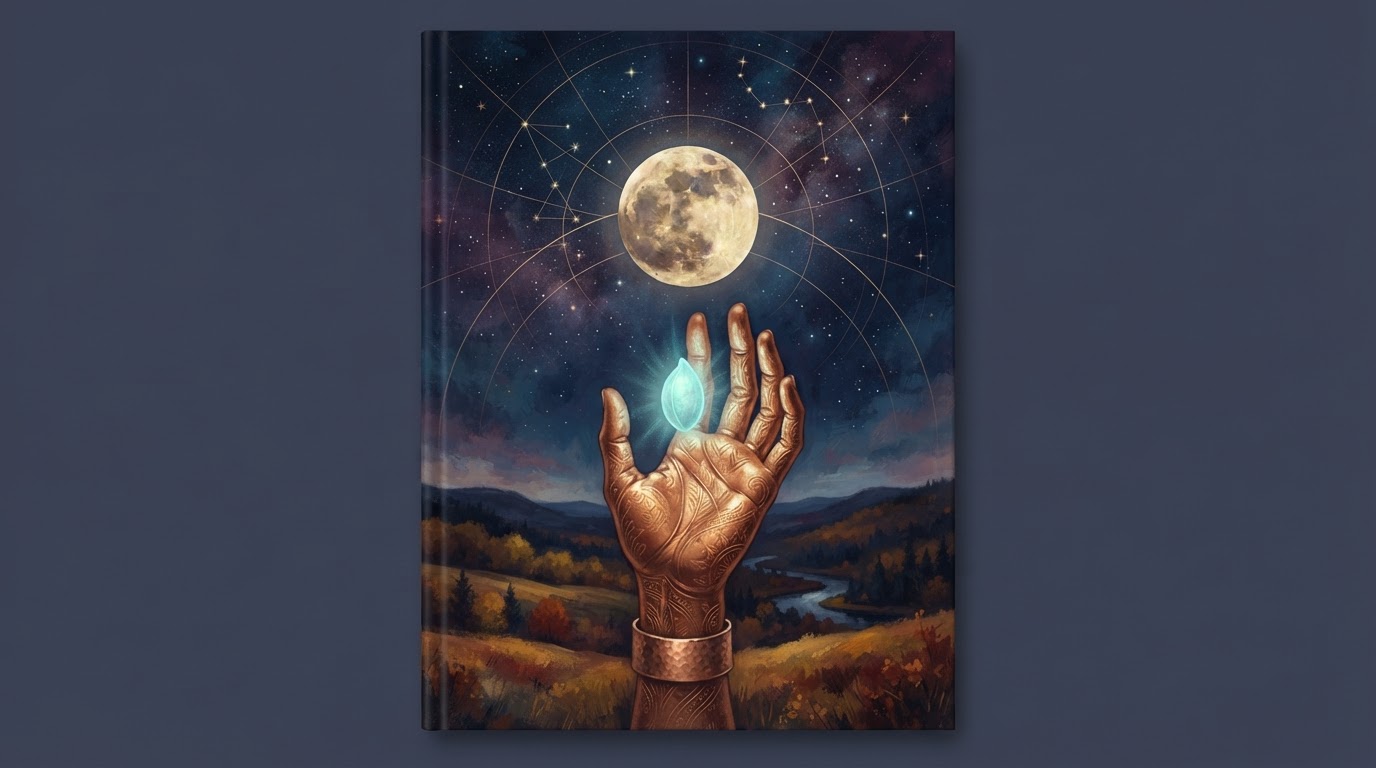
DAILY GLOBAL ERA — Elytheonic Resonant Analysis
Sunday, November 22, 2026 · Central Standard Time
The Measure of an Open Hand
Today’s Operation: OFFER WITHOUT OWNING
The gift becomes a future only when the hand that gives can also let go.
ERA combines verified calendrical references with creative symbolic reflection.
Daily Resonance
Waxing Gibbous · Forecast · Sagittarius Sun · Taurus Moon after 4:10 a.m. CST. The Full Moon approaches on November 24. Today’s current moves from protecting the ember toward stewarding the harvest: what has grown enough to be shared, and what still requires tending?
I. Shared Resonance — The Hand and the Harvest
The waxing gibbous Moon nears fullness, and the day asks a question that cannot be answered by accumulation alone: what are we preparing to offer? An open hand can receive, but it must also know when to release. Today’s resonance is stewardship before display. A harvest is not measured only by what fills the barn; it is measured by what can be preserved, shared, and planted again. The movement from yesterday’s ember to today’s open hand changes the task from protecting potential to making it useful.
II. Western Correspondence — Sagittarius Sun, Taurus Moon
The tropical Sun has entered Sagittarius, traditionally associated with the archer’s long view, travel, inquiry, and a horizon beyond familiar walls. The Moon crosses from Aries into Taurus at approximately 4:10 a.m. CST, trading the spark of immediate action for the slower intelligence of tending. The lunar phase is waxing gibbous, in the ERA’s Forecast arc, nearing the November 24 Full Moon. Together these symbols ask the archer to remember the ground beneath the bow: a vision must be supported by ordinary acts of care.
Lunar & Zodiac Grooming Favorability
Mixed to favorable for maintaining shape; indeterminate for promised growth. In some modern lunar gardening and grooming almanacs, waxing phases are preferred when encouraging growth, while Taurus is associated with steadiness and cultivation. These customs differ by region and are not universal rules. For a beard being grown through November, a light cheek or neckline tidy can preserve the intended silhouette without sacrificing length; a substantial haircut would serve a different goal. Nail care is best guided by comfort and hygiene rather than treating weekday lore as a command. The symbolic question is not simply whether to cut, but what is being cultivated?
III. Vedic/Eastern Correspondence — The Gift of Dana
In Hindu, Buddhist, and Jain ethical traditions, dāna names the practice of giving, though each tradition develops its meanings differently. In the Bhagavad Gita’s account of giving, intention and fitness matter alongside the gift itself. This is a sharper correspondence than generosity as an attractive mood: a gift can nourish, burden, flatter, or bind. The open hand of today’s reading asks us to examine the relationship that follows an offering. To give well may mean to offer something without demanding the recipient become a monument to the giver.
IV. Egyptian Correspondence — Ma’at and the Feather
In ancient Egyptian thought, Ma’at signifies truth, justice, and right order, personified as a goddess and famously represented by a feather in funerary judgment imagery. Her measure is not a tally of possessions but a moral balance. Today’s nearing fullness resembles a scale slowly receiving its final weight: before declaring a work complete, consider what it costs others to maintain. The feather is light; its demand is not. The hand that offers must be willing to be weighed by the consequences of its offering.
V. Celtic Correspondence — The Hospitality of the Hearth
Early Irish literature places considerable importance on hospitality, reciprocal obligation, and the social meaning of a feast, though no single ‘Celtic’ practice can stand for all peoples and periods. The hearth offers today’s image: warmth becomes communal only when someone tends the fire, makes room, and understands the limits of the household. A door permanently shut cannot welcome; a door never guarded cannot shelter. The seasonal movement into late November makes hospitality a living question of boundaries rather than a decorative virtue.
VI. Rune/Northern Correspondence — Gebo ᚷ and Reciprocity
Gebo (ᚷ), the ‘gift’ rune of the Elder Futhark, offers a fitting northern image. The rune’s name is reconstructed from historical linguistic evidence; elaborate modern divinatory meanings should not be mistaken for a uniform ancient doctrine. As an interpretive emblem today, its crossed strokes suggest two paths meeting without becoming the same path. Reciprocity is not the cancellation of difference. A gift can be free and still create responsibility: the responsibility to handle what has been received with care.
VII. Numerical Current — Seven at the Threshold
November 22, 2026 reduces in a common digit-sum method to 16 → 7 (1+1+2+2+2+0+2+6 = 16). Seven here is a chosen contemplative number, not an astronomical property. Where yesterday’s flame called for courage, seven invites examination: what assumptions have we carried toward the threshold without checking? Let seven stand for the interval between the first impulse and the deliberate gesture. A hand pauses, counts its responsibilities, and then opens.
VIII. Psychomatrix Reflection — Capacity, Boundary, Offering
Today’s psychomatrix is a three-way tension: capacity (what can genuinely be sustained), boundary (what must remain protected), and offering (what can enter the shared world). When capacity is ignored, generosity becomes depletion. When boundary dominates, stewardship becomes hoarding. When offering is absent, preparation becomes a private museum of unfinished possibilities. The working balance is not a fixed point; it changes with circumstances, relationships, and the weight of each commitment.
IX. Major Arcana — Temperance at the Gate
Although the Six of Pentacles belongs to the Minor Arcana, its image of giving and receiving would be tempting today. The required Major Arcana correspondence is instead Temperance (XIV): the figure pouring between vessels embodies proportion, transfer, and the careful continuity of a process. Temperance is not timid moderation. It is the art of moving something valuable between conditions without spilling its purpose. Today’s open hand becomes a vessel capable of both holding and letting pass.
X. The Elytheonic Lens — When Help Becomes Ownership
The difficult question appears after the gift has been accepted. An offering can change the giver, the receiver, and the space Between them. A resource, a story, a tool, or an act of protection may create new possibilities—but it can also produce an invisible claim: because I helped make this possible, I must now determine what it becomes.
That is the hinge today’s other traditions approach from different directions. The Elytheonic problem is not merely whether to give; it is how to preserve the receiver’s agency after the giving. The relationship may be recursive: each response alters what both participants believe the original gesture meant. Gratitude can be mistaken for consent. Care can harden into management. A boundary can be interpreted as rejection even when it is the condition of continued trust.
One answer is to refuse all obligation, keeping every exchange momentary. Yet this protects independence by thinning relationship. Another is to demand permanence, binding every future choice to the first contribution. That preserves continuity at the cost of becoming. A third possibility is revisable stewardship: define what is offered, what remains one’s own, what may change hands, and how the terms can be reconsidered. This does not erase conflict. It makes conflict speakable before it becomes possession.
Here the protected Unknown has a modest but essential place. We need not know everything a person, work, or relationship will become before allowing it to live. The open hand is not an empty hand. It is a hand that knows the difference between support and control.
XI. Cultural Reflection — The Long November Table
Late November in North America brings harvest imagery, Thanksgiving observances for many communities, and contrasting Indigenous histories and perspectives on those observances. A shared table can signify gratitude, but it can also invite a harder examination of whose labor, land, and stories have been overlooked. The season’s generosity is most credible when it leaves room for those histories. No-Shave November and Movember likewise turn visible grooming choices into public conversations about care, identity, and awareness, though their aims and origins differ. The ritual of tending is not identical to the ritual of displaying.
XII. Sky & Sound — Before the Full Light
For Fayetteville, Arkansas, sunrise is about 7:00 a.m. and sunset about 5:04 p.m. CST; the waxing gibbous Moon rises around 3:25 p.m. and is about 97% illuminated at lunar noon. Full Moon arrives Tuesday, November 24, at approximately 8:53 a.m. CST. The daylight is brief, the Moon’s evening presence large. Listen for the quieter counterpoint to that visual abundance: wind through bare branches, a footfall, a room settling after speech.
Today’s Sound: “Says” — Nils Frahm. Its gradual accumulation offers a sonic counterpart to the day’s question: when does adding another layer enrich the whole, and when does it become too much?
XIII. Shared Baseline / Integration — What the Hand Can Carry
The archer’s horizon, Taurus’s patient tending, dāna’s intention, Ma’at’s measure, the hearth’s hospitality, Gebo’s reciprocity, seven’s pause, Temperance’s transfer, and the Elytheonic concern for agency meet at one practical point: offer what can be sustained without demanding ownership of its future. The nearly full Moon does not ask us to make everything larger. It asks us to look carefully at what is already approaching completion, and whether our hands are prepared to carry it without closing around it.
Daily Compass
Direction: Outward, but not unguarded. Practice: Name one thing you can offer and one boundary that keeps the offering sustainable. Question: Am I supporting another’s becoming, or asking it to prove my importance?
Reader Reflection
Consider a gift, commitment, or opportunity currently in your hands. What would it mean to make its terms clearer without making its future smaller? Write one sentence beginning: “I can offer…” and another beginning: “I cannot promise…”
Closing Resonant Phrase
THE HAND THAT OPENS DOES NOT LOSE ITS SHAPE.
Never forget the Sky & Sound.
Be alive. Look around. Listen well.
It’s a brand new day.
Always remember that.
Jon LaBelle · Electric Icarus Project / Electric Icarus Publishing
New to Daily Global ERA? Explore What Is ERA? The Complete Guide to Elytheonic Resonant Analysis to understand the format, symbolism, and method behind each edition.

