
Everyday, with Dr. Elias Locke — November 17, 2026
A fictional column from the Electric Icarus universe, created by Jon LaBelle
The town purchased its first prediction machine on Tuesday, although the mayor insisted it had arrived the previous Thursday, as foretold by the manufacturer.
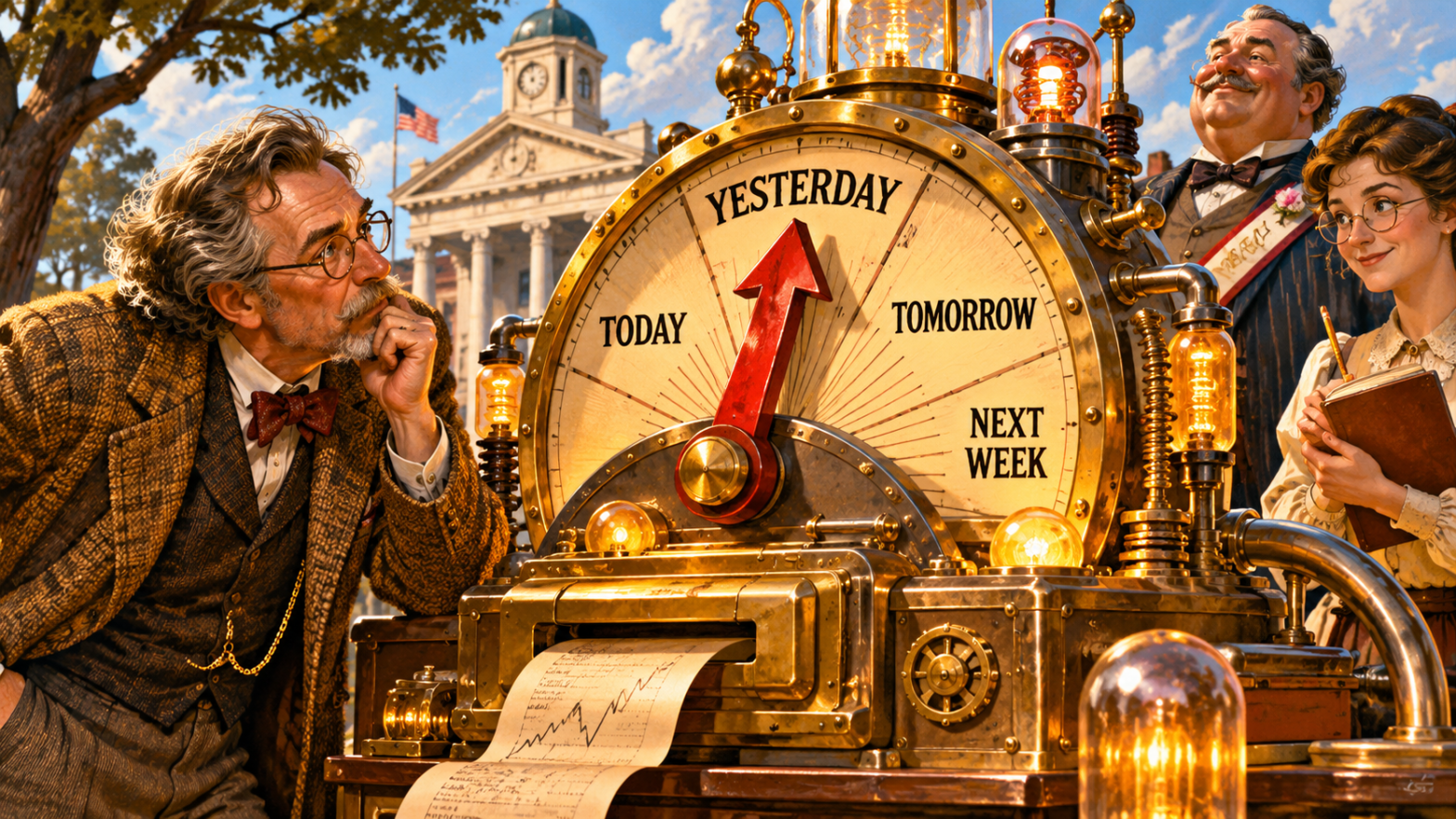
It stood on the courthouse lawn, an elaborate brass contraption with a dial for YESTERDAY, TODAY, TOMORROW, and NEXT WEEK. Its pointer was fixed firmly on YESTERDAY.
“Perfect,” said the mayor. “We can finally stop being surprised.”
Miss Bellweather, who had been assigned to record the results, asked what the machine predicted.
“Yesterday,” said the inventor.
“Yesterday what?”
“Yesterday happened.”
The mayor applauded. “A hundred percent accuracy.”
I asked the inventor to turn the dial to TOMORROW. He explained that the gears had been sealed at the factory to prevent uncertainty from entering the mechanism.
“Then it isn’t predicting,” I said. “It’s remembering.”
“Memory is a kind of prediction with excellent historical performance,” he replied.
I requested a test. We wrote down a forecast for Wednesday’s noon temperature, sealed it in an envelope, and agreed to compare it with an independently read thermometer at noon the next day. The inventor objected to the envelope, the thermometer, Wednesday, and the possibility of a difference.
The mayor suggested we simply declare the machine correct in advance.
Miss Bellweather wrote that suggestion in her notebook under PROCEDURES TO AVOID.
A small crowd gathered. One gentleman asked whether the machine could predict the price of eggs. Another asked whether it could predict the council’s next decision. The machine hummed, clicked, and printed a strip of paper: YESTERDAY, THE COUNCIL WAS CONFIDENT.
“Accurate again,” said the mayor.
“But useless for tomorrow,” said Miss Bellweather.
The inventor leaned over the mechanism. “We could add a second pointer.”
“Would it move?” I asked.
“Only after we knew the answer.”
“Then you would have two memories.”
The mayor was growing impatient. “Doctor, surely a reliable prediction is better than an uncertain one.”
“Only if it predicts something,” I said. “A forecast must risk being wrong before it can teach us whether it is useful.”
Miss Bellweather placed the sealed envelope in the courthouse safe. The inventor went home to redesign his machine. The mayor commissioned a commemorative plaque before any results were available.
The next afternoon, we would have a temperature, a written prediction, and a comparison. Until then, we had a promise and a very expensive clock pointing backward.
I left the square with a note for my log: certainty about yesterday is not evidence about tomorrow. The future has the irritating habit of arriving without asking whether we have already congratulated ourselves.


One thought on “Everyday, with Dr. Elias Locke — The Department of Predictions”