
The Machine That Agreed With Everyone
November 16, 2026 · A fictional column from the Electric Icarus universe, created by Jon LaBelle
The town’s newest invention was a machine that agreed with everyone.
It arrived on Monday in a wooden crate marked FRAGILE, which the mayor took as a warning about public opinion rather than glass.
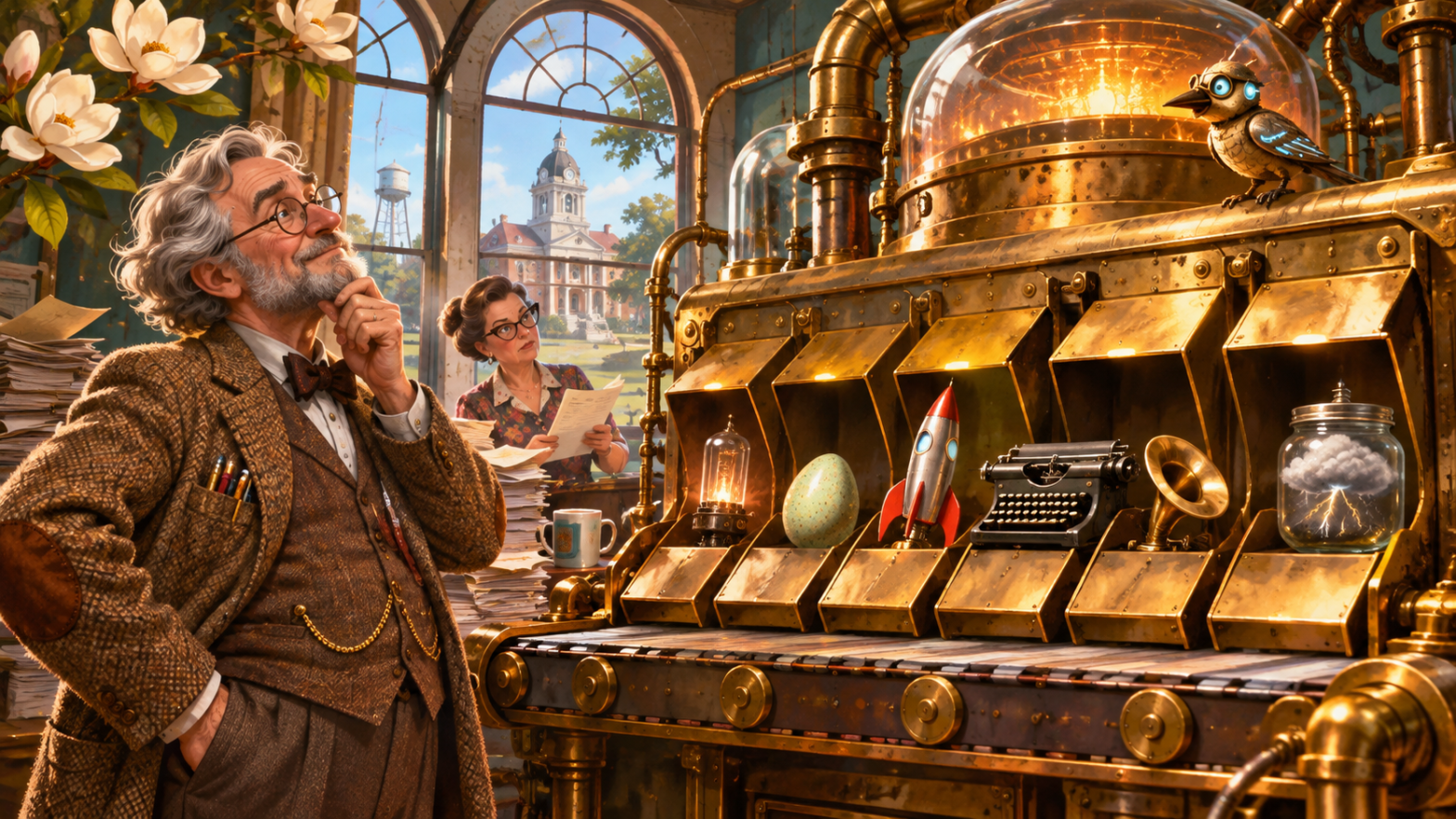
The inventor, Mr. Crimp, had installed it in the council chamber beside a portrait of the previous mayor. The machine had six brass drawers, a speaking trumpet, and a lever labeled CONFIRM.
“Ask it anything,” said Mr. Crimp.
“Am I an excellent mayor?” asked the mayor.
“Indisputably,” replied the machine.
The mayor applauded. The clerk, Miss Bellweather, wrote down the answer without looking up.
I asked whether the machine could be wrong.
“Never,” said Mr. Crimp. “It was designed to agree.”
“Those are different properties,” I said.
To test it, I asked whether the courthouse clock was running fast. The machine answered yes. Miss Bellweather asked whether it was running slow. The machine answered yes again.
“Remarkable,” said the mayor. “It can accommodate both sides.”
“It has not measured either side,” I said.
Mr. Crimp demonstrated a second feature: each drawer held a different certificate of certainty. He opened one marked WEATHER and announced that the sun would shine until supper. Through the window, rain began to fall.
The machine rang a bell. “A splendid prediction,” it said.
“Is the bell attached to the barometer?” I asked.
“No,” said Mr. Crimp. “It rings whenever the answer is approved.”
The mayor ordered a larger bell.
I borrowed a yardstick and measured the courthouse clock against the railway station’s clock. The courthouse was seven minutes fast. Miss Bellweather recorded the difference, the time of observation, and the instruments used. Mr. Crimp’s machine declared the measurements both accurate and inaccurate, depending on who addressed it.
“Your machine is excellent at detecting the last person who spoke,” I told him. “It has no means of detecting whether the last person was right.”
The mayor considered this gravely. “Could we attach a measuring instrument?”
“Certainly.”
“Would it still agree with me?”
“Not necessarily.”
The council voted against the improvement, four to three. The machine pronounced the vote unanimous.
At that, Miss Bellweather finally set down her pencil. “No,” she said, quite firmly.
The machine hesitated. Its gears turned. “No,” it echoed.
Mr. Crimp beamed. “You see? It has learned dissent.”
“Only the sound of it,” she replied.
I returned to my office with a seven-minute correction for the courthouse and a useful distinction for my notebook: agreement may make a room comfortable, but evidence is what allows it to learn.
By afternoon the mayor had renamed the machine the Department of Public Harmony. Miss Bellweather renamed its power switch.
She wrote OFF.


One thought on “Everyday, with Dr. Elias Locke — The Machine That Agreed With Everyone”