
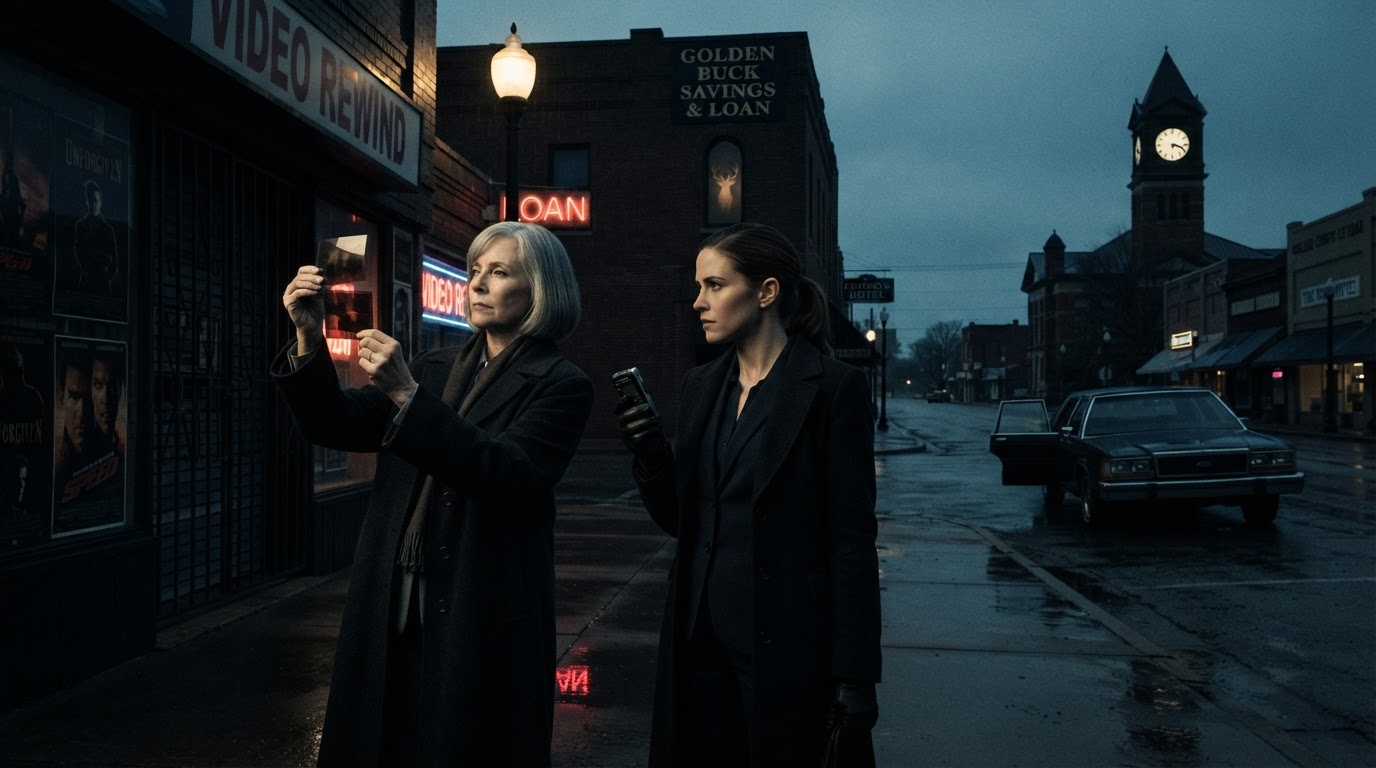
By Weston Cade · Neon Grit · Electric Icarus Publishing · Hosted by Jon LaBelle
THE HOST: OPENING
Ah, hello there. Apparently we have a guest! Well, welcome to Neon Theater. I’m the Host, Jon LaBelle.
Orison, Oklahoma, has learned a curious lesson: a debt can disappear without anybody forgiving it, a signature can be copied without anybody signing, and a witness can be named without anybody asking what she saw. June Ransom has found a woman in an old photograph and a new instruction on her tablet. First witness located. Second witness required. Tonight, in Golden Buck Cult, Episode Four: The Second Witness, we shall discover why certain people are so eager to put another name on a page. Please keep your hands inside the record at all times. The record, regrettably, has no such obligation.
The Woman in the Window
June Ransom had slept three hours in a motel whose complimentary coffee came with the assurance that it had once been near a bean.
She woke to a knock, but nobody stood outside. On the floor, beneath her door, lay a white envelope with her room number written in blue pencil.
Inside was a photographic negative.
It showed the seven men in front of the old First Community Bank, but not the picture Evelyn Rusk had given her. The angle was lower. One man had turned his face away. The second coffee can rested near the bank door, not beneath anybody’s hand. Behind the men, in a window dark enough to behave like a mirror, was the figure of a woman holding a camera.
June took the negative to the bathroom and held it against the fluorescent light. The woman in the reflection wore a light coat. A ribbon hung from her camera, and something square caught the light at her throat.
There were two other things June noticed. The woman was looking away from the men, toward the bank door. And the glass reflected a second person standing behind her.
Only a sleeve was visible.
June photographed the negative with her tablet. The image saved. A notice appeared over it before she could open the file.
WITNESS REVIEW IN PROGRESS.
The notice vanished. The photograph remained.
June turned off the tablet, put the negative in her wallet, and called Deputy Haskell at the courthouse.
“Do you know who photographed the bank dedication?” she asked.
“Which dedication?”
“The one everybody in town keeps pretending was a picnic.”
There was a pause.
“Miss Ransom, do you know what time it is?”
“Early.”
“That’s a kind description.”
“Who kept the town newspaper’s negatives?”
“The paper shut down eight years ago. Mrs. Doss used to run the darkroom. If she’s still taking visitors, you’ll find her at the portrait studio on Grant.”
“Is she reliable?”
“She photographed my high-school graduation. Nobody has ever made me look less reliable.”
June thanked him.
When she opened the motel door, the parking lot was empty except for her car and a black sedan with its engine running. The sedan’s driver did not look up. That was the first indication that he was watching her.
She walked toward the car.
It pulled out before she reached the second parking space.
The Money That Stayed
At First Community Bank, Ruth discovered that the money hadn’t vanished after all.
Not the fourteen million dollars. That was still missing from the place Gerald Pike believed money ought to be. But a separate sum had remained untouched in a ledger the bank’s newer system called inactive.
Twenty-three dollars and seventeen cents.
The entry was dated 1998, the same year the courthouse clock stopped.
ACCOUNT TYPE: ESCROW / PHYSICAL DELIVERY
SETTLEMENT AUTHORITY: OPEN
WITNESS EXPENSE: $23.17
BENEFICIARY: UNASSIGNED
Gerald leaned over her shoulder.
“That’s the amount we’re hunting?”
“That’s an expense entry, Gerald.”
“Twenty-three dollars?”
“And seventeen cents.”
“Could’ve bought lunch.”
“In 1998, maybe two lunches.”
Ruth printed the entry. She had become fond of paper since the terminal started writing things she had not asked it to say. Paper could be altered, forged, burned, or misplaced, but at least it did not usually announce a personal interest in the outcome.
She looked closer. The account had no ordinary depositor. It had a custodian code and two witness fields. One field carried an old, nearly illegible signature. The other was blank.
Ruth had worked at the bank for fourteen years. She knew the difference between a debt, a deposit, and a charge the institution had attached to an unfortunate customer because an algorithm considered inconvenience a revenue stream.
This was none of those.
She called June.
“Somebody paid to have something delivered,” Ruth said. “The account has been waiting for a receipt ever since.”
“Delivered where?”
“To the bank. Or from it. The document doesn’t say.”
“Who signed?”
“The name looks like Doss. Maybe Ross.”
June closed her eyes.
“What about the second witness?”
Ruth looked at the empty field.
“The system says pending.”
“Does it say who?”
A new line appeared on the monitor.
CANDIDATE IDENTIFIED.
Ruth held her breath until the cursor moved away. No name followed.
“Not yet,” she said.
The printer began feeding a page. Ruth removed it before Gerald could touch anything. Beneath the bank seal was a line that had not been in the original entry.
A WITNESS CERTIFIES DELIVERY, NOT OWNERSHIP.
She read it twice. Then she did something the computers could not do for her.
She wrote down the time she had received it.
Mrs. Doss Still Develops
The portrait studio on Grant Street was squeezed between a locksmith and a store that sold wedding dresses to people willing to believe in a future. Its sign read DOSS PHOTOGRAPHY in flaking letters. Beneath it, someone had added in marker: NO DIGITAL PASSPORT PHOTOS. PLEASE STOP ASKING.
June opened the door. A bell announced her with the enthusiasm of a small alarm.
A woman in her late sixties looked up from a box of negatives. She had silver hair pinned behind one ear, a white shirt stained with chemicals, and a pair of spectacles held together by the sort of tape usually reserved for plumbing emergencies.
“Portraits?” she asked.
“Records.”
“Those cost more.”
June showed her the negative.
The woman’s hand stopped above the box.
“Where did you get that?”
“Somebody left it at my motel.”
“That isn’t an answer.”
“It’s the one I’ve got.”
Mrs. Doss set down her spectacles.
“Harold Rusk told me these were gone.”
“You know Harold?”
“Knew. He paid for an entire roll and insisted I destroy the leftovers. I kept one envelope because I didn’t trust people who pay to have negatives destroyed.”
“Were you there?”
“I took the photograph.”
June pointed to the reflection.
“Then who is this woman?”
“Me.”
June looked up. The coat in the photograph was pale, nearly white. The person in the glass seemed too young, but twenty-eight years was plenty of time to change the angle of a face.
“You’re the first witness.”
Mrs. Doss gave a short laugh.
“No. I’m the photographer. Those are very different jobs.”
“What were you photographing?”
“An envelope. Seven men wanted a picture of themselves handing a sealed envelope to the bank manager. It was supposed to prove delivery.”
“Of what?”
“Didn’t see inside. I don’t pretend cameras can see through paper.”
“Who stood beside you?”
Mrs. Doss frowned.
“Beside me?”
“There’s another person in the glass.”
She raised the negative to the window. The light went through it and showed a pale cuff behind her shoulder.
“That’s not somebody beside me,” she said.
“What is it?”
“That’s a person standing inside the bank.”
June studied the negative again. A reflection could put two people next to each other who had stood on opposite sides of the glass. The sleeve was too sharply defined to be beside the photographer.
“Do you know who it was?”
“No. I was outside. They wouldn’t let me in.”
“And the envelope?”
“Mr. Rusk went through the door with it. Came out without it. They said the second picture wasn’t needed.”
“What second picture?”
Mrs. Doss retrieved a metal film canister from a drawer under the counter. Its label bore the date and the words DELIVERY — SIDE B. Inside was a narrow strip of negatives rolled in tissue paper.
“Someone brought these back a week later,” she said. “Wanted them printed. Then a man came through and paid cash for the whole job. The prints disappeared. The negatives didn’t.”
She gave June the canister, but held onto its lid.
“Before you take it, I want to know who you’re with.”
“State banking review.”
“Then you’re here about the people who owe money.”
“People who used to owe money.”
Mrs. Doss shook her head.
“People who thought they could stop owing by giving something away.”
She released the lid.
“That’s a different photograph.”
An Order in Pieces
The older man in the tan cowboy hat had been standing in the back of the video rental store for twenty minutes, watching his technician make excuses to six monitors.
The screens showed the same town from six different accounts. One declared the settlement complete. One denied it had happened. One recorded twenty-three dollars and seventeen cents held in a dormant escrow. Another displayed a list of properties beside the words COLLECTION CANDIDATES.
The fifth showed a photograph of Nora Whitcomb speaking on the courthouse steps.
The sixth was black.
“Who’s running the black one?” the older man asked.
“I don’t know.”
“Useful answer. Is it honest?”
“Yes.”
The technician pointed to an authorization key that had appeared during the night. Its symbol was a golden stag, but the antlers did not connect at the top.
“It’s not our mark,” he said.
“Neither was the one at the bank.”
“The system treats both as valid.”
“The system treats a dead man as the owner of a hardware store. We should stop using it as a moral authority.”
A radio on the shelf crackled.
“The Stag is on the line.”
The older man picked up.
“You asked for the original instruction,” he said.
“Did you find it?”
“Found an expense account. Twenty-three seventeen. Somebody paid to have the first agreement witnessed.”
“Which witness?”
“The one the bank doesn’t name.”
“Then we still don’t know who accepted the document.”
The older man looked at the black screen.
“There’s another problem. A collection group is using our authorization code.”
“Whose group?”
“Claims Unit Seven. I thought you shut it down years ago.”
Silence.
Then the Stag said, “I shut down the office. Not the people who wanted it open.”
“They’re targeting property transfers.”
“I know.”
“They have the clerk’s name.”
“Names are cheap,” the Stag said. “Authority costs more.”
“Should we stop them?”
“You should’ve stopped them before they were allowed to call it our work.”
The line went dead.
The technician waited.
“What did he say?”
The older man closed his eyes.
“He said we aren’t the only people who read the books.”
On the black monitor, pale letters appeared.
SECOND WITNESS SELECTION ACTIVE.
The Bill for Standing There
At noon, a survey truck returned to Mabel Price’s hardware store, but this time the men carried no measuring equipment.
They carried a portable sign.
PROPERTY ACCESS UNDER ADMINISTRATIVE REVIEW.
Mabel watched them plant it on the sidewalk.
“You can take that home,” she told them.
“Ma’am, we’ve been instructed—”
“Then you’ve learned to read. Congratulations.”
One man glanced at the other. He had been here twice before, and the first visit hadn’t improved his relationship with the woman who owned the dock.
“It’s just a notice.”
“So is a rattlesnake in a mailbox, if you write NOTICE on it.”
Owen Bell arrived in his own car, breathing hard. He had abandoned his tie and looked as if he’d discovered there were places a person could go without representing somebody else’s interests.
“They want you to sign the acknowledgment,” he told Mabel.
“Who does?”
“Claims Unit Seven.”
“That a company?”
“I think it was. They keep using a registration number that comes back inactive.”
“Sounds expensive.”
Owen lifted a folder. Inside were blank forms, one bearing Mabel’s name in typed capitals.
The requested action was not a transfer. It was an attestation that an authorized public representative had presented her a settlement notice. Nothing on the form said she agreed to the settlement. A footnote said her signature would not establish the beneficiary.
“You want me to sign that?” she asked.
“No,” Owen said. “I want you to see what they’re asking.”
Mabel read it. For the first time since the accounts went to zero, she seemed less angry than tired.
“They want a receipt for showing me a threat.”
“That’s one way to put it.”
“What’s the other way?”
Owen hesitated.
“Proof of service.”
“You mean they can prove they told me to be afraid.”
He didn’t correct her.
Mabel took out her phone and photographed the notice. Then she walked to the sign, read every word into the phone’s recorder, and asked each man his name. Neither answered.
“That’s all right,” she said. “I’ve got your faces.”
The men loaded the sign back into the truck. They had no order authorizing them to keep it on the sidewalk. Mabel had no proof they wouldn’t return.
When they left, Owen remained.
“Why’d you come here?” she asked.
“Because they called me to tell me you’d refused to sign.”
“I hadn’t seen the paper yet.”
“I know.”
He showed her the message on his phone.
SECOND WITNESS REFUSED. ESCALATE.
Mabel looked at the time stamp. It was forty minutes before Owen had arrived.
“Somebody’s in a hurry,” she said.
“Somebody’s writing tomorrow before we get to it.”
Two Pictures, One Door
June met Nora Whitcomb and Ruth in the courthouse records office, where no printer had made an unauthorized suggestion for almost six hours.
“That’s a new county record,” Nora said, when she heard the news.
June placed the two negatives on a light box borrowed from Mrs. Doss. The first showed the seven men outside the bank. The second showed the door itself, taken from inside.
In the second picture, Harold Rusk stood before a bank manager holding a sealed envelope. An unseen photographer had framed the shot through the office doorway. On the back wall hung a calendar for a month in 1998. At the counter, a person in a gray coat was signing something. Only her hand and the edge of her sleeve were visible.
Beneath the counter was a brass plate, almost covered by the envelope.
CUSTODIAL RECEIPT — NOT TITLE.
June turned to Ruth.
“Do you have a copy of that receipt?”
Ruth put the twenty-three-dollar expense entry on the table.
“Only the part that paid for it.”
Nora studied both photographs. “Who took the second one?”
“Mrs. Doss says she didn’t. Someone handed her the negatives a week later.”
“That means whoever took it was inside.”
“Or had permission to stand in the doorway.”
Nora held the old negative to the window.
“Look at the reflection on the brass.”
A narrow shape ran across the plate. It was not a crack. It was the image of a small hand-held mirror.
June leaned closer.
The woman in gray had not been signing the envelope. She was signing a separate receipt. The photographer had used a mirror to capture the signature while staying behind the person holding it.
The image was reversed. June rotated the scanned copy and enlarged it.
Only the first name was clear.
MARIAN.
“Marian who?” Ruth asked.
Nora opened an old municipal personnel directory. She found two Marians. One had worked in parks. The other had been the bank’s temporary document custodian before the bank replaced the position with a software vendor.
“Marian Kells,” Nora read.
June thought of the woman in a gray coat who had stood beneath the courthouse clock the night before.
“Is she still in town?”
Nora ran her finger down the directory. The forwarding address was a post office box in the next county. The last notation beside it had been made eleven years ago.
FILE CLOSED — NO CONTACT REQUESTED.
Ruth pointed at the line beneath it.
A second notation, in a different hand, had been entered four days earlier.
FILE REOPENED — WITNESS LOCATED.
Nobody spoke.
Then June’s tablet buzzed. Once.
SECOND WITNESS REQUIRED.
She turned the screen toward the others.
“They’ve got the wrong person,” Nora said.
“Maybe,” June replied. “Or they’ve got exactly who they meant to frighten.”
The Second Witness
The woman in the gray coat waited outside the abandoned video rental store, standing beneath a faded sign that still promised two movies for two dollars.
She was older than June had expected, with white hair at the temples and a leather handbag clutched in both hands. She looked like someone waiting for a bus that had stopped running years ago.
“I was told you’d come,” she said.
“Who told you?” June asked.
“A man who could afford to keep his name.”
“Marian Kells?”
“That was the name on the payroll.”
“Did you sign the bank receipt in 1998?”
Marian looked at the empty windows of the old store.
“I signed that I saw an envelope placed in a bank’s custody. I didn’t know what was in it. I didn’t guarantee it was honest. That’s why I wrote the restriction on the receipt.”
“Custodial receipt. Not title.”
Marian nodded.
“The bank wanted the envelope. The men wanted proof the bank had taken it. And somebody else wanted a signature they could use after all of us were gone.”
“Who?”
“I was the first witness. I don’t know who chose the second.”
“Why do they need two?”
“Because the first witness can say what was delivered. The second can say what the recipient did with it.”
June felt something settle into place.
“A chain of custody.”
“That’s what the document called it. They’re trying to make a chain of custody into a chain of ownership.”
“Did the bank open the envelope?”
Marian stared at her.
“Yes.”
“What was inside?”
“Copies of the town’s obligations. Not the money. Not the deeds. Promises. What the town owed itself to keep operating. Roads, water, access, upkeep. Somebody thought if they could move the promises into the bank, they’d have a right to collect on anything built to fulfill them.”
“That’s not how property works.”
“Not unless enough people act as though it does.”
June looked toward the video store’s dark windows.
“Who was the second witness supposed to be?”
“The bank manager was meant to assign one after the envelope was opened.”
“And did he?”
Marian shook her head.
“He died before signing.”
“And now they’re trying to appoint one.”
“Not appoint. Find. A new person who can attest to what survived in the bank.”
June thought of Ruth, with her printer records, her time stamps, and her stubborn refusal to erase a screen because somebody told her the balance looked better.
“Ruth,” she said.
Marian’s face changed.
“Who?”
“The teller. She saw the new records.”
“That isn’t the same thing as seeing the envelope opened,” Marian said. “Don’t let them tell you it is.”
A car turned onto the street. Its headlights stayed on. The same black sedan June had seen outside her motel rolled to a stop beyond the curb.
Marian took June by the wrist.
“If somebody asks you whether you witnessed the claim,” she said, “tell them what you saw, nothing else. No more. No less.”
June looked at the car.
The rear door opened.
A man in a charcoal jacket stepped out, holding a document case.
“Mrs. Kells,” he said pleasantly. “We’ve been looking for you.”
Marian released June’s wrist and turned toward him.
“You already found me,” she said. “That’s been the trouble.”
The man set his case on the hood and opened it.
Inside were two papers. The first was a copy of Marian’s original receipt, with her signature intact. The second was a new form.
The space for the first witness had been completed.
The second remained blank.
The man handed June a pen.
“Ms. Ransom,” he said, “we only need you to acknowledge that this meeting occurred.”
June did not take it.
“I’m a state examiner. I don’t witness private claims for the people I’m investigating.”
“Then please state your refusal for the record.”
He took out a phone and began recording.
June reached into her coat, removed her own phone, and pressed record as well.
“My name is June Ransom,” she said. “I am present. I have seen a form presented by a man who has not identified the authority under which he acts. I have not inspected an original agreement. I do not attest to any transfer of ownership, any assignment of beneficiary, or any lawful claim on the people of Orison.”
She held the phone steady.
“Now you can keep your copy of what happened. I’ll keep mine.”
The man’s smile went away.
From the video store came a sudden burst of electronic sound: a printer running, a telephone ringing, and someone inside shouting to shut the feed down.
The man in charcoal closed his case.
“You’ve made this difficult,” he said.
“No,” June replied. “I’ve made it legible.”
He returned to the sedan. It drove off with the headlights still on.
Marian watched until it turned the corner.
“They’ll say that recording makes you the second witness,” she said.
“Then they’ll have to play the whole recording.”
“Will they?”
June looked at the dark store.
“Only if somebody keeps a copy they can’t reach.”
The Copy They Didn’t Receive
That evening, Nora made four copies of June’s recorded statement.
One went in the county’s public record of the attempted correction. One went to Ruth at the bank. One to Mabel, who put it in the safe where she kept the cash receipts and the instructions for a furnace nobody had successfully operated since 2004.
The fourth went to Evelyn Rusk.
Evelyn listened to the recording in her kitchen. She kept the old coffee can beside her and the two photographs in front of her. When June finished speaking, Evelyn looked at Marian’s name on the receipt.
“Harold told me the witness would come back,” she said.
June, standing by the door, turned.
“He said that?”
“He said whoever agreed to carry the record would come back when the bill was due.”
“Did he mean Marian?”
“I thought so.”
“And now?”
Evelyn opened the coffee can and shook it. It was empty. Then she turned it upside down and tapped the bottom.
A narrow cardboard disk came loose from beneath the metal seam.
There was writing on its inside face. Not a signature. Not a name.
A number.
000-000-002.
June stared at it. The settlement reference at the bank had been 000-000-001.
Evelyn read the number aloud, then looked up.
“Harold always said there were two cans,” she whispered. “I thought he meant two cans of coins.”
June thought of the second coffee can in the photograph. The one standing near the bank door. The one nobody had been willing to identify.
Her tablet lit up on the table.
The usual field was gone. No more SECOND WITNESS REQUIRED.
In its place were three lines.
SECOND WITNESS: DISPUTED.
SECOND DELIVERY: UNLOCATED.
HUNT AUTHORIZED.
June left the device where it lay.
Beyond Orison, a pickup truck rolled along the highway, headlights passing over a faded billboard for the First Community Bank.
The Stag was driving. On the passenger seat lay a gold coin with the number seven stamped on its reverse.
The radio hissed.
“Second witness refused.”
“Good,” the Stag said.
“Claims Unit Seven is asking for the next authorization.”
“Then give them the wrong one.”
“What authorization is that?”
He glanced at the black shape of the hills ahead.
“Tell them the second delivery has already been collected.”
“Has it?”
The Stag turned the coin once between two fingers, then put it in the glove compartment.
“No,” he said. “But I’d like to see who believes us.”
Far behind him, the courthouse clock remained at 4:17.
For the first time all week, someone in Orison remembered to ask why it had stopped there.
THE HOST: IN CLOSING
That concludes Golden Buck Cult, Episode Four: The Second Witness. A photograph has yielded a name, a receipt has exposed a very old misunderstanding, and June Ransom has discovered that saying exactly what you saw can be a dangerous occupation when somebody profits from saying you witnessed more. One envelope has been found. Another is still missing. I’m Jon LaBelle, your Host at Neon Theater. Should a stranger ask you to sign for a delivery you never received, do make certain the package is not your town. Goodnight.


One thought on “Golden Buck Cult — Episode 004: The Second Witness”