
Neon Theater · Myth-Tech Saturday · November 14, 2026
The broadcast cuts away. The pursuit never stops.
THE RECAP
At dawn the networks called the interruption a promotional experiment. They showed footage of an empty street and said the contestants had been safely relocated. They showed Derrick Vox smiling. They did not show the audience behind him, or the camera in the street that was still recording after the credits.
By noon, the official number of missing persons was zero. By evening, everyone who had watched the program remembered a different ending.
I — THE THREE-SECOND RULE
Tad Phelps unplugged the television at 6:14 in the morning. At 6:14 and three seconds, it turned itself on.
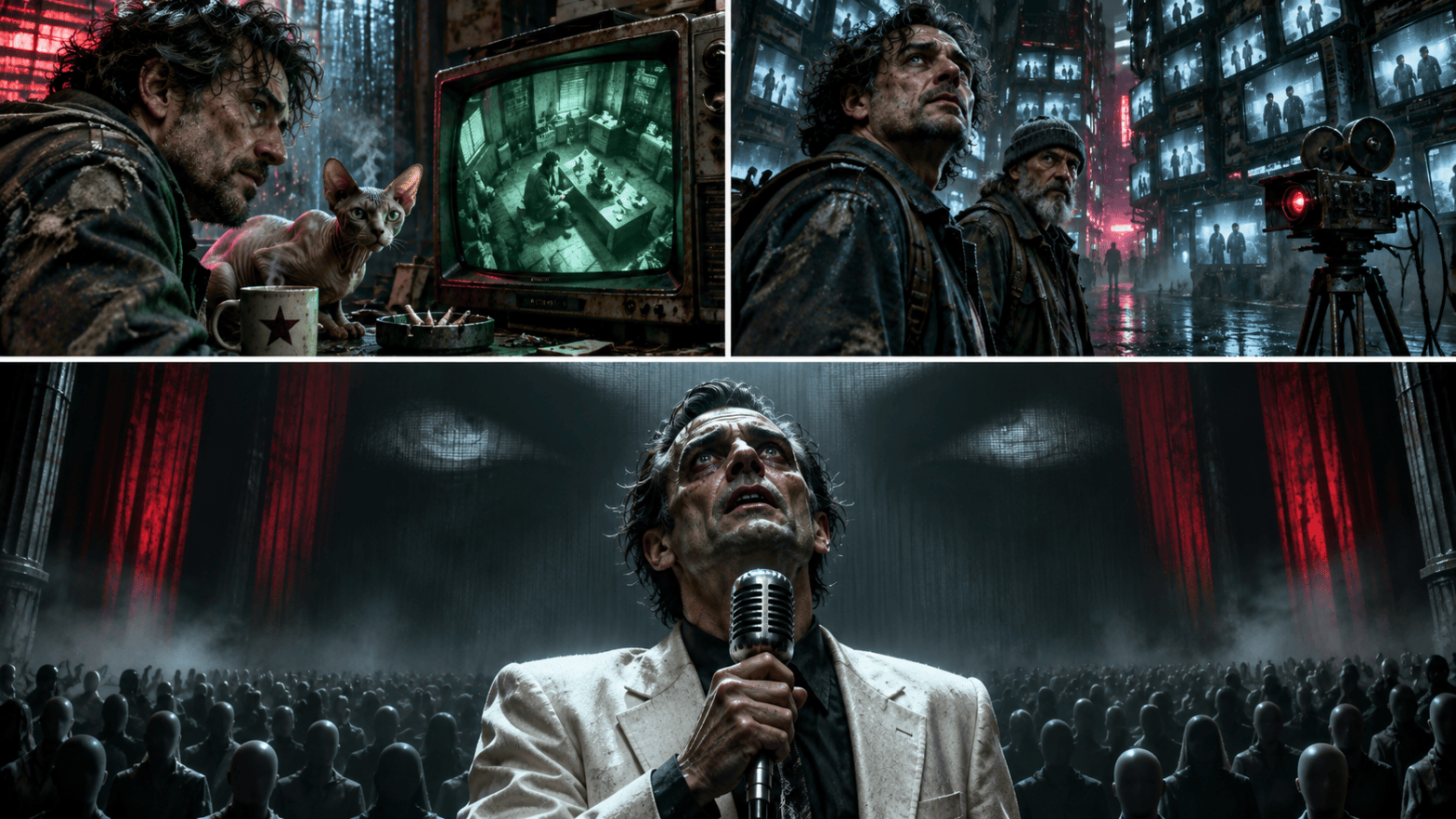
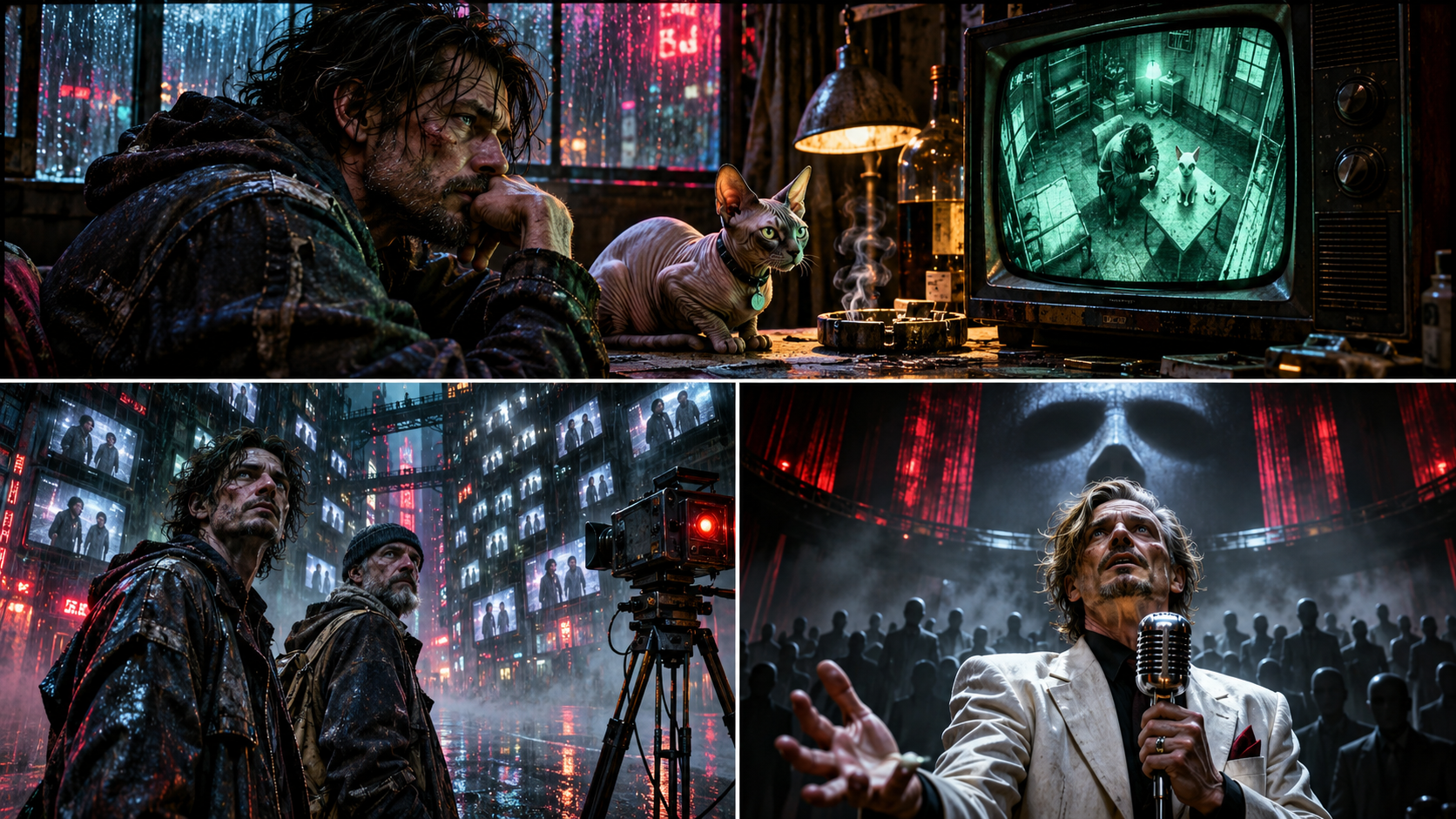
Boots, his hairless cat, sat on the kitchen counter and watched the screen without blinking. Tad had placed the remote in a saucepan, wrapped the saucepan in a towel, and put it in the refrigerator. The little red LIVE light still glowed through the refrigerator door.
The television showed his living room from above. Three seconds later, Tad watched himself carry the power cord across the floor. But the Tad on the screen did not stop at the wall socket. He turned and looked directly into the unseen camera.
The real Tad remained still.
“Boots,” he said, “we are not doing this today.”
On the screen, Boots jumped down from the counter. In the room, Boots stayed where he was.
The broadcast had stopped following him. It was showing him what came next.
Then the television displayed a simple instruction: LEAVE THE DOOR CLOSED UNTIL THE THIRD KNOCK.
Someone knocked twice.
II — THE CITY THAT WATCHED
Milo Venn and Calder Rusk had spent the night beneath a pharmacy awning, taking turns watching the street. Neither had slept. Every window facing them displayed their own exhausted faces, though most of the buildings had no power.
“Maybe we can get out past the perimeter,” Milo said.
Rusk checked the magazine in his pistol. “Perimeter’s for people who want in. This place wants us out where it can see us.”
At the intersection, a city bus sat with its doors open. There were no passengers, only rows of switched-on seatback screens. Every screen showed a different camera angle of Milo and Rusk. One showed them from inside the bus. One showed them from beneath the pavement.
One showed Milo lying dead in the gutter.
He looked away. The image vanished.
Rusk grabbed his arm. “Don’t acknowledge the edits. The thing in the tunnel copied our voices. It can copy what we expect, too.”
Across the street a red recording lamp lit up on an antique camera. Its tripod legs scraped forward over the wet asphalt.
Milo raised a piece of broken glass to the lens. In the reflection, the street behind them was crowded with people.
He lowered the glass. The street was empty.
“Rusk?”
“I saw them.”
“Then they’re real?”
“That’s not what I said.”
III — A MESSAGE FROM THE HUNTER
A figure stood beneath the elevated rail line, half concealed by steam. The man wore a battered coat and carried himself with the practiced stillness of someone who had survived by refusing to be noticed. Rusk recognized the stance before he recognized the face.
The Hunter did not lift his weapon.
“You’ve got a camera following you,” he said.
“We noticed,” Milo answered.
“No. You noticed one camera.”
The Hunter tossed a small paper envelope onto the sidewalk. Inside was a strip of black magnetic tape and a handwritten instruction: PLAY THIS WHERE THE SIGNAL CANNOT REACH.
Rusk looked up. “And where is that?”
The Hunter glanced at the rails overhead. “Somewhere nobody has paid to watch.”
A train passed. Its windows were dark, but every passenger inside turned toward Milo at the same instant. When the final carriage cleared, the Hunter was gone.
The camera remained. It pivoted toward the envelope.
A speaker crackled. “UNLICENSED MATERIAL DETECTED.”
Rusk crushed the envelope in his fist. “Run.”
IV — THE NEW CONTESTANT
The third knock came at Tad’s apartment door.
He did not move. The television displayed the hallway outside: peeling wallpaper, flickering light, a figure standing just beyond the camera’s view.
Then the picture cut to Derrick Vox. The host wore his immaculate white jacket, though there was a dark mark at the shoulder where the hand had touched him.
“Good evening, Mr. Phelps,” Vox said. “We understand you have concerns about your recent viewing experience.”
“It’s morning,” Tad said.
“Not where I am.”
Vox looked down at a card that was blank on both sides. “Tonight’s audience participation opportunity is entirely voluntary.”
The television printed a contract from its ventilation slot. Tad stared at the paper drifting to the floor.
“Then I decline.”
Vox’s smile tightened. “Excellent. Your refusal has been recorded.”
The card in his hand changed. CONTESTANT CONFIRMED.
“That’s not what I said!”
“No,” Vox whispered. “It isn’t.”
Boots sprang from the counter and clawed the paper to shreds. The television picture faltered. For one second, Vox looked relieved.
Then a voice behind him spoke. “THE ANIMAL IS NOT REGISTERED.”
Boots hissed at the screen. The broadcast cut to black.
V — THE BLIND SPOT
Rusk found the place by accident: a shuttered repair shop with no working monitors, no reflective glass and a roof of thick leaded panels left over from an old imaging business. Their pursuer stopped at the threshold. Its red lamp blinked twice and went dark.
Milo took the magnetic tape from the envelope. There was an obsolete player beneath the counter, its batteries corroded, its power cable missing. Rusk rewired it to a hand-cranked emergency radio. When Milo turned the handle, a voice emerged beneath the hiss.
It was Rae Morrow.
“If you’re hearing this, the audience hasn’t reached the blind spots yet. Kent and I mapped seven of them before the cameras changed the streets. The broadcast can show you anything it can predict. It cannot show what nobody has decided to do.”
A second voice interrupted—Kent, breathing hard. “Don’t trust the exits. They keep putting the exits in the same place.”
Then another sound: a childlike voice asking whether anyone had seen the fog-eyed survivor.
Rae returned. “The people behind the feed aren’t all watching. Some are trapped in it. If you want to interrupt the program, don’t destroy the cameras. Give the people inside them somewhere else to look.”
The tape snapped. The player kept turning.
Milo stared at Rusk. “What does that even mean?”
Outside, the camera’s red light came on again.
Rusk stood. “Means the shop isn’t a blind spot anymore.”
VI — THE PRODUCER
Derrick Vox stood beneath lights that gave no heat. Beyond the stage, an audience of silhouettes filled the dark to its horizon. He had stopped trying to count them. Some sat backward in their chairs. Some occupied several chairs at once. None applauded until he was frightened enough to ask.
A voice came from the darkness. “YOU LOST CONTROL OF A VIEWER.”
“It was a cat,” Vox replied.
“THE CAT WAS NOT IN THE CONTRACT.”
“Neither was I.”
The silence afterward was so complete that Vox heard his own heartbeat coming from the microphone a moment before he felt it.
A figure moved between the audience rows. It was too tall, its outline made from overlapping shadows and white television static.
“YOU WILL INTRODUCE THE NEXT ROUND.”
Vox looked toward a monitor suspended above the stage. It showed Tad, Boots, Milo and Rusk in four separate frames. A fifth frame remained empty.
“Who goes there?” he asked.
“THE WINNER.”
Vox swallowed. He had spent years pretending the game had rules. Now he understood that the rules were being written by whoever was still watching.
The studio countdown began at ten. It reached nine. Then it reached three. It did not move again.
VII — THE UNREGISTERED
Tad carried Boots into the hallway in a laundry basket. The apartment door had opened without his touching it. He had no intention of staying to learn whether that counted as consent.
The corridor was longer than it had been yesterday. Every apartment number read 404. Behind each door, a television played a different version of Tad’s morning: one in which he answered the knocks, one in which he hid, one in which Boots was missing.
Boots jumped from the basket and ran toward the stairwell. Tad followed.
On the landing, the cat stopped before a cracked wall mirror. Its reflection showed a service tunnel and a woman holding a flashlight. The woman wore a jacket with RAE stitched above the pocket.
“Hey!” Tad shouted.
The woman turned in the reflection, though she could not have heard him.
Then she held up a sheet of paper. It bore one sentence: STOP WATCHING THE SCREEN.
Tad looked away.
The stairwell changed. The impossible corridor vanished. He was standing at the building’s ordinary exit with Boots at his feet and sunlight through the glass.
For the first time in a day, nothing nearby had a red recording light.
He reached for the door.
A voice behind him said, “That’s a commercial break, Mr. Phelps. Not freedom.”
VIII — A DIFFERENT KIND OF AUDIENCE
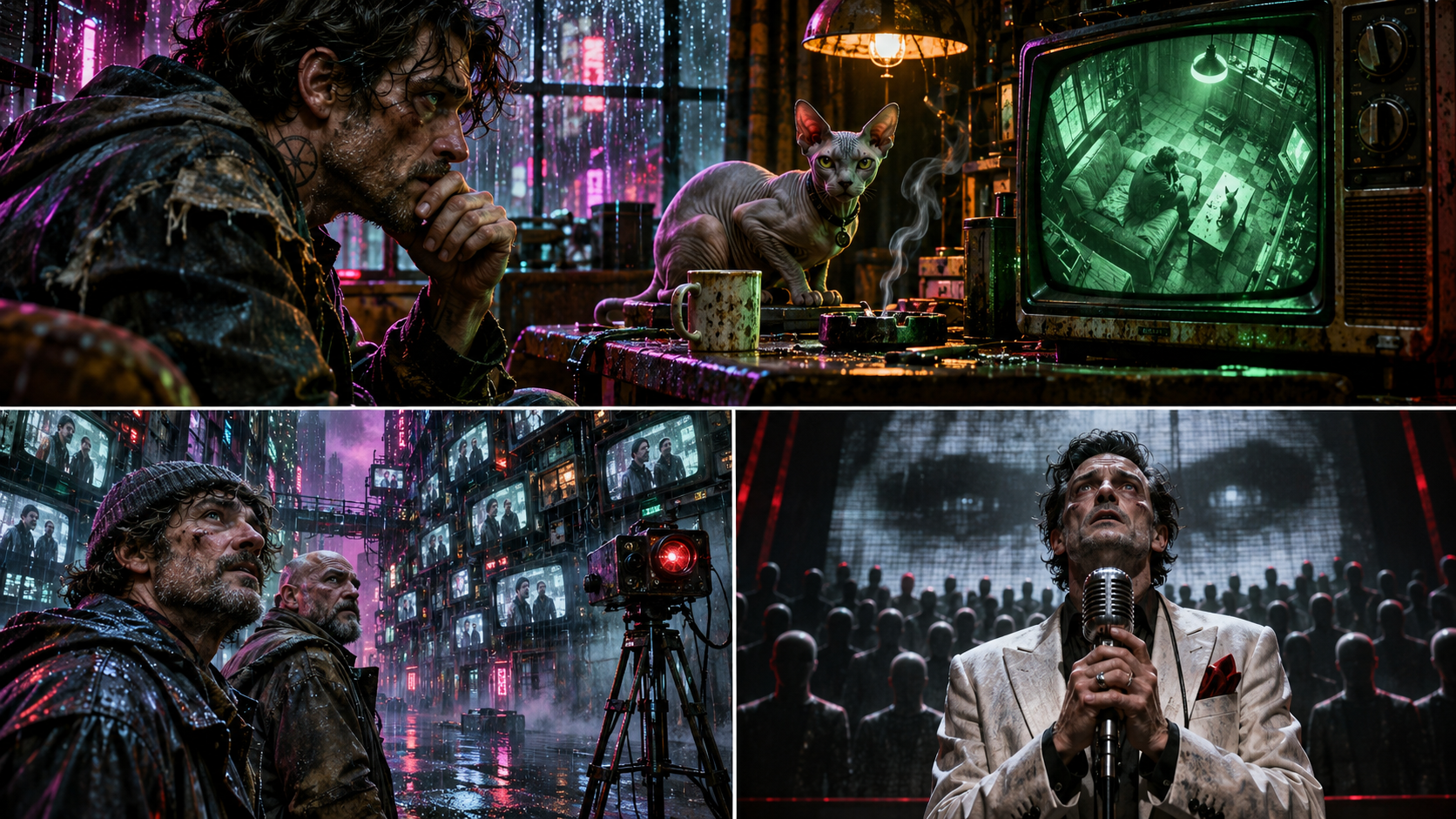
Milo and Rusk burst out of the repair shop into the rain. The camera glided after them. Above the avenue, billboards showed the pair running. A hundred thousand unseen viewers could have been following them through the city.
Milo remembered Rae’s message. The broadcast could predict what it had already persuaded them to do.
“Rusk,” he said, “give me the gun.”
“No.”
“Exactly.”
Milo stopped running. The camera overshot him. Rusk nearly collided with his back.
“Have you lost your mind?”
“Maybe. But you didn’t give me the gun.”
On the billboard overhead, Milo kept running. The screen had not caught up.
He took one step toward the camera. It rolled backward.
“Now what?” Rusk asked.
“Do something it wouldn’t put on television.”
Rusk stared at him. Then, very carefully, he laid the gun on the pavement and raised both hands.
The billboards flickered. Every image showed Rusk firing.
The real Rusk did not.
The camera’s green recording lamp turned red. Somewhere, a crowd began to boo. Beneath the boos came another sound: people shouting directions, calling names, trying to find one another through the signal.
Milo heard a woman cry, “Kent?”
For the first time, the audience sounded human.
IX — THE FIFTH FRAME
On the stage without walls, the empty fifth frame filled with static. Derrick Vox watched the other four images lose synchronization. Tad was standing at a door that was not on the building plans. Boots had vanished from the picture entirely. Milo faced the camera. Rusk stood with empty hands.
The producer’s voice became a hiss. “RESTORE THE PROGRAM.”
Vox looked at the microphone. He had always been told the show required a host. Nobody had ever explained why.
He brought the microphone to his lips.
“Ladies and gentlemen,” he began.
The silhouettes leaned forward.
“For the first time in the history of Survive: Neon Slumlight, we are accepting calls from the audience.”
The producer moved toward him. The stage lights dimmed.
“THAT FEATURE IS NOT AUTHORIZED.”
Vox smiled without being told to. “Neither am I.”
He switched the microphone toward the crowd.
A million voices erupted. Not applause. Names. Addresses. Pleas for help. Questions. An argument about whether the broadcast had ever started.
The fifth frame displayed a street that Milo did not recognize. A lone figure stood beneath a broken neon sign, its eyes filmed white by fog.
The figure looked up.
And the screen went dark.
X — CUT TO BLACK
At 9:17 that evening, every television in the city lost its picture for exactly three seconds.
Milo and Rusk stood beneath a dead billboard. The camera lay on its side, its lens unbroken, its light extinguished. Somewhere beyond the intersection, a person was calling for help. They could not tell whether the voice belonged to the broadcast or to the street.
Tad emerged from his apartment building with Boots tucked inside his jacket. The cat’s ears were forward, listening to something Tad could not hear.
On the stage without walls, Derrick Vox stood alone. The audience seats were empty. The microphone remained warm in his hand.
Then the screens came back.
The networks resumed their scheduled programs. The studio technicians received an automated message assuring them that all participants were safe. The producers announced a record audience and an upcoming special event.
But in a service tunnel beneath the city, a small camera blinked green. Its speaker crackled with a voice nobody recognized.
“ROUND FOUR COMPLETE.”
A pause.
“THE VIEWERS HAVE LEARNED TO ANSWER.”
Another pause, longer this time.
“PREPARING THE HUNTER.”
Far away, beneath an elevated rail line, a man in a battered coat checked his weapon and listened to three knocks coming from the dark.
He did not answer.
He started walking.
END OF EPISODE 004 — THE UNREGISTERED
Next Saturday: Episode 005
The broadcast cuts away. The pursuit never stops.


One thought on “Survive: Neon Slumlight — Episode 004: The Unregistered”