
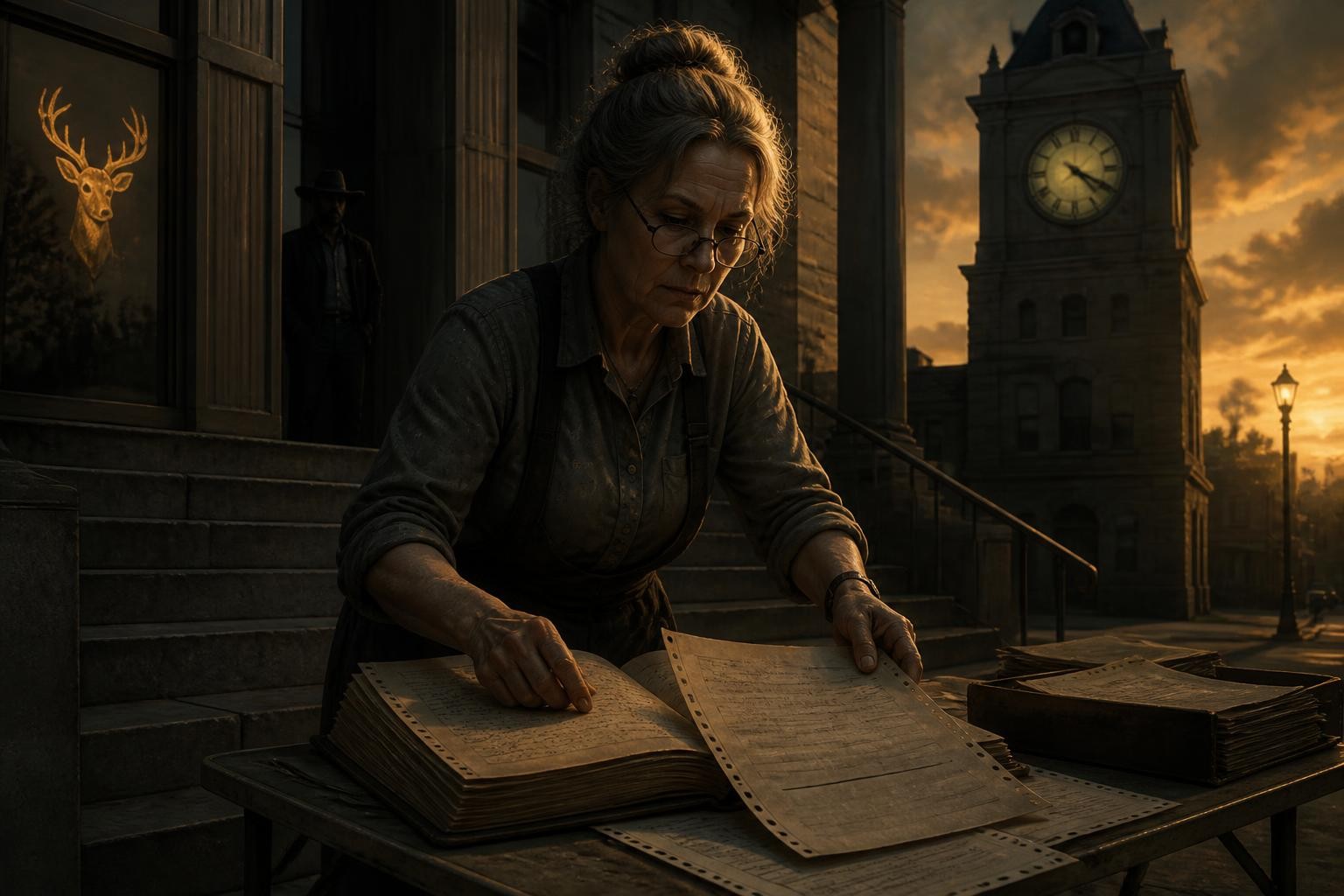
By Weston Cade · Neon Grit · Electric Icarus Publishing · Hosted by Jon LaBelle
THE HOST: OPENING
Ah, hello there. Apparently we have a guest! Well, Welcome to Neon Theater. I’m The Host here Jon LaBelle.
There is a difference between proving that something happened and agreeing that it should have happened. In Orison, Oklahoma, the difference has become rather expensive. The accounts say zero. The deeds say otherwise. A county clerk has refused to certify a transfer with no named recipient, and somebody has taken that refusal personally. Tonight’s Golden Buck Cult is Episode Three: The Seventh Signature. You’ll discover that an empty line on an old document can be more dangerous than a loaded gun. Particularly when somebody has been keeping the pen warm for forty years.
The Notice
The county records office opened at eight, which was early for the county and late for whatever had been working during the night.
Nora Whitcomb found the notice taped to the inside of the glass door.
That was the first problem. The door had been locked when she left. She was certain of this because she had checked it twice, an indulgence that had kept her employed for twenty-seven years and married for considerably fewer.
The second problem was her signature.
It sat at the bottom of the notice in the same black ink she used for land transfers, marriage licenses, and the occasional letter to the county commission explaining that a photocopier was not a budgetary philosophy.
NOTICE OF EMERGENCY RECORD RECONCILIATION
PUBLIC HEARING: 4:17 P.M.
CERTIFYING OFFICER: NORA WHITCOMB
BENEFICIARY: PENDING IDENTIFICATION
Nora took the paper down. The top edge left a crescent of adhesive on the glass.
She had not called a hearing. She had not accepted the correction. And she had never, in twenty-seven years of public service, scheduled anything for four seventeen. County business generally ended at four. At four seventeen the people who still believed in county business were drinking coffee in the diner and arguing about who should have fixed the air conditioner.
Inside, the metal filing cabinets stood where she’d left them. The public copy of yesterday’s disputed transfer remained in its folder, marked in Nora’s own hand: RECEIVED FOR INQUIRY. NOT CERTIFIED.
She had added a third box beneath two printed offers to amend her statement.
NO.
It was still checked.
Nora compared the handwriting on the notice with the handwriting on the folder. The loops matched, the pressure matched, and the last downstroke of the W bent left in the way her left hand always made it bend after too much coffee.
She looked down at her pen.
Then at the notice.
Somebody had copied her well enough to fool a person who knew her. That did not mean they had fooled her.
She carried the notice across the street to the diner, where Mabel Price was eating a biscuit with the unbroken concentration of a woman who intended to be angry on a full stomach.
“Did you schedule a hearing?” Nora asked.
Mabel looked at the page. “I don’t schedule hearings. I attend them until somebody makes me leave.”
“It’s my signature.”
“Did you sign it?”
“No.”
“Then it isn’t your signature.”
Nora sat opposite her.
Mabel took another bite. “You taught me that yesterday.”
Outside, a truck marked MUNICIPAL SURVEY rolled slowly past the hardware store. The two men in reflective vests were back. This time they weren’t measuring the loading dock.
They were measuring the sidewalk.
Seven Men
June Ransom arrived at Evelyn Rusk’s house with two photographs and a government-issued tablet that had spent the night receiving instructions from nobody.
Evelyn let her in without asking to see identification.
“Coffee?”
“Yes, please.”
“Good. Made it strong enough to dissolve an apology.”
The seven men in the first photograph stood in front of the original bank building. Harold Rusk was at the far edge, his smile a little too fixed. They held golden coins for the camera, the stag’s antlers visible even through the fading emulsion.
The second photograph showed them from a different angle. One of the men was half outside the frame. His hand rested on another Folgers can.
Five words marked the back.
ONE PROMISE WAS NEVER MADE.
June placed the photographs side by side.
“Who took them?” she asked.
“Harold said a bank employee.”
“Which employee?”
“He never said. He was very consistent about the things he didn’t say.”
“Did he sign something that day?”
Evelyn stared into her coffee. “He came home with a paper folded small enough to hide in his boot. He burned it before supper.”
“What did it say?”
“He said it was an agreement to keep Orison safe.”
“From what?”
“He didn’t know, or wouldn’t tell me.”
June waited. Evelyn had the look of a woman deciding whether the truth was worth the trouble it would cause.
“He did tell me one thing. Said the other men thought they could make the bank responsible for every promise the town had ever made to itself. Roads. Water. Mortgages. Property. Whatever people needed enough to believe somebody would provide it.”
“That’s not a banking agreement.”
“That’s what I told him. He said it wasn’t banking yet.”
June put down her cup.
Evelyn reached into the coffee can and drew out a paper sleeve stuck beneath the inner rim. June hadn’t noticed it on her previous visit. It was the color of old receipts.
“I found this after you left.”
Inside was a strip of carbon paper. On it, in reverse, were six signatures and a seventh line left empty. The names had mostly transferred. The date had not.
Beneath the blank line sat a phrase stamped in narrow capitals.
WITNESS REQUIRED BEFORE CLAIM.
June examined the strip against the kitchen window.
“Six signatures,” she said.
“Seven men,” Evelyn replied.
“Which one refused?”
Evelyn shook her head. “Harold said nobody refused. Said they all thought somebody else was going to sign last.”
June looked at the seventh line again. It was not labeled with a name.
The space beneath it was labeled Public Witness.
“Evelyn,” she said, “what did your husband call the people who ran this?”
“The Order.”
“The Order of what?”
Evelyn looked at the gold coin lying on the table.
“He called it the Golden Buck. Never told me whether that was a joke.”
The Price of a Name
At First Community Bank, Ruth had developed a way of surviving the past two days: she stopped expecting the computer to agree with itself.
The transaction record still showed fourteen million dollars cleared. The servicing references still pointed to an account without a bank code. But a new field had appeared beneath the unverified beneficiary.
CERTIFICATION STATUS: OPEN
WITNESS: PENDING
Gerald Pike stood behind her with a legal pad.
“Could we just close the system and open it again?” he asked.
“Gerald, it isn’t a refrigerator.”
“I’m aware of that.”
“Then stop asking me to unplug it.”
She printed the screen. The printer produced an ordinary copy. That frightened her more than the blank pages had.
An outside banking system should not know who certified county property records. A property filing shouldn’t decide who owned a bank loan. And neither system should be looking for a witness to something done decades before Ruth was born.
A cursor blinked beneath the word PENDING.
A second line appeared.
AUTHORIZED PUBLIC WITNESS: N. WHITCOMB
Ruth stood up so quickly the chair struck the counter.
Gerald read over her shoulder.
“Nora?”
“Do not say her name into that microphone,” Ruth said.
“What microphone?”
She pointed to the phone beside his elbow. The call indicator was lit. Neither of them had placed a call.
Gerald lifted the receiver. There was no dial tone, only the faint crackle of an open line and a sound like paper being turned.
“Who is this?” he asked.
A woman’s voice answered, pleasantly enough.
“Please confirm the witness will attend the scheduled reconciliation.”
Gerald covered the receiver with his palm.
“Ruth?”
“Hang up.”
“It’s probably some clearing office.”
“Hang up.”
He did. The line indicator stayed lit.
Ruth took the printout, folded it twice, and left the bank by the rear door.
She had grown up in Orison. She knew people who would forgive a lender for a bad rate, a politician for a bad promise, and a husband for missing a birthday if the apology involved enough fried chicken.
She did not know anybody who would forgive a computer for signing their name.
Four Seventeen
By three forty-five, the courthouse had attracted a crowd large enough to suggest either a trial or free barbecue.
There was no barbecue.
Mabel brought her deed. Nora brought her county seal and the disputed documents. June brought a photocopy of Evelyn’s carbon strip. Ruth brought the printout from the bank.
And standing beneath the courthouse clock was Owen Bell, the young servicing representative who had tried to persuade Mabel to surrender her right to question the settlement.
His tie had been loosened. He looked as if he’d spent the morning apologizing to people who hadn’t yet learned what he had done.
“I didn’t call this,” he told June before she could speak.
“Who did?”
“I was told to bring a statement. That’s all.”
“By whom?”
“The person who sent me last time.”
“Name?”
Owen gave her a miserable smile. “If I had one, I’d have used it.”
At four, a man in a charcoal jacket appeared carrying the same leather document case Nora had seen in her office. He walked up the courthouse steps with a confidence that suggested he believed the building belonged to him.
“I appreciate everyone’s cooperation,” he said.
Nora stepped in front of the entrance.
“It’s not a hearing until I post a lawful notice.”
“The notice was posted.”
“Somebody copied my signature onto it.”
“Your signature appears on the document.”
“A picture of a horse appears on a cereal box. Doesn’t mean breakfast can run in the Derby.”
A few people laughed. The man’s face did not change.
“We require acknowledgment of an outstanding correction.”
“Which correction?” June asked.
“The settlement instrument affecting the county’s underlying obligations.”
“To whom?”
“Beneficial ownership is being reconciled.”
“Then there isn’t a beneficiary,” June said.
“There is a beneficiary,” the man replied. “Identification is pending.”
“That isn’t an answer.”
“It’s the one I have.”
He opened his case and produced a sheet already bearing Nora’s name. There was a box for certification, one for acknowledgment, and a third marked Failure to Respond.
Nora read it.
“Either I sign,” she said, “or you write down that I didn’t.”
“It’s a routine administrative record.”
“No. It’s a trap with letterhead.”
He passed her a pen.
She did not take it.
Behind them, the courthouse doors opened. A deputy stepped outside. He was young, with a nameplate reading HASKELL and the careful expression of someone who had volunteered for courthouse duty because nobody usually shot at a courthouse on a weekday.
“Ma’am,” he told Nora, “dispatch says there’s a question about whether you’re authorized to hold records.”
“I am the records custodian.”
“I know that.”
“Then that’s one question answered.”
The deputy’s radio crackled. A voice recited Nora’s office address and the words person of interest.
June leaned toward him. “Ask dispatch for the originating agency and case number.”
He did.
The reply came after a silence.
“No agency listed. No case number.”
The man in the charcoal jacket closed his eyes briefly, as though disappointed that a subordinate had failed an easy examination.
The deputy looked at the paper in his hand and then at Nora.
“I’m not detaining anybody on that,” he said.
The courthouse clock remained at 4:17.
It had been at 4:17 for twenty-eight years.
The Seventh Line
Nora set a folding table on the courthouse steps. She had brought it in her pickup because county government, whatever its defects, still believed in a table.
On it she arranged the disputed transfer notice, her original refusal, Ruth’s banking printout, Mabel’s deed, and the carbon strip Evelyn had preserved.
The man in the charcoal jacket watched without helping.
“I can tell you what these papers prove,” Nora said to the people gathered below. “And what they don’t.”
She held up Mabel’s deed.
“This is a recorded property interest. I have the book, page, date, and signature. I can certify that this is what our office has.”
She placed it down and lifted the notice.
“This claims somebody can transfer that interest. It names no recipient. Nobody has given me an instrument showing that Ms. Price agreed. Nobody has shown me a valid order directing the change.”
The man cleared his throat.
“These are complex financial arrangements—”
“Then they’ll survive a simple question.”
She turned the document toward the crowd so they could see the blank beneficiary line.
“Who gets the property?”
He didn’t answer.
“That’s what I thought.”
For the first time that afternoon, the crowd was quiet.
June handed Nora the carbon strip. Six names and a blank line.
“This was recovered from a private residence,” June said. “It hasn’t been authenticated. We don’t know what agreement it came from.”
“Then we aren’t calling it proof,” Nora said. “We’re calling it a reason to keep looking.”
She laid it beside the other papers.
The man approached the table.
“You have a duty to complete the reconciliation.”
“I have a duty to keep an accurate record.”
“Those are not necessarily different duties.”
“They are today.”
He lowered his voice.
“If you refuse to participate, the record will show refusal.”
“Good. Let it.”
“An acknowledgment of refusal is still an acknowledgment.”
That was the first thing he’d said all afternoon that made June truly uneasy.
She looked at the form again. It did not ask Nora to approve the transfer. It asked her to become the person who had witnessed that the transfer had been presented.
If the original agreement required a public witness before somebody could make a claim, a refusal might still establish that a witness was present.
“Don’t sign anything,” June said.
“I wasn’t going to.”
“Don’t mark their form. Don’t initial the margin. Don’t touch the pen.”
The man smiled, just a little.
“Then you understand.”
June faced him.
“I understand you’re trying to turn a person’s objection into their consent.”
“That’s a strong characterization.”
“It’s a precise one.”
Nora looked from June to the gathered crowd. Then she took out a blank county form of her own.
She wrote slowly, in front of everyone.
This office has received a request. It has not verified the authority of the requesting party. No transfer has been certified. No witness has accepted responsibility for the underlying settlement.
She dated it with the current date and signed as custodian of the county records, not as witness to the disputed agreement.
The distinction was small enough to disappear in a bad photocopy.
Nora made three.
One went into the public file. One to June. One to Mabel.
The man in the charcoal jacket held out his hand.
“A copy for our records?”
Nora considered him.
“Public office,” she said. “You can request one through the window.”
A laugh moved through the crowd, not very loud, but enough to leave the man standing alone on the steps.
He closed his case.
At four seventeen, by every wristwatch June could see, he walked away.
The courthouse clock did not move.
The Man With the Coin
The Stag sat in his pickup outside town, watching an empty stretch of highway through a windshield powdered with dust.
The radio hissed.
“She didn’t sign.”
“Expected.”
“She filed her own statement.”
“Also expected.”
“The public has copies.”
The Stag turned the gold coin between two fingers. The blank face caught the late sunlight. He did not like this part of the report.
“And the witness?”
“She’s documented her refusal.”
“On whose paper?”
“County.”
A longer silence.
“Good,” the Stag said at last.
The voice on the radio sounded relieved. “So we proceed?”
“No.”
“Sir?”
“You’ve confused receiving a statement with owning the person who made it.”
“We have an open authorization.”
“Then close your mouth before someone hears you use it.”
The radio crackled. “The Order wants a witness.”
“The Order wants a name it can put on a line. That’s not the same thing.”
“What do we do with the clerk?”
“Nothing.”
“What about Ransom?”
The Stag watched a freight train pass in the distance. Every car was the same dull red, except one.
“Find out who wrote the first agreement,” he said. “Not who refuses the last one.”
He clicked the radio off.
Then he looked down at the coin.
On its reverse, beneath the stag, was a mark he hadn’t noticed before: a small stamped numeral, almost worn smooth.
Seven.
He had been carrying that coin for sixteen years.
It had never carried a number before.
The Eighth Place
That evening, June found a message on the motel room phone.
There was no voice. Just eight seconds of a dot-matrix printer running, followed by a single click.
She walked back to the courthouse. Deputy Haskell let her into the public records room on condition that she not make him regret knowing what a public record was.
Nora’s statement was where it belonged, signed and filed. The disputed transfer notice sat beside it. Nothing had been erased.
June examined the copy of Evelyn’s photograph she’d tucked into her folder. Seven men. One coffee can. One more can at the edge of the second photograph.
It was not the can that bothered her.
In the reflection of the bank window behind those men, there was a person holding the camera.
Not a bank employee, as Evelyn had been told. A woman in a light-colored coat. The angle placed her beside the bank’s door, and her free hand held what appeared to be a clipboard.
June turned the photograph over again.
ONE PROMISE WAS NEVER MADE.
She had spent the day asking which of seven men had failed to sign. Now she wondered who had written the agreement, and why a public witness had been required at all.
The deputy watched her from the doorway.
“Did you find something?”
“Maybe.”
“Will it help?”
“That depends on who else finds it.”
June stepped outside. Across Main Street, a woman in a gray coat stood beneath the dead courthouse clock.
June had never seen her before.
The woman raised one hand. Not a wave. An acknowledgment, the kind a witness gives when called into court.
Then she turned the corner and disappeared.
June’s tablet buzzed.
For two days, the same words had appeared without an agency, a sender, or a case number.
HUNT AUTHORIZED.
Now the message was different.
FIRST WITNESS LOCATED.
SECOND WITNESS REQUIRED.
June looked down at the carbon strip. Six signatures. One empty line.
And a place on the old photograph where someone had been standing all along.
Orison had not discovered who owned its debts.
It had discovered that someone was still taking attendance.
THE HOST: IN CLOSING
That was Golden Buck Cult, Episode Three: The Seventh Signature. Nora Whitcomb has done something quietly dangerous: she has made the public record say exactly what it can prove, and not one word more. June Ransom, meanwhile, has discovered that seven signatures may have been the wrong number to count. The accounts remain unsettled, the Order remains unseen, and the courthouse clock has once again been perfectly punctual about being wrong. I’m Jon LaBelle, your Host at Neon Theater. When someone presents you with a blank line, be certain they aren’t asking you to become the missing name. Goodnight.

