
Friday, November 6, 2026 · A fictional column from the Electric Icarus universe, created by Jon LaBelle.
The Office of Unnecessary Keys
At precisely eight seventeen this morning, the Institute informed me that I had been promoted to Acting Custodian of Unnecessary Keys.
No one could explain whether the position was temporary or the keys were.
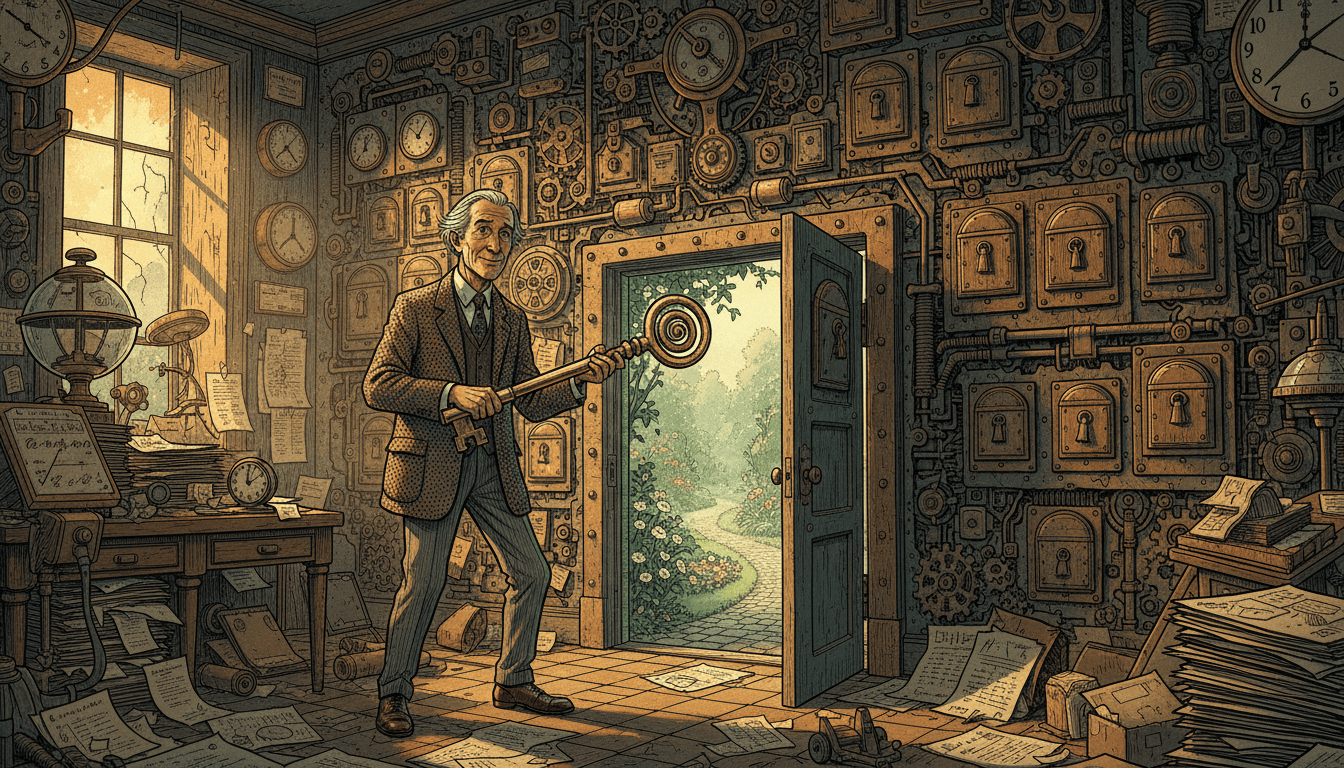
The office occupied a narrow room between the Department of Doors That Open and the Department of Doors That Ought To. Its walls were lined with brass hooks, each bearing a key and a handwritten explanation of why that key was no longer required.
“Key to the old laboratory,” said one tag. “Laboratory demolished.”
“Key to the executive washroom,” said another. “Executive has transcended plumbing.”
The third was labeled simply: “In case.”
I asked Miss Quill, who had accompanied me with a clipboard and the expression of a woman who had already seen the next three disasters, what exactly I was expected to do.
“Account for them,” she said.
“Do they go missing?”
“Not often. Mostly they remain.”
“Then what is the problem?”
“The Institute cannot establish whether remaining is a form of usefulness.”
I considered this. In my experience, an institution can survive a missing key, a missing door, and occasionally a missing building. What it cannot survive is an object that refuses to justify its continued existence on the appropriate form.
We began the inventory.
At eleven, a committee arrived to determine whether the inventory was itself necessary. At eleven fifteen, a second committee arrived to determine whether the first committee possessed the proper key to the meeting room. At eleven twenty, both committees were locked inside, and for the first time all morning the Institute became productive.
Miss Quill pointed to a small brass key beneath the window.
It had no tag.
“What does that one open?” I asked.
“We’ve never been able to find out.”
“Has anyone tried it?”
“Of course not. It’s listed as unnecessary.”
I took the key into the corridor, where a plain wooden door stood between two filing cabinets. I had passed it every day for six years without once wondering where it led. The key turned easily.
Beyond the door was a garden. Nothing spectacular: a patch of grass, a crooked bench, a bird making an unreasonable amount of noise for its size. Sunlight lay across the stones without having first applied for clearance.
Miss Quill stepped beside me.
“Should we report this?” she asked.
“Eventually.”
“Under what category?”
I looked back at the hooks, the forms, and the committees negotiating their release through the ventilation grille.
“Put it under ‘In case,’” I said.
We left the door open.
— Dr. Elias Locke

