
EVERYDAY, WITH DR. ELIAS LOCKE · NOVEMBER 2, 2026
The Button Orchard
A fictional column from the Electric Icarus universe, created by Jon LaBelle
Monday.
At eight this morning, Mr. Bledsoe telephoned to report that his pecan tree had stopped producing pecans.
This would ordinarily be a matter for an agricultural specialist, but Mr. Bledsoe insisted that the replacement crop was beyond the county extension office’s usual expertise.
“Buttons,” he said.
“Buttons?”
“Four holes in most of them. Two in a few. One’s got a little anchor on it.”
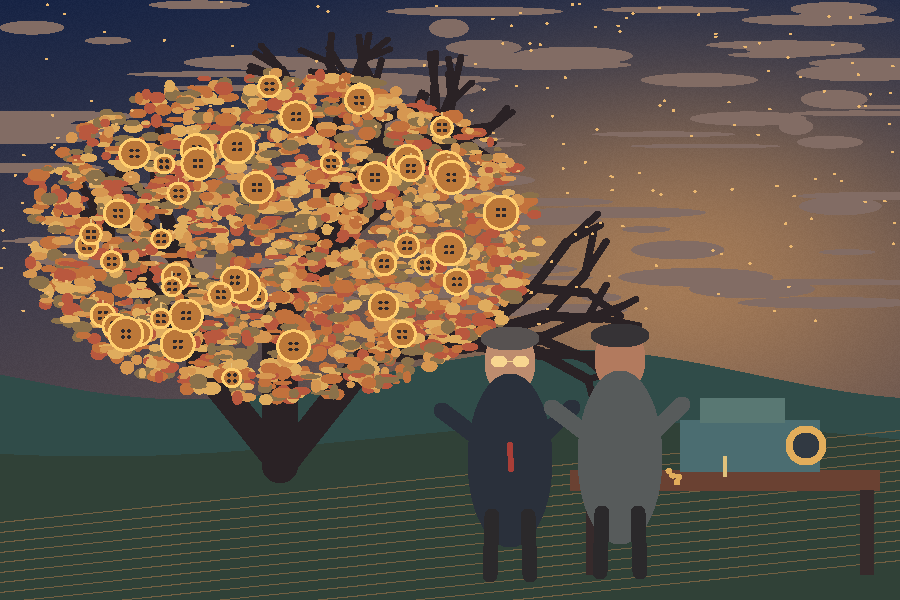
I arrived to find a magnificent old tree standing in a field behind his barn. Its branches were heavy with brass buttons, black wooden buttons, pearl-colored buttons, and several that appeared to have been borrowed from military uniforms no army had ever issued.
There wasn’t a pecan in sight.
Mr. Bledsoe held out a bucket.
“Do you think crop insurance covers this?”
“Only if the policy includes haberdashery.”
He frowned.
“I knew I should’ve read the small print.”
I examined a brass specimen with a magnifying glass. It had four holes, a smooth rim, and no discernible means of having grown from a tree. The branch from which it hung was perfectly ordinary, except for the button.
I made a note.
The button made no note in return, which I considered encouraging.
By nine, Miss Hattie Quill, who ran the town’s alterations shop, had arrived with a measuring tape around her neck and the look of a woman who had spent forty years waiting for agriculture to become useful.
“Good heavens,” she said. “They’re all different.”
“Is that a problem?” asked Mr. Bledsoe.
“Only if you expect the world to wear matching coats.”
She selected a round wooden button and held it against the missing fastener on her work apron.
It fit.
“Will it sew itself on?” I asked.
“Doctor, if it did, I’d have to find another profession.”
She produced a needle and thread.
Within minutes, word had spread through town. People arrived carrying coats, bags, cushion covers, and one extremely optimistic umbrella. The mayor brought a ceremonial jacket that had been missing its top button since the spring parade.
He demanded to know whether the tree was public property.
“It stands on my land,” said Mr. Bledsoe.
“Then we may need a special harvest permit.”
“Do we have a button-harvest permit?”
“We will by Thursday.”
I was preparing to investigate whether the buttons possessed any unusual physical properties when a hard wind came across the field.
Down the road, the canvas roof of the autumn market began to tear away from its frame. The vendors were struggling with loose ropes and flapping corners. A table of pumpkins rolled toward the ditch with all the dignity of escaping prisoners.
Miss Quill looked at the tree.
Then she looked at her sewing kit.
“Mr. Bledsoe,” she said, “may we borrow your crop?”
The next twenty minutes were a spectacle of practical ingenuity.
Farmers held the canvas. Shopkeepers brought cord and needles. Miss Quill stitched reinforced loops along the torn edge while volunteers threaded the larger buttons through them and secured the fabric to the frame.
The mayor offered to supervise, but was assigned to retrieve pumpkins instead.
When the wind finally passed, the market roof remained in place.
Mr. Bledsoe stood beneath it, staring at a brass button the size of a half-dollar.
“Well,” he said, “I suppose that counts as a harvest.”
“An unusually well-tailored one,” I replied.
By afternoon, the tree was still producing buttons. The county had no explanation. Neither did I.
There were several hypotheses worth testing, none of which improved by being announced as fact.
Mr. Bledsoe proposed selling the buttons as organically grown fasteners. Miss Quill suggested saving a basket for anyone who needed a repair and couldn’t afford one.
They agreed to try both.
As I left, I noticed a single small button lying beside my notebook. It was silver, with four holes arranged like a tiny constellation.
I checked my jacket.
Every button was present.
I put the silver one in my pocket anyway.
A button is a curious invention. It cannot decide what belongs together. It cannot mend a tear by itself. It is a small, rather stubborn invitation for two edges to meet.
Someone still has to pick up the needle.
For the moment, I believe the tree has done enough.

