
EVERYDAY, WITH DR. ELIAS LOCKE · OCTOBER 30, 2026
The Tunnel That Answered First
A fictional column from the Electric Icarus universe, created by Jon LaBelle
Friday.
There is an old railroad tunnel outside town that hasn’t seen a train in forty-three years, unless you count the one Mr. Bell claims he heard last Christmas. Mr. Bell also claims his refrigerator has opinions, so I reserve judgment.
This morning, the tunnel began producing echoes before anyone made a sound.
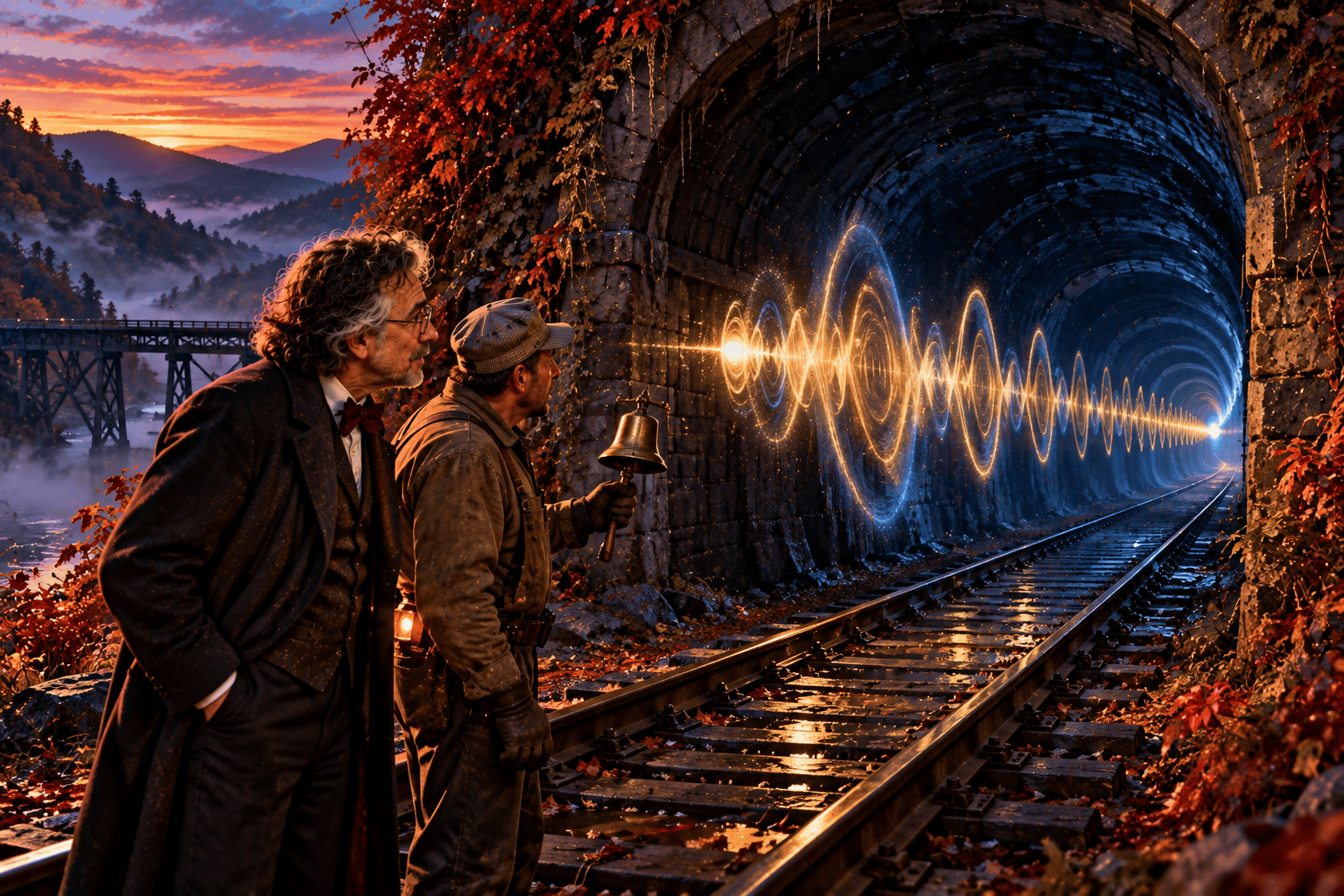
The first incident occurred when a maintenance worker approached the entrance carrying a brass bell. Before he could ring it, the tunnel rang back.
He dropped the bell.
The tunnel produced the sound of the bell hitting the ground approximately two seconds before it actually did.
Naturally, the county sent for me.
“Is it dangerous?” asked the maintenance supervisor.
“Only if it begins answering questions about the budget,” I said.
We established a testing station beside the tracks. I brought a notebook, a stopwatch, and three instruments whose manufacturers would probably object to the circumstances of their deployment.
Our first experiment was straightforward.
I clapped my hands.
Nothing.
Then the tunnel clapped.
Then I clapped my hands.
The supervisor stared at me.
“You already clapped,” he said.
“Apparently I am running behind.”
We repeated the experiment with a whistle, a dropped wrench, and a remarkably uncooperative kazoo.
Each time, the tunnel produced the expected echo before the original sound.
This was either a significant temporal anomaly or the most irritating acoustic phenomenon ever discovered.
By noon, a small crowd had gathered. Someone brought lawn chairs. Someone else began selling tickets. The mayor announced that the tunnel would be designated a historical attraction pending verification that history was still operating in the correct direction.
I asked the crowd to remain silent.
From the darkness came a voice.
“Are you listening?”
Nobody had spoken.
The supervisor looked at me.
“Who said that?”
“I suspect,” I replied, “someone is about to.”
We waited.
Nothing happened.
Then a little boy standing beside his grandfather raised his hand.
“Are you listening?” he asked.
The grandfather turned toward him.
“Yes,” he said.
The tunnel remained silent.
That was when I began to suspect the phenomenon had very little interest in acoustics.
For the next hour, the tunnel produced fragments of ordinary conversation before their speakers found the courage, patience, or opportunity to say them.
“I’m sorry.”
“Can I try again?”
“I don’t understand.”
“Would you explain that?”
One gentleman heard himself say, “You were right,” and immediately left the premises.
The mayor requested that we keep the incident confidential until the tourism committee could determine whether advance apologies were taxable.
By late afternoon, the echoes stopped.
I examined the tunnel one final time. Its walls were stone. Its rails were rusted. Its darkness was perfectly ordinary, which is often the most suspicious kind.
There was no measurable evidence of a mechanism capable of predicting speech. There was also no evidence that the tunnel had any intention of explaining itself.
As we packed our equipment, the supervisor asked what I intended to write in my report.
“An acoustic irregularity of undetermined origin,” I said.
“That’s all?”
“Would you prefer that I accuse the mountain of clairvoyance?”
He considered this.
“Probably not.”
I closed my notebook.
The tunnel had given us something peculiar: the sound of words before the effort required to speak them.
I have spent years investigating the distance between cause and consequence. Usually, one follows the other. Occasionally, the universe misplaces the instructions.
But perhaps the more interesting distance is the one between having something to say and actually saying it.
If the mountain has learned to shorten that distance, I hope it will consider opening an office.
The county could use the assistance.

