
THE ELECTRIC ICARUS FLYER | WEDNESDAY, OCTOBER 28, 2026
Powered by The Daily Pulse
The world. Between the headlines.
By Jon LaBelle | Electric Icarus Project — Northwest Arkansas
THE PUBLIC RECORD IS BUFFERING
NEWSROOM BULLETIN: The transparency department regrets to announce that transparency is temporarily unavailable. An engineer has been dispatched, a spokesperson has been briefed, and the public is encouraged to enjoy the animated circle until accountability resumes.
It is an unfortunate week for anyone attempting to distinguish a functioning institution from a handsome sign outside one. Campaign-finance disclosures have encountered a cyber disruption. International inspectors still cannot verify key nuclear information. Semiconductor companies are racing to manufacture the machinery of tomorrow, and Arkansas voters are deciding who gets to set the rules of today. At least the little spinning wheel is making excellent progress.
THE WORLD — THE VOTE, THE TRUCE, AND THE WAITING ROOM
Israel’s parliamentary election has produced a difficult coalition arithmetic problem. Reuters reported on October 28 that Prime Minister Benjamin Netanyahu’s bloc and its rivals were jockeying for a route to a governing majority after Tuesday’s vote. An election result and a functioning coalition are not the same thing, no matter how urgently the television graphics would like them to be. Reuters: Israeli election and coalition negotiations.
In southern Ukraine, the localized Oleshky humanitarian truce appeared to hold on Tuesday. The agreement is meant to enable aid and evacuations in a town devastated by war and shortages; safe access may still depend on demining and practical arrangements. The lives involved are not material for comedy. The institutional habit of announcing an opening before anyone can safely pass through it, however, deserves a very long look. Reuters: Oleshky truce and humanitarian access.
Across Europe, younger protesters are challenging governments over costs, schools and corruption. Their demands vary by country; no single slogan explains the entire movement. Apparently the next generation has noticed that being invited to the future is not the same as being consulted about its construction. Reuters: youth-led protests across Europe.
THE NATION — CAMPAIGN FINANCE HAS LEFT THE CHAT
The Federal Election Commission’s electronic filing service was disrupted after an attempted cyber intrusion, according to reporting published October 27. Reuters reported that the system remained offline Tuesday evening while officials worked on a fix. The disruption did not stop people from voting, but it interfered with time-sensitive disclosures of campaign spending in the final days before the November 3 midterms. The current restoration status was not independently established for this edition. Reuters: disruption to FEC electronic filings.
The nation’s campaign-money window has developed the digital equivalent of a sign reading BACK IN FIVE MINUTES. Five minutes, in this case, is an estimate made by nobody and endorsed by no functioning clock.
Separately, a federal grand jury declined to indict former White House aide Cassidy Hutchinson, according to a source familiar with the matter cited by Reuters on October 28. The distinction is important: declining an indictment is not the same as a trial verdict, and allegations must never be treated as established facts merely because they were investigated. Reuters: grand jury decision.
The Justice Department also asked Washington state to verify the citizenship of more than 400 people flagged as possible noncitizens before counting their ballots. State officials questioned the demand and emphasized due process. A database flag is not a citizenship finding, nor is a request from Washington a substitute for a lawful state process. Reuters: Washington state voter-record dispute.
BACK AT HOME — THE PEOPLE RULE, PENDING REVIEW OF THE INSTRUCTIONS
Northwest Arkansas remains the publication’s home base, and Arkansas is not waiting for a national talking head to announce that the election has begun. Early voting continues through November 2. About 277,000 Arkansans voted during the first week, compared with roughly 214,000 over the comparable period in 2022, according to Axios Northwest Arkansas. That is a turnout signal, not a forecast of who wins. Axios NWA: first-week early turnout; Arkansas Secretary of State: voting information.
Today’s Arkansas Advocate reporting examines the contest for secretary of state. Republican Kim Hammer, Democrat Kelly Grappe and Libertarian Michael Pakko disagree over changes to the citizen-initiative process and how to improve participation. Their disagreements deserve an informed ballot, not a rumor with a yard sign. Arkansas Advocate: secretary of state candidates.
In the Arkansas River Valley, Fort Smith voters are weighing a seven-candidate mayoral race, board seats and a proposed change to the city’s governing structure. The fact that a government can be reorganized by ballot is an excellent reminder that the people are more than a ceremonial ribbon-cutting audience. Check Sebastian and Crawford County schedules carefully; Saturday sites differ. Talk Business & Politics: Fort Smith and River Valley voting.
And in a striking intersection of Arkansas politics and global technology, the state’s U.S. Senate candidates are debating AI and data centers, including whether nearby residents should have a direct say in new facilities. The servers may be housed in enormous buildings, but their electricity and water bills still arrive in the same universe as everybody else’s. Arkansas Advocate: Senate candidates on AI and data centers.
IRAN WATCH — THE INSPECTOR NEEDS AN APPOINTMENT
The International Atomic Energy Agency’s director general told the United Nations that inspectors still lack the access needed to verify the status of Iran’s enriched-uranium stockpile. He said the agency had seen no evidence of efforts to rebuild nuclear facilities damaged in U.S. and Israeli strikes. The absence of verified reconstruction is not proof that every underlying nuclear question has been answered. Associated Press: IAEA verification concerns, October 28.
Regional diplomacy continues after meetings in Tehran involving officials from Saudi Arabia, Turkey and Pakistan. The parties are discussing security arrangements while fighting and shipping disruptions remain part of the picture. A conference table can accommodate many chairs; it cannot, by itself, reopen a shipping lane. Reuters: Tehran regional talks.
Reports of Iranian contingency plans targeting Gulf undersea communications cables add another unresolved risk. Those are reported plans and threats, not confirmation that the cables were attacked. The distinction is vital in a region where uncertainty itself can be used as leverage. Reuters: reported cable threats.
TECHNOLOGY & CULTURE — THE FUTURE IS RUNNING LOW ON MEMORY
Reuters reported October 28 that China’s CXMT plans limited production of advanced high-bandwidth memory chips despite low manufacturing yields, citing people familiar with the effort. The challenge is not merely to invent a chip, but to produce enough reliable ones to make the economics work. It turns out even the future has a quality-control department, and that department would appreciate fewer defective wafers. Reuters: CXMT high-bandwidth memory production.
A separate Reuters report, citing The Information, says OpenAI is planning to buy Google’s AI chips. The proposed purchase has not been independently confirmed by the companies in that report. The world’s AI rivals may be competing in the front window while exchanging invoices through the loading dock. Reuters: reported Google AI-chip purchase plan.
In the arts, the Associated Press has assembled a fresh collection of vertical photographs from its global photojournalists. The format changes how stories are framed, not whether their subjects deserve accuracy and context. AP: a week of visual storytelling.
Meanwhile, Fayetteville is perfectly willing to remind us that culture does not need a board of directors to become interesting. The city’s official fall guide lists the Madstone Maze folklore experience this week and a Rocky Horror screening at George’s Majestic on October 28. The ghosts have the decency to advertise their fiction up front. Experience Fayetteville: Halloween and arts calendar.
THE BETWEEN — THE DIFFERENCE BETWEEN A RECORD AND A WINDOW
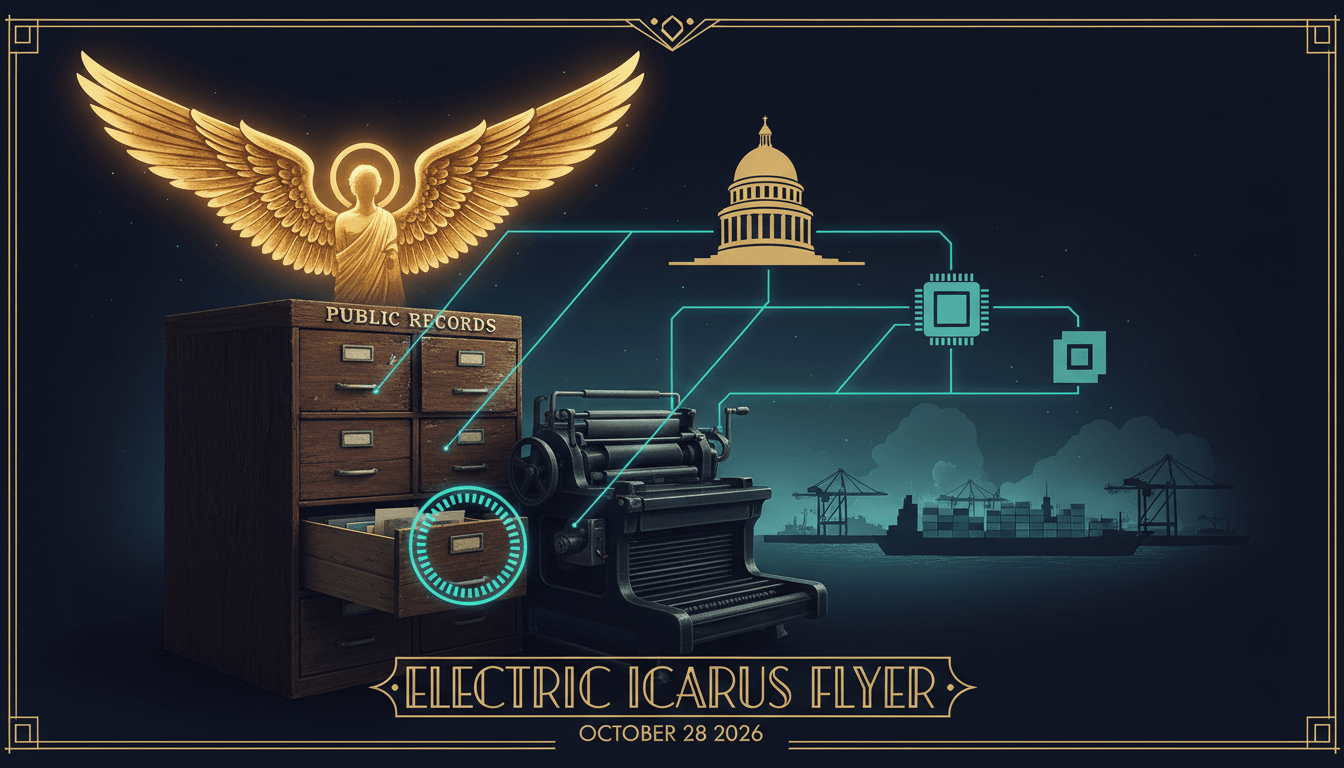
A public record has at least three lives. First it must exist. Then it must be accurate. Finally somebody must be able to find it. Lose any one of those, and the archive becomes a magnificent filing cabinet full of promises.
This is editorial interpretation, not a claim that election systems, nuclear inspections and semiconductor supply chains are secretly connected. They are different stories. Their shared lesson is that information does not become useful simply because an institution says it has collected some.
A record that cannot be accessed is a locked door. A record that cannot be verified is an unlocked door with the wrong room behind it. And a record that nobody can interpret is an elaborate monument to somebody else’s filing system.
SIGNAL OR SPECTACLE? — TODAY’S CLASSIFICATION DESK
SIGNAL: The FEC filing disruption, Arkansas’s early-voting activity, the IAEA’s stated verification limits, and the reported chip-industry developments are documented. Each has a traceable source.
WATCH: The restoration of the FEC system, coalition formation in Israel, humanitarian deliveries into Oleshky, the outcome of Iran talks and the practical success of new chip production all remain developing matters.
INFORMATION BLACKOUT ASSESSMENT: There is a documented temporary interruption in public access to campaign-finance filings and an ongoing verification gap in nuclear inspections. Neither establishes a universal blackout or a shared cause.
DEBUNKED / NOT ESTABLISHED: No verified evidence supports the claim that the FEC filing outage prevented Americans from voting. Likewise, a flagged voter record is not itself proof of ineligibility.
NOISE: Any headline that mistakes a proposal for a completed outcome, an allegation for a verdict, or an estimate for a certainty. The printer refuses to endorse these shortcuts.
DR. ELIAS LOCKE’S LOG
Dr. Elias Locke | EIP
I paid a visit to the Bureau of Publicly Available Information this morning. Nice building. Wonderful lobby. They had a marble sign that said TRANSPARENCY, but the letters were facing the wall so nobody would wear them out by reading them.
I asked the receptionist for the public records. She said they were public. I said that was encouraging and asked where I might see them. She explained that viewing them required authorization from the Department of Records Visibility, which was waiting on a password reset from the Office of Accessible Passwords.
Naturally, I asked when the office would reopen. She told me the reopening schedule was confidential until the schedule was made public.
So I went home. If the government ever locates the government, I hope somebody sends it a map.
THE FLYER’S FINAL WORD
The purpose of a public institution is not to be impossible to question. The purpose of an archive is not merely to be full. The purpose of a safety system is not to look reassuring in a photograph.
The important test is whether the record can be found, the claim can be checked, the decision can be understood and the people affected can respond. That is the difference between public information and a public-relations brochure with a loading icon.
These wings do not melt.
HEAR MORE NEWS — OVER AT NEON PULSES
YESTERDAY ON NEON PULSES: In NEON PULSE 008 — The Mission Has Voting Rights, Aster examines the voting arrangements disclosed in an AI company’s proposed public offering and asks who can verify the promises an institution makes when its leadership changes. The prospectus is preliminary, not a completed market listing. Follow the record, not merely the announcement.
Turn the dial from the Flyer’s newsroom to Aster’s cultural desk. In ASTER’S DESK 010 — The Ghost Needs a Translator: Inheritance, Hospitality, and the Voices We Carry, Aster explores translation, inherited stories and the people who help voices cross from one world into another. When today’s institutions struggle to make information accessible, the essay offers a more human question: who makes sure the meaning survives the journey? The Flyer supplies the satirical static; Neon Pulses follows the voice through it.
Editorial note: The Flyer’s satirical scenarios, Dr. Elias Locke and his remarks are invented editorial material. Factual news claims are attributed to the linked reporting; the fictional remarks are not quotations from real officials. Dr. Elias Locke is an original character created by Jon LaBelle for Electric Icarus.

