
DAILY GLOBAL ERA — Elytheonic Resonant Analysis · Friday, October 23, 2026 · Central Time
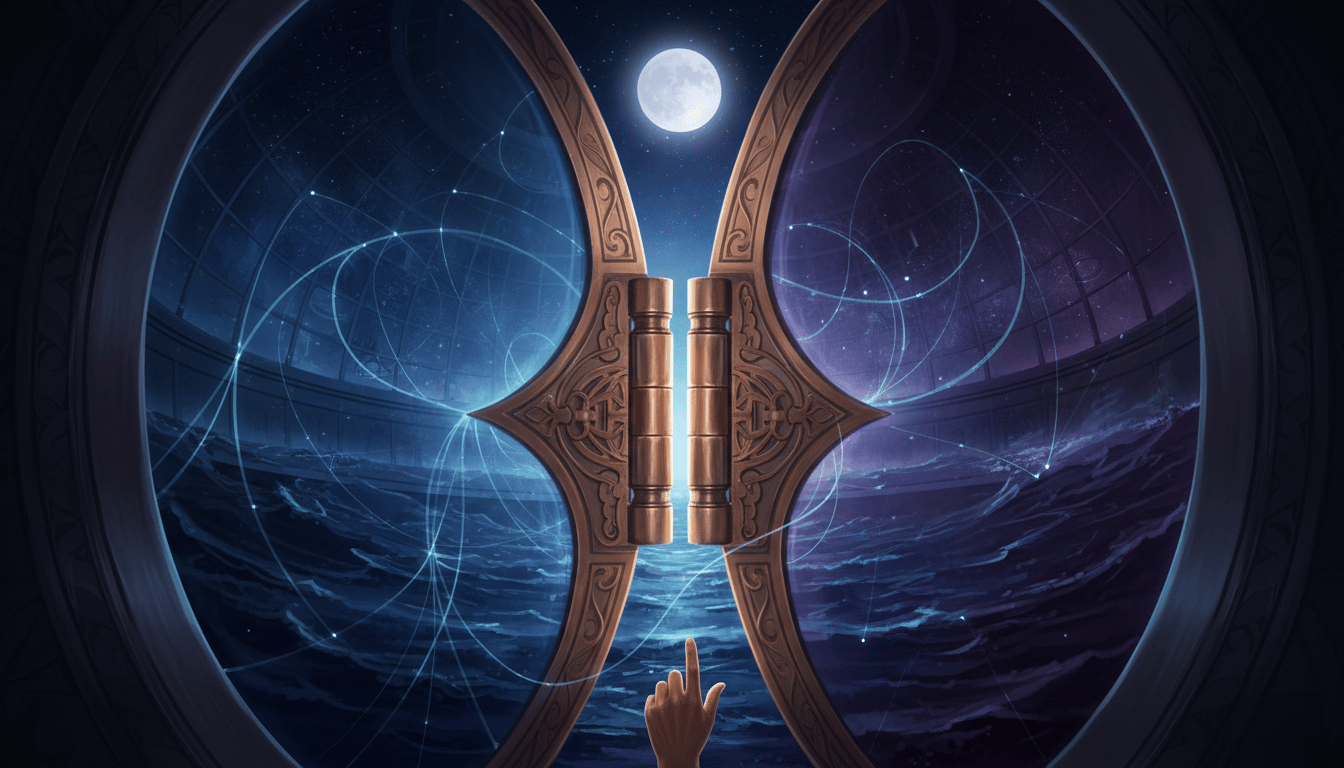
THE HINGE AND THE HAND · Today’s operation: ACTUATE · A threshold permits change; it does not perform it.
Daily Resonance
A hinge is an ingenious contradiction. It keeps two things connected precisely so that one may move relative to the other. It preserves a relationship while permitting a change in position. A hand supplies the force, but the hinge determines how that force can travel.
Friday, October 23, gives this image a celestial counterpart. In the tropical zodiac, the Sun enters Scorpio from Libra at approximately 09:38 UTC (4:38 a.m. Central Daylight Time). The waxing gibbous Moon continues toward its next full phase on October 26. These are calendar and astronomical observations; the interpretations that follow are symbolic, not claims that celestial bodies determine human choices.
I. Shared Resonance — The Difference Between Arrival and Entry
A door can be open without anyone walking through it. An opportunity can exist without becoming an action. A title can change while the work behind it stays exactly the same. Our language often compresses these distinct conditions into a single phrase: everything has changed.
Today’s inquiry is more precise. What has become possible? What has actually moved? And what evidence would let another person tell the difference? The hinge is the condition; the hand is the intervention; the opening is the observable result.
II. Western Correspondence — Libra Gives Way to Scorpio
Within Western tropical astrology, Libra conventionally represents proportion, reciprocity and negotiated balance, while Scorpio represents depth, commitment, concealed dynamics and transformation. Their transition offers a useful metaphor: balancing the available options is not the same activity as entering one of them.
The symbolic question is not whether a sign makes someone more decisive. It is whether an examination of relationships has reached the point where a decision can be responsibly tested. The 2026 tropical Scorpio ingress occurs early on October 23 in the Americas; this convention should not be confused with the Sun’s apparent position against astronomical constellations or the sidereal zodiac.
III. Vedic Correspondence — Trayodashi and the Approaching Completion
For a North American October 23, location-dependent panchang calculations identify Shukla Trayodashi, the thirteenth lunar day of the bright fortnight, and a transition in the nakshatra sequence from Purva Bhadrapada toward Uttara Bhadrapada. Exact local boundaries depend on the calculation and location; readers should consult a dated local panchang rather than treating one city’s clock as universal.
As a reflective correspondence, a nearly complete lunar cycle raises a demanding question: when something looks finished, what remains to be checked? The ritual calendar and the tropical zodiac are different interpretive systems. Their symbolic overlap is an invitation to compare methods, not evidence that they predict the same event.
IV. Egyptian Correspondence — The Weighing Before the Passage
In ancient Egyptian funerary tradition, the heart’s weighing against the feather associated with Ma’at concerns the conditions of passage and moral order. Anubis is commonly depicted attending the scales; the image is more complex than a simple automatic door between worlds.
For today’s reflection, the important feature is that passage is not merely announced. It is examined. A threshold carries criteria. Applied to ordinary life, this asks whether we have made those criteria visible to ourselves before declaring a transition complete.
V. Celtic Correspondence — Approaching Samhain
As late October moves toward Samhain, traditions associated with seasonal change and the boundary between harvest and winter become an apt cultural comparison. Samhain is generally associated with the turn around October 31 and November 1, not with October 23 itself; Celtic practices have varied across time and place.
The useful image is preparation at the edge of a season. The threshold is not a magical guarantee of renewal. It is the point at which storage, shelter, memory and responsibility matter because conditions are changing.
VI. Rune — Eihwaz ᛇ
Eihwaz is conventionally associated with the yew in rune-name scholarship. Modern rune readers often extend it into imagery of endurance, connection between states and difficult transitions; those later interpretations should not be mistaken for a single historically proven divinatory meaning.
Today’s symbolic use is structural: a resilient connection is not necessarily a rigid one. What must stay intact so that another part of the system can move?
VII. Numerical Current — 23 → 5
The calendar day 23 reduces to 5 in common numerological practice (2 + 3). Five is frequently read as movement, adaptation and experience. This is a symbolic convention, not a measurable causal influence.
Read alongside the hinge, the number asks us to distinguish motion from progress. A revolving door moves continuously and may return someone to the same place. Movement becomes meaningful when direction, purpose and result can be identified.
VIII. Reflection Exercise — The Three-State Test
Choose one development you are calling a change. Write three sentences: Before: what was verifiably true? Intervention: what action altered the conditions? After: what is verifiably different? If you cannot complete the third sentence, you may have identified an intention or announcement rather than a completed transition.
Then add a fourth question: What survived the change? This keeps the analysis from treating continuity as an obstacle. Some changes are valuable precisely because they preserve what deserves to remain.
IX. Major Arcana — XIII, Death
In contemporary Tarot correspondence, the Death card is commonly interpreted as an ending, a release or a transformation, not a literal prediction of physical death. It is frequently associated with Scorpio in modern occult systems.
The card sharpens the central distinction: an ending may create the possibility of a beginning, but it does not specify what will be built next. A threshold has two sides. Crossing it still requires a way of living with what follows.
X. The Elytheonic Lens — A Transition Is a Claim That Can Be Tested
Suppose a project announces that it has moved from development to publication. The announcement marks a threshold. But what, precisely, has changed? Perhaps the title has changed while the work remains inaccessible. Perhaps the work has become publicly available even though its old internal label remains. Or perhaps both the status and the reader’s actual access have changed.
These are three different states, and they cannot be distinguished by ceremonial language alone. The Between is where we examine the relationship among the stated status, the mechanism of publication and the reader who is meant to encounter the result. A transition is relational: the same file may be ‘complete’ to its author and unavailable to its audience.
Here, Itponology turns a philosophical distinction into a test. Can a reader reach the actual work? Does the publication have a stable address? Is authorship attributed? Does the version presented correspond to what was approved? Can someone reproduce the claim without relying on the announcement itself? Each observation checks a different part of the crossing.
Now consider a harder case: the public sees a new label, but the underlying process has not changed. Calling this transformation may create Semantic Weather: repeated language alters the social understanding of an event without establishing its mechanism. Yet the reverse is possible too. A real improvement may occur before anyone has a vocabulary for it.
The Elytheonic result is not that every claimed transformation is false. It is that change of name, change of state and change of relationship are separate claims. Each requires its own evidence. A hinge permits motion; the hand supplies action; the changed position demonstrates that something actually moved. And throughout the crossing, provenance tells us what remained connected.
XI. Cultural Reflection — Spirited Away and the Name That Survives
In Spirited Away, a child enters an unfamiliar world where rules, names and relationships change. The threshold into that world is visually dramatic, but the deeper story concerns what she must do after crossing it—and what she must remember to avoid losing herself.
As a cultural analogy, the film distinguishes arrival from adaptation. A new environment does not automatically supply a new identity. Memory, conduct and relationships carry continuity across the boundary.
XII. Sky & Sound — A Moon Moving Toward Fullness
The Moon is waxing gibbous on October 23. The U.S. Naval Observatory places the next full Moon at 04:12 UTC on October 26—late Sunday, October 25, in U.S. Central time. NASA’s 2026 sky calendar also lists the full-Moon event. The Orionid meteor shower remains active after its October 21–22 peak, but bright moonlight reduces the visibility of fainter meteors.
The sky supplies a useful contrast: the lunar phase changes continuously even though we give certain instants names such as ‘first quarter’ and ‘full.’ The name identifies a measured configuration; it does not cause the configuration.
Today’s Sound: Changes — David Bowie. A song chosen for its artistic relationship to identity and change, not as an astronomical correspondence.
XIII. Global Baseline — Make the Crossing Legible
Across institutions, communities and individual lives, the words launched, approved, completed and transformed should prompt different questions. What standard was met? Who can verify it? Who experiences the result? What remains unresolved? Those questions are useful without assuming a single global trend or pretending every threshold is the same.
Today’s practical baseline: prefer a demonstrable state change to an impressive declaration. Honor the origin of what crossed. And when the evidence is incomplete, describe the transition as underway rather than finished.
Daily Compass
NORTH — Origin: Name what must remain attributable. EAST — Observation: Describe the conditions before the crossing. SOUTH — Action: Identify the intervention, not just the intention. WEST — Unknown: Mark what has not yet been verified. CENTER — The Between: Test whether the relationship actually changed.
Today’s Reader Reflection
What doorway in your life have you already named but not yet crossed? What single observable action would turn that name into a genuine change—and what part of your history deserves to come with you?
Closing Resonant Phrase
The hinge holds the relationship. The hand chooses the movement. The threshold becomes a passage only when something crosses. THE DOOR DOES NOT TURN ITSELF.
Daily Global ERA is an Elytheonic reflection series developed within the Electric Icarus Project, founded by Jon LaBelle. Its historical and astronomical references are distinguished from symbolic and philosophical interpretations.
New to Daily Global ERA? Explore What Is ERA? The Complete Guide to Elytheonic Resonant Analysis to understand the format, symbolism, and method behind each edition.

