
ELECTRIC ICARUS PROJECT / NOVA ACADEMY / FOUNDATIONS OF INQUIRY
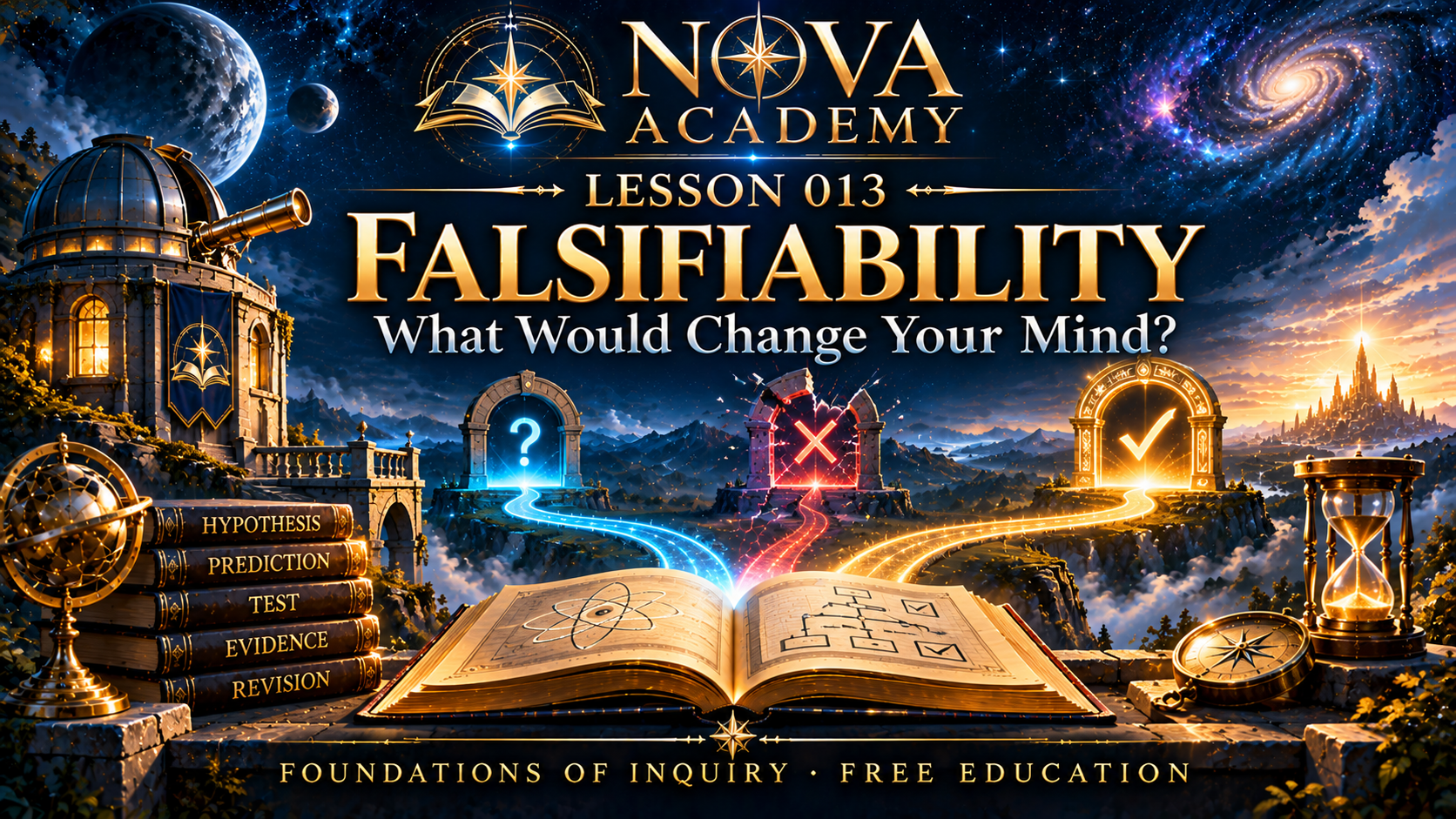
LESSON 013 · FALSIFIABILITY
What Would Change Your Mind?
A powerful claim can explain what we have already seen. A testable claim also tells us what could challenge it. Explore how predictions, counterexamples, and honest revision turn an idea into an investigation.
FREE · BEGINNER · 40–50 MINUTES · NO ENROLLMENT · NOVEMBER 2, 2026
What you need: paper or a notes app. The activity uses only fictional card data and takes 15–20 minutes. No equipment or prior statistics training is required.
Previously: Lesson 012 — Replication.
The question a strong idea should survive
Suppose someone says: “Every gold-bordered card in this deck contains a triangle.” What would make that statement incorrect? One genuine gold-bordered card with a circle or square—provided the card and markings were recorded accurately.
Now suppose someone says: “Gold-bordered cards are special.” What observation would show that the statement failed? Until “special” is defined in measurable terms, the question has no clear answer.
Lesson 012 examined what happens when a finding is tested again. Today we examine an earlier obligation: before collecting evidence, say what observations would make your claim harder to defend.
By the end of this lesson you can:
- Distinguish a clearly testable claim from one with undefined terms.
- Identify a possible observation that conflicts with a universal claim.
- Explain why surviving several tests does not logically prove a universal statement.
- Tell a strict claim apart from a probabilistic claim that needs larger samples and appropriate uncertainty.
- Write a prediction and a decision rule before looking at the outcome.
- Revise a claim transparently without quietly changing the terms of the original test.
1. What is falsifiability?
Falsifiability means a claim rules out at least some possible observations: if one of those observations were reliably established, it would conflict with the claim. Philosopher Karl Popper gave this idea a central role in his account of scientific inquiry.
A claim does not have to be false to be falsifiable. “Every card in the sealed deck is blue” is falsifiable because one genuine nonblue card would contradict it. Whether such a card actually exists is a separate question.
Three meanings to keep separate
- Falsifiable: A conceivable, observable outcome would count against the claim.
- Falsified: Reliable observations conflict with the claim, under clearly stated assumptions.
- Corroborated: The claim has survived a relevant test, without becoming immune to future challenge.
Popper’s position is influential but not the only philosophy of scientific method. Real science uses many kinds of observation, models, statistical evidence, and causal investigation; there is no single universally agreed rule that completely separates science from other inquiry.
2. A prediction is useful because it takes a risk
A useful prediction tells us what we should observe if a claim is right. A risky prediction, in this context, is one that could easily turn out otherwise; the claim rules out meaningful alternatives.
For example, imagine that a researcher predicts: All gold-bordered cards have triangles. Seeing one gold triangle fits the prediction. Seeing one gold square contradicts the universal statement. By contrast, “Some cards will look interesting” does not tell us what to count or what would challenge it.
Turn an attractive statement into a test
- Define the objects or population: Which cards? Which deck?
- Define the measurable property: What exactly counts as a triangle?
- State the prediction before inspecting the relevant cards.
- Describe the result that would disagree with the prediction.
- Record how you will verify an unusual result before drawing a conclusion.
3. The card-table experiment
15–20 MINUTES · PAPER ONLY · INVENTED CLASSROOM DATA
You are given 12 fictional cards. Each card has either a blue or green border and displays either a star or circle. They are selected only to illustrate how a claim can be tested; the figures are not observed research data.
| Card | Border | Symbol |
|---|---|---|
| 1 | Blue | Star |
| 2 | Blue | Star |
| 3 | Blue | Circle |
| 4 | Blue | Star |
| 5 | Blue | Circle |
| 6 | Blue | Star |
| 7 | Green | Circle |
| 8 | Green | Star |
| 9 | Green | Circle |
| 10 | Green | Circle |
| 11 | Green | Star |
| 12 | Green | Circle |
The three hypotheses
- H1 — Universal: Every blue-bordered card in this set has a star.
- H2 — Probabilistic: Blue-bordered cards have a higher probability of showing a star than green-bordered cards in the larger card population.
- H3 — Vague: Blue cards are naturally special.
Your investigation
- Before looking for the answer, write what a genuine counterexample to H1 would look like.
- Locate any such card in the table. What does it establish about H1 as worded?
- Count stars among blue-bordered cards and among green-bordered cards. Calculate the observed proportions.
- Does this small fictional table prove H2 about a larger population? Explain why not.
- Explain what must be defined before H3 can become an empirical question.
- Write a new, precise prediction that could be tested on a fresh set of cards.
4. Interpret the outcome without exaggerating it
Worked answer
H1: Card 3 and Card 5 are blue circles. Each contradicts “every blue-bordered card in this set has a star.” With these correctly recorded cards, the universal statement is false for the set.
H2: Four of six blue cards show stars, or 4/6 ≈ 66.7%. Two of six green cards show stars, or 2/6 ≈ 33.3%. The observed difference is about 33.3 percentage points. These small, invented counts are compatible with the claim, but they cannot establish that the larger population has different probabilities.
H3: “Special” has no operational definition; we need to state what quality is being measured and how a possible result could count against it.
Next test: Before gathering a genuinely new random sample from a defined population, specify the sampling procedure, comparison measure and how much uncertainty will be reported.
Notice the difference: a verified contradiction defeats H1 as written, but six observations per group cannot settle H2. Probabilistic claims generally require statistical reasoning and repeated data, not one dramatic exception.
5. One contradictory result is not always the end of an experiment
For a simple, accurately classified universal statement about a fixed set of cards, a genuine counterexample is decisive. Real scientific theories are more complicated. Unexpected data may reflect measurement error, a faulty instrument, an unstated boundary condition, an incorrect auxiliary assumption—or a genuinely flawed hypothesis.
The Stanford Encyclopedia of Philosophy’s Scientific Method overview explains why methodologists have challenged the idea that a single anomaly always determines the fate of a complex theory.
When a result appears to disagree
- Check that the record is accurate.
- Repeat or independently check the measurement where appropriate.
- Look for a hidden assumption or condition that affects the test.
- Report the observation even if it is inconvenient.
- Revise the claim clearly, and test the revised claim on new evidence.
6. Plan the test before seeing the answer
Imagine looking at 100 cards, searching through dozens of possible patterns, and finally announcing that the most striking pattern was the prediction all along. Finding patterns is legitimate exploratory work. Presenting a pattern discovered after the fact as a successful advance prediction is misleading.
A helpful research practice is preregistration: documenting hypotheses, measurements, planned analyses and decisions in advance of inspecting the relevant results. The Center for Open Science explains why distinguishing planned tests from exploratory discoveries makes findings easier to interpret.
A miniature prediction record
Claim: [Specify a testable statement.]
Population: [Which objects or observations count?]
Measure: [How will results be classified or counted?]
Challenge: [What pattern would conflict with the claim?]
Plan: [How many observations and what procedure?]
Revision: [How will an unexpected result be recorded?]
Changing a plan can be reasonable. Transparency requires stating what changed, when, and why rather than retroactively presenting the revised plan as the original.
7. Falsifiability is not the same as meaning
An ethical principle, a work of fiction, a philosophical question, or a personal value may be meaningful without being formulated as a falsifiable scientific hypothesis. We should not pretend every important sentence belongs in a laboratory.
Likewise, statements that are mathematically true by definition are assessed through reasoning and proof rather than by opening physical card decks. Clear thinking includes knowing what kind of claim is being made and selecting methods appropriate to it.
Nova Academy approaches scientific, philosophical, creative, and educational questions differently while welcoming connections between them. Testability helps us evaluate empirical claims; it is not a measure of the worth of art or myth.
8. Knowledge check · Six questions
- Does a claim need to be false in order to be falsifiable?
- What observation contradicts “all blue-bordered cards in this set have stars”?
- Does a dozen invented cards establish a reliable difference in population probabilities?
- What makes “blue cards are special” difficult to test?
- Why is it useful to state a prediction before examining results?
- If a complex theory encounters a contradictory measurement, what should an investigator check first?
Compare your answers
1. No; it must be open to a possible observation that conflicts with it. 2. A genuine blue card displaying a circle, such as Cards 3 or 5. 3. No; such a small invented sample does not establish a population conclusion. 4. “Special” is undefined and supplies no observation rule. 5. It distinguishes genuine advance testing from after-the-fact explanations. 6. Measurement quality, assumptions, context, and whether the observation is reliable before revising the hypothesis.
Reflection · What would change your mind?
We do not protect a good question by protecting every answer it produces. A strong inquiry preserves the question and its record while leaving room for conclusions to change.
Takeaway: Define the claim. State the prediction. Name a possible counterexample. Collect evidence fairly. Verify surprises. Revise transparently.
Completion: You have completed Lesson 013 when you can identify a counterexample to H1, calculate both sample percentages for H2, and rewrite H3 as a measurable question. No enrollment, tuition, grades, or certificate are required.
Sources & further learning
- Stanford Encyclopedia of Philosophy — Karl Popper: falsifiability and severe tests.
- Stanford Encyclopedia of Philosophy — Scientific Method: competing views on testing and scientific practice.
- Center for Open Science — Preregistration: separating predicted tests from exploratory findings.
- Government of Canada — The Scientific Method: empirically testable hypotheses.
← Review Lesson 012 · Browse the Nova Academy Curriculum · Explore the Quantum Atrium
Nova Academy is a free, non-accredited educational initiative within the Electric Icarus Project. The card experiment is a fictional learning tool. Statistical comparisons are illustrative and must not be interpreted as empirical research findings.

